
India–New Zealand Strategic Partnership: Roadmap to 2030
- 13 Jul 2026
In News:
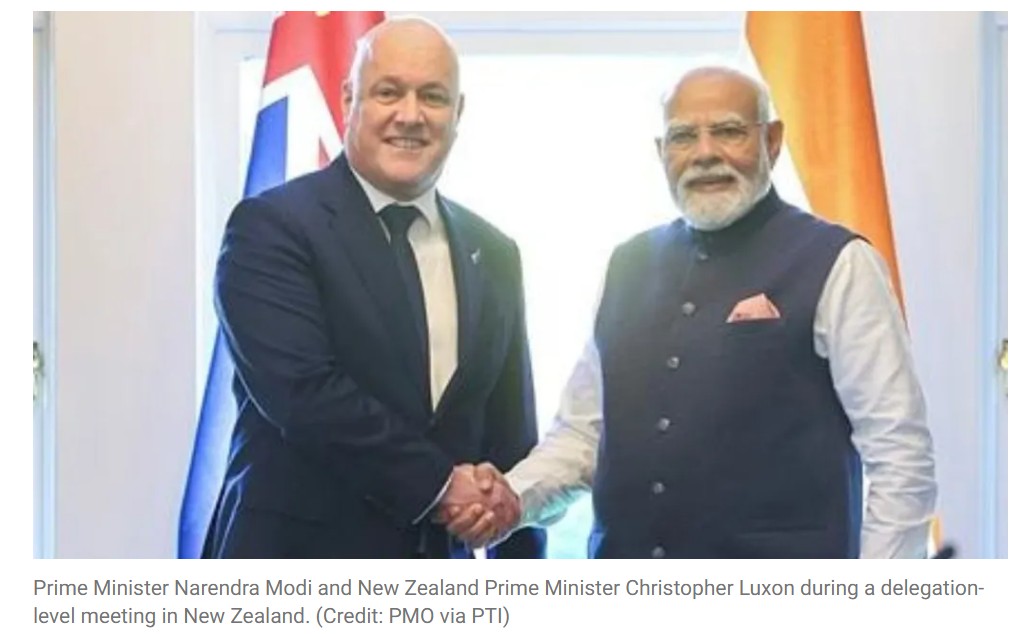
Prime Minister Narendra Modi's visit to New Zealand—the first by an Indian Prime Minister in 40 years—marked a historic milestone in bilateral relations. During the visit, both countries elevated their ties to a Strategic Partnership and adopted the India–New Zealand Strategic Partnership: Roadmap to 2030, outlining a comprehensive framework for cooperation in trade, defence, maritime security, agriculture, technology, education, clean energy and the Indo-Pacific.
Background
India and New Zealand established diplomatic relations in 1952, later upgrading them to High Commissions. Their relationship is founded on shared democratic values, the rule of law, Commonwealth membership and a rules-based international order. New Zealand has also pursued deeper engagement through its "Opening Doors to India" (2011) policy and "India–New Zealand 2025: Investing in the Relationship" (2020) strategy. The Indian diaspora of nearly 250,000 people—the third-largest ethnic community in New Zealand—and around 8,000 Indian students further strengthen people-to-people ties.
Key Outcomes of the Visit
The centrepiece of the visit was the adoption of the Roadmap to 2030, which provides a long-term vision for expanding cooperation across strategic and economic sectors.
On the economic front, both countries committed to doubling bilateral trade to NZ$7 billion (about ?35,000 crore) by 2030. The recently concluded India–New Zealand Free Trade Agreement (FTA) is expected to improve market access, enhance supply-chain integration and create opportunities for industries, farmers and youth. New Zealand also announced its intention to invest USD 20 billion in India over the next 15 years, particularly in infrastructure, technology and emerging sectors.
Recognising evolving security challenges, both countries agreed to establish a Maritime Security Dialogue and a Joint Working Group (JWG) on Counter-Terrorism to strengthen intelligence sharing and address terrorism and violent extremism. They reaffirmed their commitment to a free, open, inclusive and rules-based Indo-Pacific, respect for UNCLOS (1982), freedom of navigation, and peaceful resolution of disputes. Both sides also highlighted their cooperation under Combined Task Force-150 (CTF-150) in 2025, where New Zealand served as Commander and India as Deputy Commander, supporting efforts against narcotics trafficking, maritime terrorism and other illicit maritime activities.
Sectoral cooperation was further expanded through agreements on animal husbandry and dairying, the launch of the Kiwifruit Action Plan with Centres of Excellence in Nagaland and Uttarakhand, a Joint Action Plan on Sports, collaboration in Antarctic research, and initiatives to build transparent and resilient supply chains. Cultural ties were also reinforced through the shared symbolism of Matariki, the M?ori New Year, and Krittika, the ancient Indian name for the same star cluster.
Strategic Significance
The Strategic Partnership reflects the growing convergence between India and New Zealand in promoting a stable Indo-Pacific, strengthening economic resilience, expanding high-value investments and deepening cooperation in emerging sectors. It also enhances collaboration on maritime security, counter-terrorism and supply-chain resilience, while leveraging strong diaspora and cultural linkages to build a long-term partnership.
Challenges
Despite growing momentum, bilateral ties continue to face challenges such as relatively low trade volumes, geographical distance, implementation of the FTA, addressing concerns related to pro-Khalistan extremist activities, and translating investment commitments into tangible outcomes.
Way Forward
The successful implementation of the Roadmap to 2030 requires timely execution of the FTA, operationalisation of new security mechanisms, expansion of scientific and agricultural collaboration, greater private-sector investment, and sustained people-to-people engagement. A stronger India–New Zealand partnership will contribute not only to bilateral prosperity but also to a secure, inclusive and rules-based Indo-Pacific.