
Digital Public Infrastructure
- 16 Aug 2026
In News:
India’s Digital Public Infrastructure (DPI) has emerged as a major enabler of efficient governance, financial inclusion, economic opportunities and digital self-reliance. Over the past decade, digital platforms have increasingly replaced paper-based and physical processes, strengthening the vision of Viksit Bharat.
India’s Digital Transformation
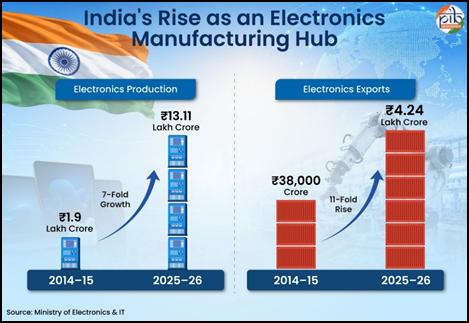
1. Digital economy and manufacturing:The digital economy contributes around 12–14% of GDP and is projected to reach 20% over the next decade. Electronics production increased nearly seven-fold, from ?1.9 lakh crore (2014–15) to ?13.11 lakh crore (2025–26), while electronics exports rose from ?38,000 crore to ?4.24 lakh crore. Electronics now constitute India’s third-largest export category, generating nearly 25 lakh jobs.
India is also strengthening strategic technological capabilities through Semicon 2.0 (?1.27 lakh crore). Under India Semiconductor Mission 1.0, 12 semiconductor units worth ?1.64 lakh crore have been approved.
2. Connectivity:Telephone connections have crossed 134.8 crore, with tele-density rising to 94.31% by June 2026. Internet subscribers exceeded 109.2 crore, while data costs declined from ?308/GB in 2014 to ?7.51/GB in 2026. 5G is available in 99.9% of districts, supported by 5.63 lakh BTSs.BharatNet has made 2.21 lakh Gram Panchayats service-ready, while PM-WANI has deployed over 4 lakh hotspots.
3. Digital payments and commerce:UPI processes nearly 50% of global real-time payment volumes and handled 24,161.69 crore transactions worth ?314.23 lakh crore in FY 2025–26. It serves over 55.49 crore individuals and 6.5 crore merchants across 731 banks and has expanded to 11 countries. ONDC, meanwhile, had over 20 crore buyers and 5 lakh sellers across 1,000 cities by June 2026.
4. Citizen-centric governance:Aadhaar, DigiLocker, UMANG, CSCs and DBT have created an integrated digital service-delivery ecosystem. DigiLocker has 72 crore users, UMANG offers 2,585 services, and Aadhaar generation has crossed 145 crore. Aadhaar-linked DBT covers 318 schemes across 56 Ministries, transferring over ?52 lakh crore directly to beneficiaries.
Challenges and Way Forward
Despite rapid expansion, India must address the digital divide, cybersecurity threats, data privacy, digital literacy, affordability and exclusion of digitally vulnerable groups. The next phase should focus on secure and interoperable infrastructure, indigenous technology and semiconductors, last-mile connectivity, responsible AI, stronger data protection and human-centric digital governance.
Conclusion
India’s DPI model demonstrates how technology can combine scale, inclusion and state capacity. Consolidating this ecosystem while ensuring security, privacy, accessibility and accountability will be crucial for converting digital transformation into inclusive growth and achieving Viksit Bharat.