
SIPRI Yearbook 2026
- 13 Jun 2026
In News:
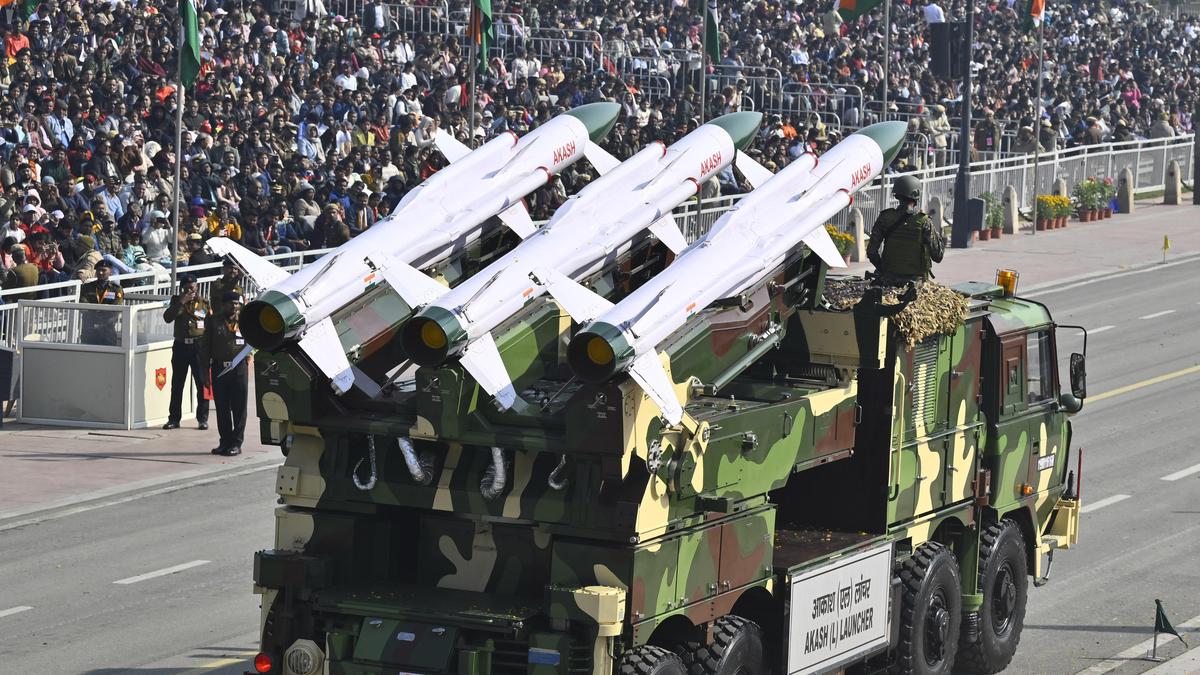
The Stockholm International Peace Research Institute (SIPRI), in its Yearbook 2026, has highlighted growing global nuclear risks, weakening arms-control frameworks, and the increasing integration of emerging technologies into warfare. A significant observation regarding India is the expansion of its nuclear arsenal to approximately 190 warheads and the reported deployment of a small number of warheads in an operational state, reflecting the evolving nature of India's strategic deterrence posture.
Key Findings on India
India emerged as the fifth-largest military spender globally in 2025, with defence expenditure rising by 8.9% to USD 92.1 billion. SIPRI also identified India as the second-largest importer of major arms during 2021–25, accounting for 8.2% of global arms imports.
According to the report, India's nuclear stockpile is estimated at 190 warheads, comprising 12 deployed warheads and 178 in reserve/storage. This places India behind China (620 warheads) but ahead of Pakistan (170 warheads). The report suggests that India is gradually enhancing the operational readiness and survivability of its nuclear deterrent.
Another notable development was the integration of cyber operations into military confrontation during the 2025 India-Pakistan conflict, indicating the growing importance of cyber capabilities in modern warfare and deterrence.
Global Security Trends
The report notes that all nine nuclear-armed states continue to modernize and expand their arsenals. Globally, there are an estimated 12,187 nuclear warheads, of which around 9,745 are available for military use, while more than 4,000 remain deployed on missiles and aircraft.
The United States and Russia together possess nearly 86% of the world's nuclear weapons, yet the expiry of the New START Treaty in 2026 without a successor agreement has increased concerns regarding strategic stability.
SIPRI also points to the growing use of artificial intelligence, autonomous systems, drones, and cyber capabilities in contemporary conflicts such as Ukraine and Gaza, signalling a transformation in the nature of warfare.
Simultaneously, the global arms-control architecture is witnessing strain, reflected in withdrawals from treaties such as the Convention on Cluster Munitions and the Anti-Personnel Mine Convention.
India's Nuclear Doctrine
India's nuclear doctrine, officially operationalized in 2003, is based on the principles of credible minimum deterrence and No First Use (NFU).
Under the doctrine, India pledges not to initiate a nuclear attack and reserves the use of nuclear weapons solely for retaliation against a nuclear strike on Indian territory or armed forces. Any such retaliation would be massive and designed to inflict unacceptable damage on the aggressor.
The doctrine also emphasizes strict civilian control through the Nuclear Command Authority (NCA). The Political Council, chaired by the Prime Minister, alone possesses the authority to authorize nuclear weapon use, while the Executive Council, headed by the National Security Advisor, provides operational inputs.
India additionally maintains that it may consider nuclear retaliation in response to a major chemical or biological weapons attack.
Evolution of India's Nuclear Programme
India's nuclear journey began as a peaceful programme focused on energy self-reliance under Homi J. Bhabha and Jawaharlal Nehru. However, changing security dynamics, particularly China's nuclear test in 1964, prompted India to conduct its first nuclear test, Pokhran-I (Smiling Buddha), in 1974.
Subsequently, strategic concerns arising from China's capabilities and the China-Pakistan nexus led to Pokhran-II (Operation Shakti) in May 1998, after which India formally declared itself a nuclear weapon state.
Since then, India has developed a doctrine centred on deterrence rather than warfighting while simultaneously integrating into global nuclear commerce through the 2008 India–US Civil Nuclear Agreement and the Nuclear Suppliers Group waiver.
India's Position on Global Nuclear Governance
India remains outside the Nuclear Non-Proliferation Treaty (NPT) and the Comprehensive Nuclear-Test-Ban Treaty (CTBT), arguing that these arrangements are discriminatory because they divide the world into nuclear "haves" and "have-nots."
At the same time, India has demonstrated responsible nuclear behaviour and has secured membership in major export-control regimes, including the Missile Technology Control Regime (MTCR), Wassenaar Arrangement, and Australia Group, while continuing to seek membership in the Nuclear Suppliers Group (NSG).
Conclusion
The SIPRI Yearbook 2026 underscores a world witnessing renewed strategic competition, nuclear modernization, and rapid technological transformation in warfare. For India, the expansion of its nuclear arsenal and limited deployment of warheads reflect efforts to maintain a credible deterrent amid a complex security environment shaped by nuclear rivalry with Pakistan, strategic competition with China, and evolving threats in cyberspace and emerging technologies. Going forward, balancing national security requirements with commitment to responsible nuclear stewardship and global disarmament will remain central to India's strategic outlook.