
Rural Employment Guarantee in Limbo
- 29 Aug 2026
In News:
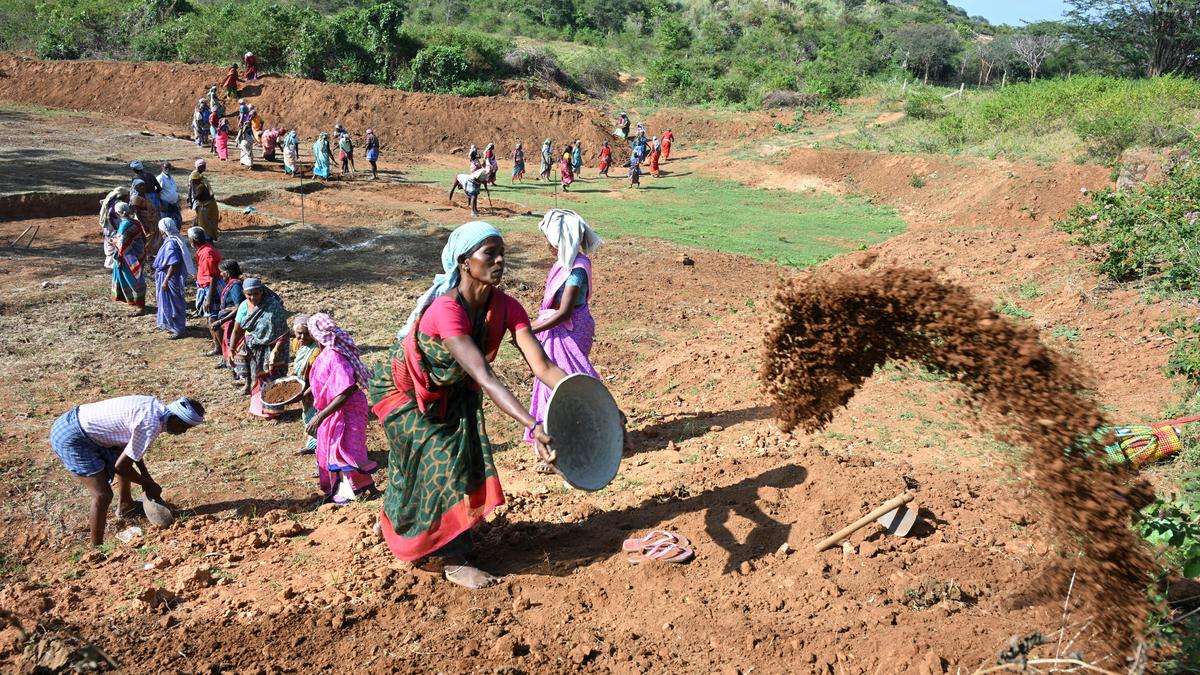
The transition from the Mahatma Gandhi National Rural Employment Guarantee Act (MGNREGA), 2005 to the Viksit Bharat–Guarantee for Rozgar and Ajeevika Mission (Gramin) (VB-G RAM G) Act, 2025 has raised concerns over a sharp contraction in rural employment generation.
The new framework increases the statutory employment guarantee from 100 to 125 days per household, but administrative delays, changes in financing and new compliance requirements have reportedly disrupted work generation during the transition.
The Emerging Employment Gap
During April–July 2026, only around 70 crore person-days of employment were generated, about 43% below the average of 2024–25 (128 crore) and 2025–26 (119 crore).
The contraction has been particularly severe in poorer States. In 10 of 19 major States, including Uttar Pradesh, Madhya Pradesh and Jharkhand, employment generation reportedly fell by 60–85%. July 2026 alone recorded only around 8.3–9 crore person-days, more than 40% lower than July 2025.
This is significant because the pre-monsoon agricultural slack season traditionally generates a large share of annual rural employment, leaving landless labourers and vulnerable households with limited alternatives.
MGNREGA vs VB-G RAM G
The transition represents a substantial change in the architecture of the employment guarantee.
Under MGNREGA, employment was a demand-driven legal entitlement, with the Centre bearing the full cost of unskilled wages. The new VB-G RAM G framework provides 125 days of guaranteed work, but operates as a Centrally Sponsored Scheme, with a 60:40 Centre-State funding ratio for general States and 90:10 for Himalayan and North-Eastern States.
It also introduces normative allocations, effectively creating State-wise expenditure ceilings, integrates rural employment planning with Viksit Gram Panchayat Plans, and permits a work pause of up to 60 days during peak agricultural seasons.
Thus, the reform seeks to link employment generation with durable rural infrastructure and decentralised planning, but simultaneously introduces greater fiscal and administrative constraints.
Why Has Implementation Slowed?
- Delayed rule-making: Although the Act was passed in December 2025, draft rules emerged only in late May 2026 and were finalised at the end of June, creating an operational gap during the initial months of the financial year.
- Fiscal constraints: The 60:40 cost-sharing arrangement places a greater financial burden on States. Cash-strapped States may consequently delay approval of works or release of funds.
- Technology-related exclusion: Mandatory facial recognition, biometric authentication and digital muster rolls can create difficulties in areas with weak connectivity or inadequate digital infrastructure.
- Normative spending ceilings: Unlike the earlier demand-driven framework, predetermined allocations may incentivise local administrations to restrict the opening of works when allocations approach their limits.
Budget–Implementation Disconnect
The Union Budget 2026–27 allocated ?95,692 crore for VB-G RAM G, with the overall projected expenditure reaching around ?1.5 lakh crore after accounting for State contributions. Yet, the reported contraction in actual employment generation illustrates that budgetary allocation alone cannot guarantee employment access.
The key challenge is ensuring that financial resources translate into timely work opportunities at the Gram Panchayat level.
Way Forward
The transition needs to protect the rights-based character of rural employment while improving administrative efficiency. Centre-State fund flows should be streamlined, potentially through revolving mechanisms that prevent wage payments from being held up by reconciliation issues.
Digital verification should have offline and non-biometric alternatives so that technology does not become a barrier to accessing a statutory entitlement. Panchayats also require greater administrative capacity, digital infrastructure and training to prepare and implement Viksit Gram Panchayat Plans.
Most importantly, normative allocations should function as planning benchmarks rather than rigid barriers to employment when genuine demand rises. Regular social audits, effective grievance redressal and enforcement of the unemployment allowance when work is not provided within 15 days of demand are essential safeguards.
Conclusion
The VB-G RAM G Act seeks to modernise rural employment policy by combining a higher employment guarantee with rural infrastructure and decentralised planning. However, the transition demonstrates a crucial lesson: expanding a statutory entitlement on paper is meaningful only when institutional capacity, financing and administrative systems enable citizens to exercise it in practice. Protecting demand-driven access while resolving fiscal, technological and implementation bottlenecks will be central to making the new rural employment guarantee an effective social-security instrument.