
Strait of Hormuz and India's Energy Security
- 16 Jul 2026
In News:
US President Donald Trump withdrew his proposal to impose a 20% fee on commercial vessels transiting the Strait of Hormuz, replacing it with a proposal centred on trade and investment agreements. The reversal followed widespread criticism over the proposal's legality, feasibility and potential impact on global trade.
About the Strait of Hormuz
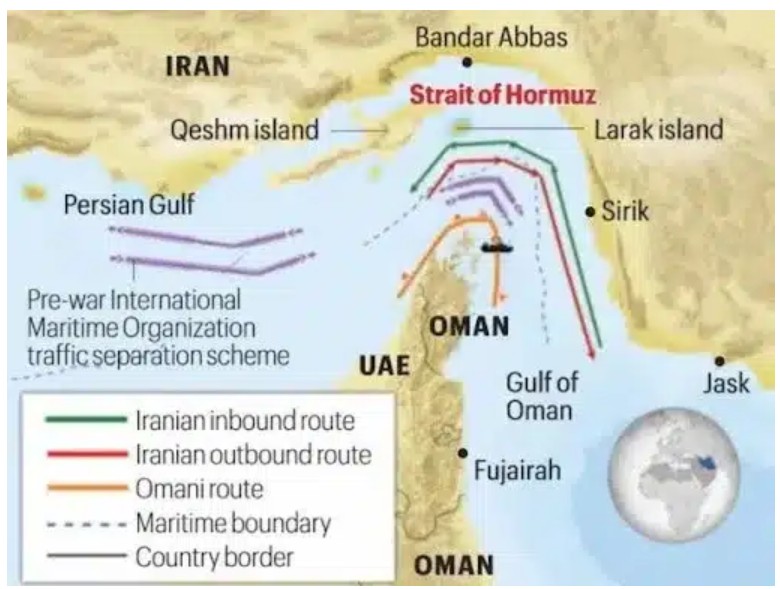
The Strait of Hormuz is one of the world's most strategically important maritime chokepoints, connecting the Persian Gulf with the Gulf of Oman and the Arabian Sea. It serves as the primary export route for crude oil and natural gas from major Gulf producers to global markets, making uninterrupted navigation through the strait vital for global energy security.
The US Proposal and Its Withdrawal
The US had proposed imposing a 20% "United States Reimbursement Fee" on commercial cargo transiting the Strait of Hormuz, arguing that the fee would compensate the US for providing maritime security in the region.
However, the proposal faced several practical and legal challenges:
- No clarity on how the fee would be calculated.
- Potential sharp increase in global shipping and energy costs.
- Questions regarding enforcement under international law.
- Uncertainty over the US's ability to guarantee uninterrupted maritime security.
Amid strong international criticism, the proposal was withdrawn within a day.
International Legal Concerns
The International Maritime Organization (IMO) stated that there is no legal basis for imposing mandatory transit charges on vessels passing through international straits.
Under the United Nations Convention on the Law of the Sea (UNCLOS), straits used for international navigation enjoy the principle of transit passage, under which ships and aircraft have the right to pass continuously and expeditiously without the payment of transit tolls.
Although neither the United States nor Iran has ratified UNCLOS, these principles are widely regarded as customary international law.
Strategic Contest over the Strait
The controversy reflects the broader geopolitical competition between the United States and Iran over influence in the Strait of Hormuz.
Recent developments include:
- An interim US-Iran understanding (June 2026) temporarily improving vessel movement.
- Renewed tensions leading to a decline in commercial transits.
- Iran asserting its role as the "guardian" of the Strait while claiming sovereignty over parts of the waterway.
- Continued military confrontation affecting commercial navigation.
Implications for India
India is particularly vulnerable to disruptions in the Strait because of its heavy dependence on energy imports from West Asia.
According to the source:
- Around 40% of India's crude oil imports transit through the Strait of Hormuz.
- Nearly 60% of LNG imports and 90% of LPG imports also pass through the Strait.
- India imports over 88% of its crude oil, around 60% of LPG, and nearly 50% of natural gas.
The proposed 20% transit fee would have significantly increased India's energy import costs. According to the article:
- A $75/barrel crude oil price could have increased to over $90/barrel after the proposed fee.
- The fee alone could have added about $9 billion annually to India's oil import bill.
- Every $1 increase in crude oil prices raises India's annual oil import bill by up to $2 billion.
Higher energy prices could also worsen inflation, the current account deficit, fiscal pressures and exchange rate stability.
India's Response
India has consistently supported the principle of free and uninterrupted navigation through international waterways.
To manage supply disruptions, India has:
- Diversified crude oil sourcing.
- Prioritised energy security despite higher import costs.
- Temporarily rationed gas supplies to certain industries during periods of disruption.
- Continued advocating for open sea lanes and stability in West Asia.