
India–South Africa Technology Partnership
- 11 Jun 2026
In News:
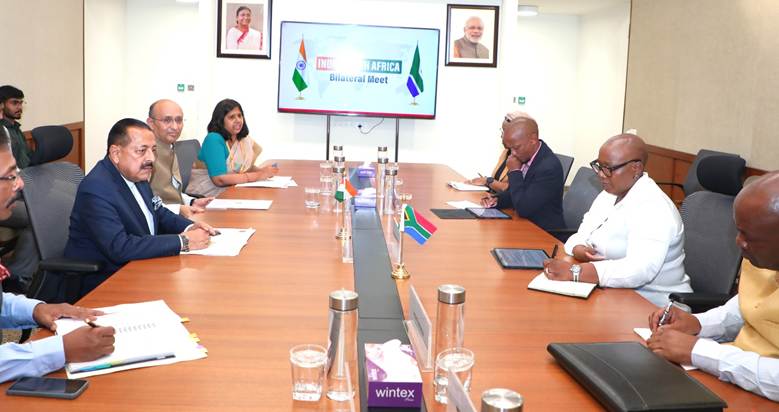
India and South Africa have upgraded their 31-year-old Science and Technology partnership from a research-centric framework to a technology-driven industrial co-production model, marking a significant evolution in India–Africa relations. The move reflects India's broader strategy of strengthening Global South cooperation through innovation, supply-chain resilience and economic integration.
Key Areas of Cooperation
- The partnership will focus on emerging technologies such as Artificial Intelligence (AI), Digital Public Infrastructure (DPI), advanced manufacturing, quantum technologies, genomics and cyber-physical systems. Both countries are also expanding cooperation in green hydrogen, renewable energy, biotechnology, vaccine development and healthcare innovation.
- A major area of collaboration remains the Square Kilometre Array (SKA) project, which supports advancements in astronomy, big data analytics and high-performance computing.
Telangana–South Africa Collaboration
- The partnership has acquired a sub-national dimension through cooperation between Telangana and South Africa. Leveraging Hyderabad's strengths in IT, pharmaceuticals, healthcare, aerospace and defence manufacturing, the collaboration seeks to promote medical tourism, vaccine production, healthcare supply chains and investment in advanced manufacturing.
India's Emerging Africa Strategy
- India's engagement with Africa is gradually shifting from Lines of Credit and development assistance towards industrial co-production, technology partnerships, critical minerals cooperation and value-chain integration.
- India is increasingly leveraging the African Continental Free Trade Area, while also pursuing access to strategic minerals such as lithium, cobalt and rare earth elements that are crucial for electric mobility, renewable energy and the green hydrogen economy.
Geopolitical Significance
- The deepening partnership strengthens cooperation among Global South countries and supports efforts to reform global governance institutions. It also complements India's SAGAR (Security and Growth for All in the Region) vision through enhanced maritime cooperation and capacity building in the Indian Ocean Region.
- The partnership offers an alternative model of development cooperation based on capacity building, technology sharing and mutual benefit, while reinforcing India's growing diplomatic and economic presence in Africa.
Challenges
- Despite growing engagement, challenges persist in the form of project implementation delays, political instability in parts of Africa, competition from China's economic presence, trade barriers and connectivity constraints.
Conclusion
The India–South Africa partnership signifies a transition from traditional scientific cooperation to a comprehensive framework centred on technology, innovation, green energy, healthcare and industrial co-production. As India deepens its engagement with Africa through economic integration and strategic partnerships, the relationship is likely to emerge as a key pillar of Global South cooperation and sustainable development.