
RBI Surplus Transfer & the Economic Capital Framework (ECF)
- 22 Jun 2026
In News:
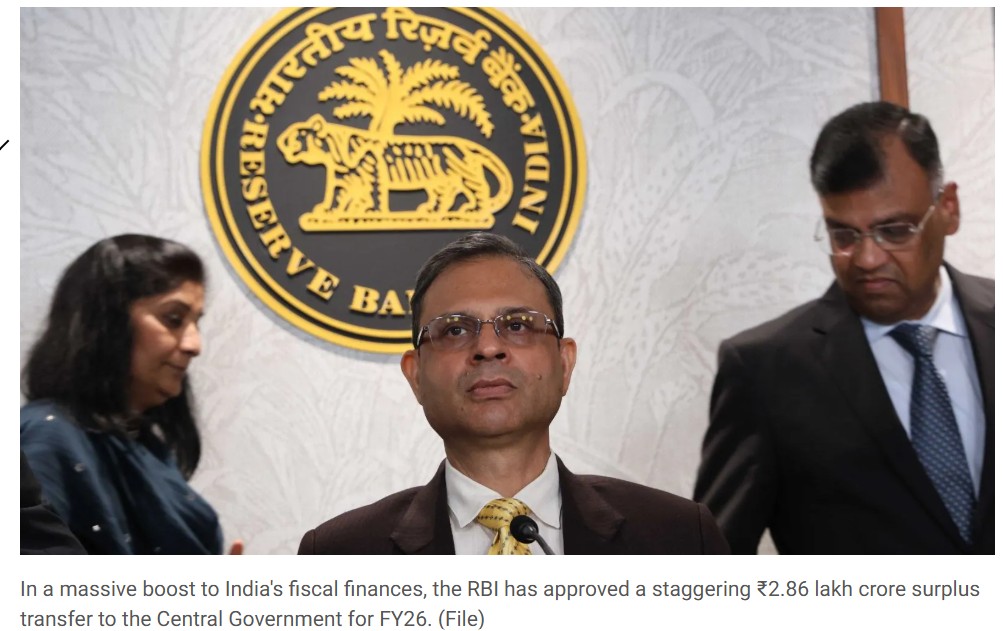
The Reserve Bank of India (RBI) approved a record surplus transfer of ?2.87 lakh crore to the Union Government for FY 2025–26, the highest ever. The transfer has intensified debate over the RBI's expanding fiscal role, central bank independence, and implications for fiscal federalism.
Background
The RBI earns income primarily from interest on government securities, foreign exchange operations, returns on foreign assets (including gold), and reserve management activities. After meeting operational expenses and maintaining prescribed financial buffers under the Economic Capital Framework (ECF), the remaining surplus is transferred to the Government as non-tax revenue.
Traditionally, annual transfers ranged between ?30,000 crore and ?65,000 crore. Following the adoption of the revised ECF in 2019, transfers have increased sharply:
- FY 2022–23: ?87,416 crore
- FY 2023–24: ?2.11 lakh crore
- FY 2024–25: ?2.69 lakh crore
- FY 2025–26: ?2.87 lakh crore (Highest Ever)
The RBI's balance sheet expanded by 20.6% to ?91.97 lakh crore by March 2026, while gross income increased by over 26%, supported by higher earnings from reserve management, foreign assets, and government securities.
Economic Capital Framework (ECF)
The Economic Capital Framework (ECF), based on the recommendations of the Bimal Jalan Committee (2019), provides a rule-based mechanism to determine how much capital the RBI should retain for financial stability and how much surplus can be transferred to the Government.
Its objective is to balance monetary and financial stability with the government's fiscal requirements by ensuring adequate risk buffers.
|
Component |
Provision |
|
Contingent Risk Buffer (CRB) |
4.5%–7.5% of the RBI balance sheet |
|
Contingency Fund (CF) |
5.5%–6.5% of the balance sheet |
|
Economic Capital (including CGRA) |
20.8%–25.4% of the balance sheet |
|
Review Period |
Every five years (first review in 2025) |
Concerns
The unprecedented scale of transfers has raised concerns regarding the RBI's evolving role as a fiscal support institution. Growing dependence on central bank profits may create pressures that could gradually dilute the RBI's operational independence and increase the risk of fiscal dominance, where monetary policy decisions become influenced by the government's financing needs.
Another important concern relates to fiscal federalism. Since RBI surplus is classified as non-tax revenue, it lies outside the divisible pool under Article 270, meaning States receive no automatic share despite bearing substantial expenditure responsibilities in sectors such as health, education, and welfare. When viewed alongside the increasing use of cesses and surcharges and borrowing restrictions under Article 293, some analysts argue that it reflects a broader trend toward fiscal centralization.
There are also concerns that consistently high payouts, though currently within the ECF limits, could reduce the RBI's long-term financial buffers needed to manage future macroeconomic or financial shocks.
Way Forward
The Government should prioritize utilizing RBI surplus for capital expenditure and public debt reduction rather than financing recurring revenue expenditure. The RBI must continue to manage its portfolio solely on the basis of financial stability, liquidity management, and inflation objectives, without profit maximization becoming an implicit policy goal. Greater transparency in surplus calculations and periodic reviews of the Economic Capital Framework will help preserve both fiscal credibility and central bank autonomy. At the same time, future Finance Commissions may examine the growing share of non-divisible revenues to ensure a balanced approach to cooperative fiscal federalism.