
Passive Euthanasia in India
- 13 Mar 2026
In News:
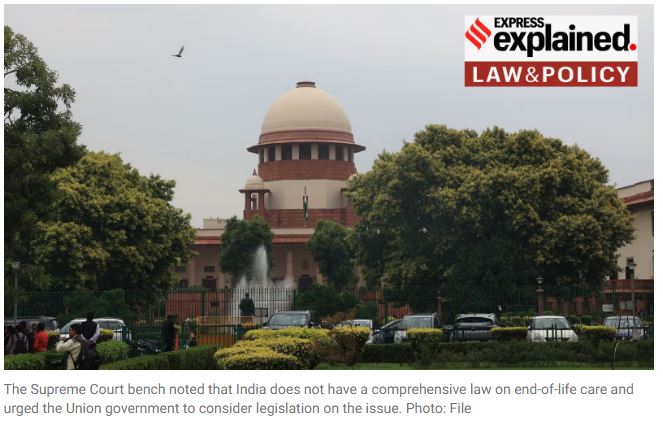
The Supreme Court of India recently applied its passive euthanasia framework for the first time to permit the withdrawal of life-sustaining treatment for Harish Rana, a 32-year-old patient who had remained in a persistent vegetative state for about 13 years. The decision marked a significant step in the practical implementation of the constitutional principle of “right to die with dignity” under Article 21.
The case highlighted the evolving legal framework governing euthanasia in India and renewed debate on the need for comprehensive legislation regulating end-of-life medical decisions.
Concept of Euthanasia
Euthanasia refers to the deliberate act of ending a person’s life to relieve extreme pain or suffering, usually in cases of terminal illness or irreversible medical conditions. It is often described as “mercy killing.”
Types of Euthanasia
1. Active Euthanasia
- Involves a direct action to cause death, such as administering a lethal injection.
- It remains illegal in India.
2. Passive Euthanasia
- Involves withholding or withdrawing life-sustaining treatment such as ventilators, feeding tubes, or medications, allowing death to occur naturally.
- Permitted in India under strict judicial guidelines and medical oversight.
Evolution of Euthanasia Jurisprudence in India
India’s legal position on euthanasia has developed through several landmark Supreme Court judgments.
- P. Rathinam v. Union of India (1994): The Court initially held that the Right to Life under Article 21 included the Right to Die, effectively decriminalizing suicide. This interpretation was later overturned.
- Gian Kaur v. State of Punjab (1996): A Constitution Bench ruled that the Right to Life does not include the Right to Die, but acknowledged that the right to live with dignity could extend to a dignified death in cases of terminal illness.
- Aruna Shanbaug Case (2011): In this landmark case involving a nurse in a prolonged vegetative state, the Court legalised passive euthanasia for the first time, subject to approval by the relevant High Court and medical boards.
- Common Cause v. Union of India (2018): The Court recognised the “Right to Die with Dignity” as a fundamental right under Article 21 and allowed individuals to issue Living Wills or Advance Medical Directives, specifying their wishes regarding end-of-life medical treatment.
- Supreme Court Guidelines Modification (2023): To simplify implementation, the Court relaxed earlier requirements by removing the mandatory countersignature of a Judicial Magistrate for living wills, making the process more practical.
Need for Comprehensive Legislation
Despite judicial guidelines, experts argue that India requires a dedicated statutory framework to regulate euthanasia.
- Clear Medical Criteria: Legislation could define distinctions between terminal illness and persistent vegetative states, preventing ambiguity in medical decision-making.
- Standardised Medical Boards: A law could establish uniform protocols for primary and secondary medical boards, ensuring consistency across hospitals and states.
- Legal Protection for Doctors: Medical practitioners often fear criminal liability under provisions such as abetment of suicide. Statutory clarity would provide legal immunity for actions taken in accordance with approved procedures.
- Role of Family Members: Legislation could formally define the decision-making authority of next of kin, particularly when patients are incapable of expressing consent.
- Simplified Procedures: A statutory framework could replace the current court-dependent process with an administrative mechanism, reducing delays and emotional stress for families.
Challenges in Implementation
- Risk of Misuse: There is concern that euthanasia could be misused against vulnerable groups, such as the elderly or disabled, for financial or property interests. Strict medical oversight remains necessary.
- Ethical and Religious Concerns: Many religious and cultural traditions view euthanasia as interference with the natural cycle of life, raising ethical debates between the sanctity of life and quality of life.
- Defining “Dignity”: The concept of dignity is subjective and difficult to codify in law, making consistent application challenging.
- Limited Palliative Care Infrastructure: India’s palliative and hospice care facilities remain limited, which may influence end-of-life choices if adequate pain management is unavailable.
- Judicial Inconsistencies: Different courts may interpret euthanasia guidelines differently, creating legal uncertainty and prolonged litigation.
Way Forward
To address these concerns, several policy measures have been suggested:
- Enacting a Medical Treatment of Terminally Ill Patients Law to provide a comprehensive legal framework.
- Establishing a digital national registry for Living Wills, ensuring quick access to advance directives during emergencies.
- Expanding palliative and hospice care services to provide compassionate end-of-life treatment.
- Training healthcare professionals on the ethical and legal aspects of end-of-life decisions.
- Conducting public awareness campaigns on living wills and patient rights.
Conclusion
The Supreme Court’s decision in the Harish Rana case marks a significant step in translating the constitutional right to die with dignity into practical application. However, reliance on judicial intervention for individual cases is neither efficient nor sustainable. A comprehensive legislative framework balancing ethical concerns, patient autonomy, and medical safeguards is essential to ensure compassionate and legally sound end-of-life care in India.