
India-Oman Comprehensive Economic Partnership Agreement
- 22 Dec 2025
In News:
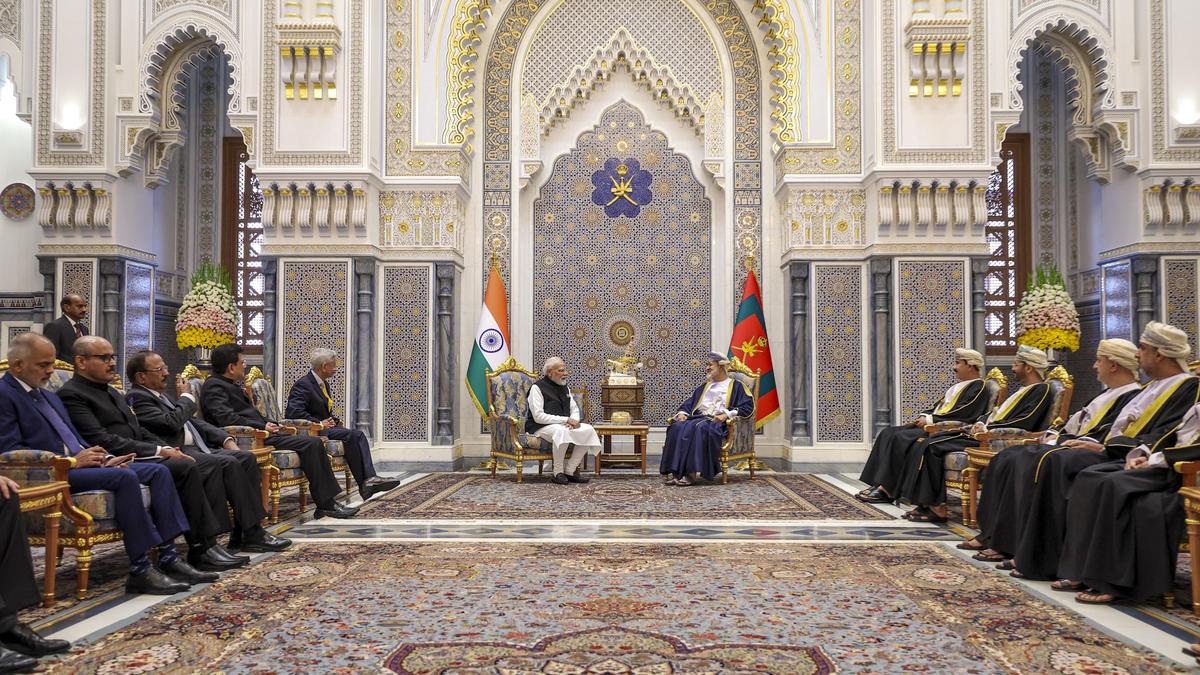
India and Oman have signed a Comprehensive Economic Partnership Agreement (CEPA), marking a major milestone in India’s trade diplomacy in West Asia. The agreement is Oman’s first bilateral trade pact since 2006 and India’s second CEPA in the GCC, after the India–UAE CEPA (2022). The occasion was further elevated by the conferment of the Order of Oman on Narendra Modi by Sultan Haitham bin Tarik, recognising his contribution to strengthening bilateral ties. Instituted in 1970 by Sultan Qaboos bin Said, the Order of Oman is the country’s highest civilian honour for foreign leaders.
Key Features of the India–Oman CEPA
A defining feature of the CEPA is near-universal duty-free access for Indian exports. Oman has granted zero-duty access on 98.08% of its tariff lines, covering 99.38% of India’s exports by value, with immediate elimination on most lines. This is expected to deliver quick gains for Indian exporters in the Gulf market.
The agreement strongly supports labour-intensive sectors such as textiles, leather, footwear, gems and jewellery, engineering goods, plastics, furniture, pharmaceuticals, medical devices, automobiles, and agricultural products. By strengthening MSMEs, artisans, and women-led enterprises, the CEPA aligns trade liberalisation with employment generation.
India, in turn, has offered calibrated tariff concessions on 77.79% of its tariff lines, covering 94.81% of imports from Oman, while protecting sensitive sectors through exclusion lists and Tariff Rate Quotas (TRQs). This ensures a balanced trade framework without undermining domestic interests.
A major advancement lies in ambitious services liberalisation. Oman has committed to opening 127 services sub-sectors, including IT, professional services, R&D, education, healthcare, and audio-visual services. Crucially, for the first time, Oman has offered expansive Mode 4 commitments under GATS, raising the intra-corporate transferee quota from 20% to 50% and extending the stay of contractual service suppliers from 90 days to two years, with scope for further extension. The CEPA also allows 100% FDI by Indian companies in key services sectors through commercial presence.
Another landmark provision is the world’s first comprehensive commitment on Traditional Medicine across all modes of supply, opening new avenues for India’s AYUSH and wellness sectors and promoting medical value travel. Trade facilitation measuressuch as fast-tracked pharmaceutical approvals, acceptance of GMP inspections, mutual recognition of Halal certification, and acceptance of India’s National Programme for Organic Production (NPOP), address non-tariff barriers and enhance regulatory cooperation.
Strategic and Economic Significance
Oman, a member of the Gulf Cooperation Council (GCC) with a strategic location on the Gulf of Oman and Arabian Sea, acts as a gateway to the GCC, Central Asia, Eastern Europe, and Africa. The CEPA strengthens India’s economic footprint in the Gulf and complements its broader FTA strategy focused on resilient supply chains.
India–Oman relations were elevated to a Strategic Partnership in 2008, making Oman India’s oldest strategic partner in the Gulf. Defence and maritime cooperation is deep, with Oman being the first Gulf country to conduct tri-service exercises with India. Economically, bilateral trade crossed USD 10.6 billion in FY 2024–25, though it remains energy-dominated, resulting in a trade deficit of about USD 2.5 billion for India.
Challenges and Way Forward
Key challenges include under-utilisation of services potential—India accounts for only 5.31% of Oman’s services imports, a structural trade imbalance, regional geopolitical risks in West Asia, and uncertainties arising from Omanisation policies. Addressing these requires deeper services engagement, diversification into high-value manufacturing and pharmaceuticals, stronger investment partnerships, and cooperation in maritime security and the blue economy.
Conclusion
Overall, the India–Oman CEPA is a balanced, forward-looking agreement that integrates trade, services, mobility, and investment with strategic objectives. If effectively implemented, it can significantly enhance India’s economic and strategic presence in the Gulf while advancing inclusive and resilient growth.