
Energy Statistics India 2026
- 03 Apr 2026
In News:
The Ministry of Statistics and Programme Implementation (MoSPI) has released its annual publication, “Energy Statistics India 2026.” This comprehensive dataset integrates information on India’s energy reserves, production, consumption, and trade, providing a pulse check on the nation's energy security and transition trajectory as of March 31, 2025.
Macro-Economic Energy Indicators
During the Financial Year 2024-25, India’s energy sector mirrored the nation’s robust economic growth.
- Primary Energy Supply: The Total Primary Energy Supply (TPES) registered a healthy expansion of 2.95% over the previous year.
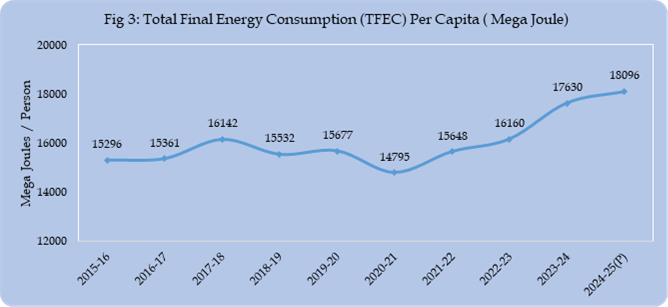
- Per-Capita Consumption: Reflecting rising living standards and industrialization, per-capita energy consumption has grown at a Compound Annual Growth Rate (CAGR) of 1.89% over the decade spanning 2015-16 to 2024-25.
- Credit Flow: Financial confidence in the sector has skyrocketed. Investment flows surged from ?1,688 crore in 2021 to ?10,325 crore in 2025, a more than six-fold increase in just four years.
The Renewable Energy Paradigm
India’s renewable energy (RE) sector is the cornerstone of its climate strategy, showing both immense potential and rapid adoption.
- Total Potential: As of March 2025, India’s estimated renewable energy potential stands at a staggering 47,04,043 MW.
- Resource Composition:Solar energy is the dominant pillar, accounting for nearly 71% of this potential. This is followed significantly by wind power and large hydro projects.
- Geographic Concentration: A critical administrative challenge is the spatial distribution of these resources. Over 70% of India's RE potential is clustered in just six states: Rajasthan, Maharashtra, Gujarat, Andhra Pradesh, Karnataka, and Madhya Pradesh.
- Generation Growth: Actual electricity generation from renewable sources (Utility and Non-Utility) has witnessed a robust CAGR of 9.17%, outpacing conventional growth rates.
Continued Reliance on Fossil Fuels
Despite the green surge, the report highlights a persistent structural reality: Coal remains the dominant source of energy, contributing the highest share to the total primary energy supply. This underscores the "Energy Trilemma" India facesbalancing energy security, energy equity, and environmental sustainability.
Key Takeaways for Policy Analysis
- Demand Dynamics: The steady rise in demand reflects sustained economic growth, but it also necessitates a concurrent expansion in generation capacity to prevent supply deficits.
- Infrastructure Imperatives: The geographic concentration of RE in western and southern states creates an urgent need for the Green Energy Corridor and enhanced interstate transmission networks to prevent regional energy imbalances.
- Transition Challenges: The dominance of coal indicates that while the "addition" of green energy is fast, the "replacement" of fossil fuels is a long-term structural challenge.
- Investment Climate: The massive growth in credit flow suggests that policy frameworks like the Production Linked Incentive (PLI) for solar modules and sovereign green bonds are successfully building investor trust.