
India-Türkiye Relations
- 10 Apr 2026
In News:
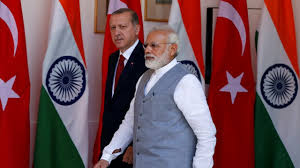
The recent conclusion of the 12th round of Foreign Office Consultations (FoC) between India and Türkiye, held after a four-year hiatus, marks a pivotal moment in West Asian diplomacy. This engagement signals a "thaw" in a relationship that has been historically characterized by a complex mix of robust economic ties and deep-seated geopolitical disagreements.
Historical Context and Recent Strains
The bilateral relationship traces its formal economic roots back to the 1973 Bilateral Trade Agreement and the 1983 Joint Commission on Economic and Technical Cooperation (JCETC). To institutionalize diplomatic dialogue, Foreign Office Consultations were established in 2000.
However, relations took a sharp downturn in recent years due to several factors:
- The Kashmir Factor: Under President Recep Tayyip Erdo?an, Türkiye has frequently used international platforms, including the UN General Assembly, to raise the Kashmir issue, often echoing Pakistan's stance.
- Operation Sindoor& Strategic Realignment: Tensions peaked during "Operation Sindoor," where Türkiye’s military and diplomatic alignment with Pakistan drew sharp reactions from New Delhi.
- Indian Diplomatic Counter-measures: In response to Ankara's provocations, India scaled back diplomatic briefings for Turkish officials and witnessed public sentiment shifting against Turkish trade and tourism.
Economic and Social Consequences of Friction
The diplomatic chill had tangible impacts on "soft power" and economic engagement:
- Tourism Contraction: Indian tourist arrivals to Türkiye saw a drastic 37% decline by June 2025 compared to previous years, reflecting the impact of public boycotts.
- Trade Volatility: While bilateral trade had reached a peak of $13.88 billion in 2022–23, recent data indicates a contraction to approximately $8.71 billion, highlighting how political instability can jeopardize economic gains.
Strategic Imperatives:
Despite the friction, Türkiye remains a vital partner for India’s long-term interests:
- Geopolitical Crossroads: Situated at the intersection of Europe and Asia, Türkiye is a critical node for trans-continental connectivity and India’s outreach to the Mediterranean and Central Asia.
- Multilateral Influence: As a member of the G20 and a significant voice in the Islamic world (OIC), Türkiye’s cooperation is essential for India’s global governance ambitions and its engagement with Muslim-majority nations.
- Institutional Frameworks: Existing mechanisms like the Joint Working Group on Counter-Terrorism (last met in 2019) and the Policy Planning Dialogue (launched in 2020) provide ready-made platforms for cooperation if political will persists.
- Humanitarian Diplomacy: India’s Operation Dost (2023), launched to provide relief after devastating earthquakes in Türkiye, demonstrated India’s commitment to "Vasudhaiva Kutumbakam" (The World is One Family), creating a reservoir of goodwill among the Turkish populace.
The Broader Global Recalibration
The resumption of talks must be viewed through the lens of India’s pragmatic foreign policy. India has shown an increasing willingness to engage with traditional critics:
- Regional Rebalancing: Just as India has engaged with Azerbaijan (despite its support for Pakistan) and recalibrated ties with China and Malaysia, the outreach to Ankara reflects a policy of "multi-alignment."
- Turkish Regionalism: Türkiye itself is diversifying its diplomacy, engaging with regional powers like Egypt and Saudi Arabia, creating a more fluid environment for India to maneuver.
Challenges to a Lasting "Thaw"
The path toward a strategic partnership remains obstructed by significant hurdles:
- The Pakistan-Türkiye Axis: The deep military-technical cooperation between Ankara and Islamabad remains a primary security concern for India.
- Divergent Narratives: Leadership rhetoric and domestic political compulsions in both nations often lead to provocative statements that derail diplomatic progress.
- Trust Deficit: The gap between economic cooperation and political alignment continues to be a "perception gap" that requires sustained high-level engagement to bridge.
Conclusion
The 12th Foreign Office Consultations represent a shift from confrontation to managed pragmatism. For India, the goal is not necessarily total alignment, but the neutralization of Turkish hostility on core national interests while leveraging economic synergies. In an increasingly fragmented global order, maintaining a functional relationship with a middle power like Türkiye is essential for India to uphold its strategic autonomy and ensure stability across the Eurasian landmass.