
State Finance Commissions (SFCs)
- 15 Jun 2026
In News:
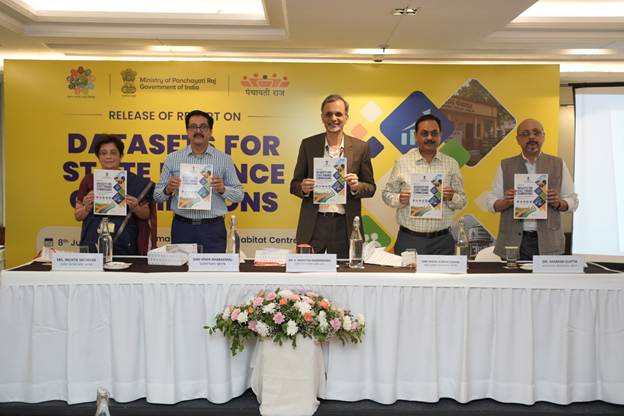
The Ministry of Panchayati Raj (MoPR) released the Report on Datasets for State Finance Commissions (June 2026), highlighting critical data gaps affecting fiscal decentralisation and recommending reforms to improve the functioning of State Finance Commissions (SFCs).
State Finance Commission (SFC)
The State Finance Commission (SFC) is a constitutional body established through the 73rd and 74th Constitutional Amendment Acts, 1992 to strengthen fiscal decentralisation. It reviews the financial position of Panchayati Raj Institutions (PRIs) and Urban Local Bodies (ULBs) and recommends principles for the devolution of State finances.
Constitutional Provisions
- Article 243-I: Mandates every State to constitute an SFC every five years to review the finances of Panchayats.
- Article 243-Y: Extends the SFC's mandate to Municipalities.
- Article 280(3)(bb) & (c): Requires the Central Finance Commission (CFC) to recommend measures for augmenting State Consolidated Funds for local bodies based on SFC recommendations.
Major Functions
The SFC recommends:
- Distribution of State taxes, duties, tolls and fees between the State and local bodies.
- Allocation of resources among different tiers of PRIs and ULBs.
- Assignment of taxes and grants-in-aid.
- Measures to strengthen the financial position of local governments.
Key Findings of the MoPR Report
The report finds that poor quality and fragmented local government data remain one of the biggest obstacles to effective fiscal decentralisation.
Major Challenges
- Fragmented databases and absence of consolidated local accounts make expenditure analysis difficult.
- Shortage of trained accounting personnel at the Gram Panchayat level leads to incomplete and non-uniform financial records.
- The 15th Finance Commission observed an average delay of 16 months in submission of SFC reports.
- The 16th Finance Commission found many SFC reports inconsistent and unsuitable for framing central devolution recommendations.
Existing databases such as eGramSwaraj, Panchayat Advancement Index (PAI 2.0), Census and SECC 2011, and CAG audit reports suffer from issues of outdated information, inconsistent data entry, or inadequate Gram Panchayat-level granularity.
Key Recommendations
Strengthening Data Systems
- The report recommends creating Gram Panchayat-level digital databases with standardized accounting practices and restructuring the Panchayat Advancement Index (PAI) by classifying indicators based on needs, performance and backwardness.
- It also suggests integrating datasets through the Local Government Directory to enable uniform GP-level reporting.
Institutional Reforms
- Establish permanent SFC Cells within State Finance or Planning Departments.
- Create a national forum for knowledge sharing among SFCs.
- Request the Comptroller and Auditor General (CAG) to conduct a performance audit on the implementation of the 73rd Constitutional Amendment.
Budgetary & Reporting Reforms
- Introduce uniform accounting heads for all transfers to local bodies.
- Publish supplementary State Budget documents showing devolution up to the Gram Panchayat level.
- Adopt a common reporting format, as recommended by the 13th Finance Commission.
Capacity Building
The report recommends that NIRDPR undertake regular capacity-building programmes and document best practices, while NIPFP should prepare a comprehensive State Finance Commission Manual. It also proposes an Expert Group comprising MoPR, MoSPI, MoHUA and NITI Aayog to strengthen India's local statistics ecosystem.
Issues with State Finance Commissions
- Delayed constitution and submission of reports.
- Weak implementation of SFC recommendations by States.
- Inadequate fiscal autonomy of local bodies.
- Poor quality, fragmented and outdated data.
- Limited technical and institutional capacity.
Significance
Robust and timely SFC recommendations are essential for strengthening cooperative federalism, ensuring predictable fiscal transfers, improving local governance, and achieving the objectives of the 73rd and 74th Constitutional Amendments. Reliable local-level data will also enable evidence-based resource allocation and improve accountability in Panchayati Raj Institutions.
Way Forward
Strengthening the local government data ecosystem through standardised accounting, digital integration, capacity building, timely SFC constitution and improved institutional coordination is crucial for deepening fiscal decentralisation. Implementing these reforms will empower Panchayats and Urban Local Bodies to deliver public services more effectively and realise the constitutional vision of grassroots democracy.