
New WPI Series and Transition to Producer Price Index (PPI)
- 05 Jun 2026
In News:
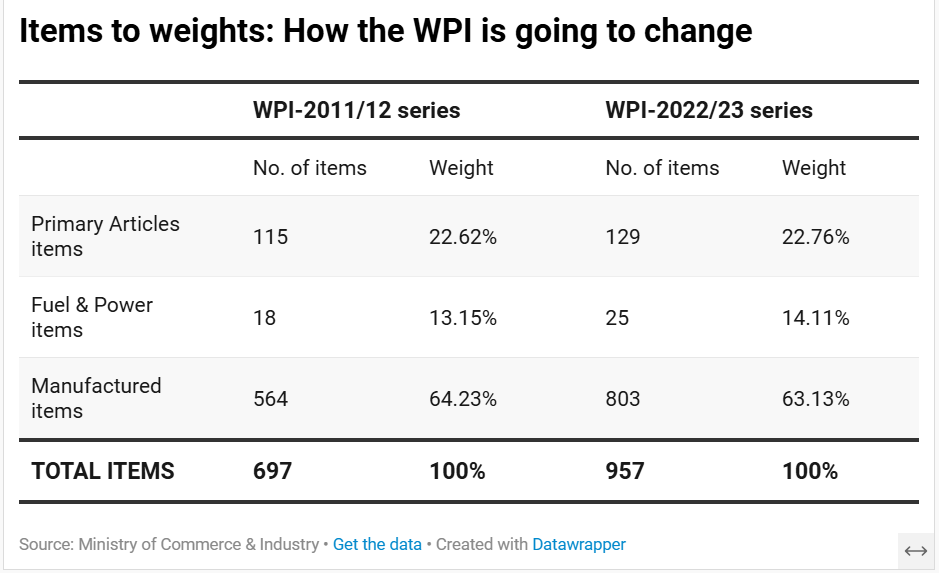
Recently, the Department for Promotion of Industry and Internal Trade (DPIIT) under the Commerce Ministry will release a revised Wholesale Price Index (WPI) series with 2022-23 as the new base year, replacing the 2011-12 series. Simultaneously, India will introduce a comprehensive Producer Price Index (PPI) framework — with the WPI expected to be discontinued by 2031 after a five-year transition.
This reform is part of India's broader statistical overhaul in 2026, following base year revisions to GDP, CPI, and IIP — all updated to 2022-23.
Key Features of the Revised WPI
The commodity basket has been expanded from 697 items to 957 items, with new additions including solar energy, wind energy, nuclear electricity, and other emerging sectors. The revised series will be released with data from May 2026, along with a back-series from April 2023.
The New PPI Framework
Three types of PPIs will be released simultaneously on June 15:
- Output PPI measures prices received by producers at the farm gate or factory gate. It excludes indirect taxes and trade/transport margins. It will initially cover 125 items, expanding to approximately 1,500 items once the WPI is discontinued. This index will be released monthly, with a back-series from April 2023.
- Input PPI (experimental) measures prices paid by producers for inputs, including trade and transport margins. It is being introduced for the manufacturing sector on a trial basis starting March 2026, with validation expected over approximately two years.
- Services PPI covers seven major services: banking, securities transactions, insurance, pension fund management, railways, air passenger transport, and telecommunications. It will be released quarterly, with the first data covering January–March 2026.
All three PPIs carry 2022-23 as the base year.
Why Transition from WPI to PPI?
WPI only tracks goods prices, leaving India's increasingly service-driven economy out of the measurement framework. PPI addresses this gap. Additionally, the output PPI is more consistent with the national accounts framework — the IMF and other global institutions have long advocated PPI adoption for accurately deflating nominal GDP into real GDP. Currently, India uses a combination of WPI and CPI to compute real GDP; once the PPI series stabilises, the output PPI is expected to serve as a more accurate deflator, improving the robustness and international comparability of India's GDP estimates.
Five-Year Transition (2026–2031)
WPI remains widely embedded in long-term procurement contracts, infrastructure agreements, construction projects, and price escalation clauses. To avoid disruption, WPI and PPI will be published in parallel for five years. The Ministry of Finance's Department of Expenditure will issue a circular directing users that fresh long-term contracts extending beyond 2031 should adopt PPI-based escalation mechanisms.
Challenges
Building reliable producer-level price databases — especially for services — is complex. Input PPI remains experimental. Industries and government departments must adapt existing contracts and data frameworks progressively.
Way Forward
- Strengthen data collection infrastructure: Robust producer-level price databases must be built across manufacturing and service sectors. This requires capacity building in statistical agencies, particularly at the district and firm level.
- Validate the Input PPI: The experimental input PPI for manufacturing needs rigorous quality testing and stakeholder feedback over its trial period before it can be formally adopted.
- Expand services coverage: The initial services PPI covers only seven sectors. A roadmap must be developed to progressively include sectors such as healthcare, education, real estate, and IT services.
- Facilitate contractual transition: Government departments, PSUs, and private firms need clear guidelines and legal frameworks to seamlessly migrate price escalation clauses from WPI to PPI in long-term contracts before the 2031 deadline.
- Coordinate with RBI and MoSPI: Close coordination between DPIIT, MoSPI, and the Reserve Bank of India is essential to ensure PPI data is reliable enough to eventually serve as a GDP deflator, strengthening the quality of national income estimates.
Conclusion
India's transition from WPI to PPI is not merely a statistical exercise — it reflects the structural transformation of the Indian economy from a goods-dominated to a services-led one. The simultaneous release of output PPI, input PPI, and services PPI, alongside the revised WPI, marks a decisive step toward aligning India's price measurement architecture with global best practices. Together with the recent revisions in GDP, CPI, and IIP, this reform signals a maturing of India's statistical system, which is foundational to sound policymaking, credible GDP estimation, and investor confidence.