
Tehran’s Turmoil: Regime Change, Regional Order and India’s Strategic Stakes
- 01 Mar 2026
In News:
Recent reports of a joint United States–Israel military action targeting Iran, allegedly aimed at facilitating regime change in Tehran, have brought the legacy of the 1979 Islamic Revolution back into sharp focus. The unfolding developments represent a potential geopolitical inflection point for West Asia, with implications extending to global energy markets and great-power rivalries.
Why the 1979 Islamic Revolution Matters
The 1979 Revolution overthrew the Pahlavi monarchy and established the Islamic Republic of Iran, restructuring the political system around the doctrine of Velayat-e-Faqih (Guardianship of the Islamic Jurist). Under this model, the Supreme Leader wields ultimate religious and political authority, above elected institutions.
Ayatollah Ali Khamenei consolidated this system after 1989, ensuring regime continuity through a powerful security apparatus. Beyond domestic transformation, the revolution reshaped West Asian geopolitics by:
- Promoting a revolutionary ideological agenda across the region,
- Supporting the Palestinian cause,
- Positioning Iran as a strategic adversary of the US and Israel,
- Deepening sectarian divides and unsettling conservative Arab monarchies.
The revolution also contributed to the 1980 oil shock, demonstrating how political upheaval in Iran can disrupt global energy markets.
Regime Survival and Internal Dynamics
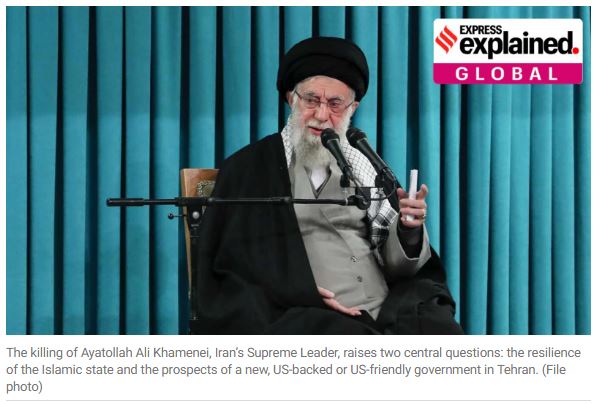
Speculation regarding the potential elimination of Iran’s top leadership has raised questions about regime resilience. However, regime change in Iran is complex:
- Since 2000, Iran has witnessed periodic protest movements demanding reform.
- These protests were consistently suppressed by state coercive institutions.
- The Islamic Revolutionary Guard Corps (IRGC) remains a powerful stabilising pillar of the regime.
The political trajectory will depend on internal elite cohesion, public mobilisation—especially among urban middle classes—and the depth of external intervention. The primary contest may unfold within Iranian society rather than across the broader “Arab street.”
Regional and Global Implications
Iran’s revolutionary posture shaped West Asia’s security architecture for decades. A regime shift could:
- Reconfigure alliances in the Gulf,
- Alter Iran’s engagement with Israel and Arab states,
- Influence proxy conflicts across the region.
Rising tensions in the Strait of Hormuz, through which a significant portion of global oil shipments pass, have already pushed energy prices upward. Iran holds substantial hydrocarbon reserves, and sanctions relief under a new political dispensation could reintroduce Iranian oil to global markets, stabilising prices.
At the global level, post-1979 Iran gravitated toward Russia and China, joining platforms such as the Shanghai Cooperation Organisation (SCO) and BRICS-related groupings. A pro-West government in Tehran would represent a strategic setback for Moscow and Beijing, reshaping great-power competition in West Asia.
Implications for India
India’s stakes in West Asia are substantial and multidimensional:
1. Energy Security
Iran and the Gulf region are critical to India’s crude oil imports. Escalation risks supply disruptions and price volatility.
2. Diaspora Interests
Over 9 million Indians reside in GCC countries, including:
- Around 43 lakh in the UAE (≈35% of its population),
- Large numbers in Saudi Arabia, Qatar, Kuwait, and Oman,
- Over 100,000 in Israel and more than 10,000 in Iran.
3. Remittances and Economic Linkages
According to RBI data (2023–24), India received $118.7 billion in remittances, with:
- UAE contributing 19.2%,
- Saudi Arabia 6.7%,
- Qatar, Kuwait, and Oman among major contributors.
West Asia is also a major travel and trade corridor for India.
4. Strategic Balancing
India maintains a delicate balance between:
- Iran (energy, Chabahar Port, connectivity to Central Asia),
- Israel (defence cooperation),
- Gulf monarchies (energy and diaspora).
Instability could strain this multi-aligned diplomacy.
Conclusion
Efforts to reverse or reshape the legacy of the 1979 Islamic Revolution constitute a major geopolitical moment. The outcome will influence regional alignments, global oil markets, and great-power competition. For India, the priority lies in safeguarding energy flows, protecting its diaspora, and maintaining strategic autonomy amid shifting alliances.
Whatever direction Tehran takes, the ripple effects will extend far beyond Iran, reshaping the geopolitical landscape of West Asia and the wider international system.