
Indus Waters Treaty: The Road Ahead for India and Pakistan
- 05 Sep 2026
In News:
The Permanent Court of Arbitration (PCA) recently issued an award on the status of the Indus Waters Treaty (IWT), 1960, and an order concerning interim measures at the Ratle Hydroelectric Project. The Court held that India's decision to place the Treaty in “abeyance” was not permissible under the Treaty or applicable international law and treated the Treaty as continuing to remain in force. It also directed interim restrictions concerning construction at Ratle.
India, which has not participated in the arbitration proceedings, rejected the Court's jurisdiction and maintained that its decision to keep the Treaty in abeyance remains in force.
Indus Waters Treaty: Framework
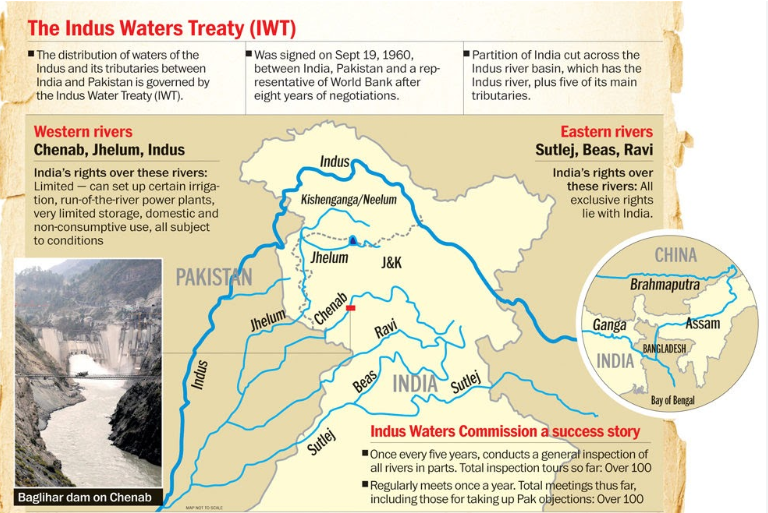
Signed in 1960 with the World Bank's involvement, the IWT governs the utilisation of the waters of six rivers of the Indus system:
- Eastern Rivers: Ravi, Beas and Sutlej — allocated primarily to India.
- Western Rivers: Indus, Jhelum and Chenab — allocated primarily to Pakistan, while permitting India specified uses, including domestic use, non-consumptive uses and limited hydropower generation.
The Treaty provides a Permanent Indus Commission and a graded dispute-resolution mechanism involving the Commission, a Neutral Expert, or a Court of Arbitration, depending on the nature of the dispute.
Why Has India Rejected the Arbitration?
India's principal objection is that the arbitration process was constituted despite the existence of a parallel Neutral Expert process concerning related technical issues. India argues that this amounts to an impermissible parallel mechanism under the Treaty.
The PCA, however, has maintained that it was properly constituted and competent to adjudicate the disputes. Its earlier awards have also held that its decisions are final and binding under the Treaty.
Thus, the present situation reflects a fundamental disagreement between India's position on the legitimacy of the proceedings and the PCA's interpretation of its treaty-based jurisdiction.
Strategic and Diplomatic Implications
For India, the immediate focus is on maximising the permissible utilisation of the western rivers through hydropower and other infrastructure projects. The dispute therefore has implications for energy security, water management and development in Jammu & Kashmir.
For Pakistan, the PCA rulings provide a legal and diplomatic basis for raising the issue in international forums. However, the practical implementation of the awards remains complicated because India does not recognise the jurisdiction of the Court in this proceeding.
The dispute also demonstrates the limitations of international water-law mechanisms when one party rejects the jurisdiction or proceedings of the adjudicatory body.
The Road Ahead
A return to the original Treaty framework appears difficult in the near term. India has advocated renegotiation, while Pakistan has strong incentives to preserve the existing arrangement.
At the same time, “abeyance” does not mean that India can simply stop the flow of the Indus system's waters to Pakistan. Physical and hydrological realities, along with India's existing infrastructure limitations, constrain the extent to which water flows can be altered.
The way forward requires a combination of bilateral dialogue, technical cooperation, improved water-use efficiency, climate-resilient water management and greater storage capacity. A durable arrangement would need to balance India's developmental requirements with Pakistan's downstream water security.
Conclusion
The IWT dispute has moved beyond a conventional water-sharing disagreement into a wider question involving international law, national security, hydropower, bilateral relations and transboundary resource governance. The present stalemate underlines the need for mechanisms that can preserve cooperation over shared rivers even amid broader political tensions.