
National Handloom Day
- 11 Aug 2026
In News:
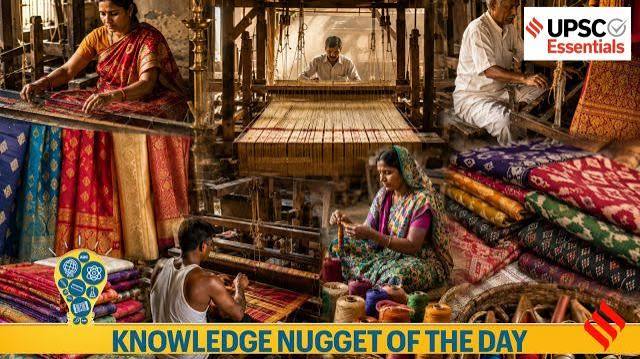
National Handloom Day, observed on 7 August, highlights the economic, social and cultural importance of India’s handloom sector. Despite supporting millions of livelihoods, the sector faces challenges such as declining returns, fragmented markets and the gradual disappearance of traditional weaving skills.
Historical and Economic Significance
India has a centuries-old handloom tradition. Indian textiles were historically traded across continents and contributed significantly to the country’s manufacturing and commercial importance. During the freedom struggle, handloom became an instrument of economic resistance. The Swadeshi Movement of 1905 promoted the boycott of British textiles, while Mahatma Gandhi’s charkha became a symbol of self-reliance.
The sector continues to have substantial economic significance. It provides livelihoods to more than 35 lakh weavers and allied workers across over 31 lakh households, with women constituting nearly 70% of the workforce. It also accounts for nearly 15% of India's cloth production, making it an important source of rural non-farm employment.
Challenges Facing the Sector
The major concern is the declining economic viability of weaving. Lower returns, fragmented markets and inadequate access to buyers are pushing younger generations away from the profession. As traditional skills are no longer consistently transmitted within families, several lesser-known weaving traditions face the risk of extinction.
The loss of a weave represents more than the disappearance of a commercial product. It also means the loss of traditional knowledge, design traditions and cultural identity accumulated over generations.
Government Support and Emerging Opportunities
The National Handloom Development Programme focuses on skill development, design innovation, technology adoption, branding and market access. Greater integration with e-commerce and export markets can help artisans reach consumers directly.
The Office of the Development Commissioner for Handlooms, in collaboration with UNESCO, has also been working towards identifying and documenting languishing and endangered weaves. Promotion of GI-tagged handloom products can further strengthen their market identity.
Examples such as the revival of Tangaliya weaving in Gujarat, cluster-based development in Badturang village of Odisha, and the growing popularity of Siddipet Gollabhama sarees show that traditional crafts can regain economic relevance when design, institutional support and market access come together.
Making Handloom Aspirational
The next phase of policy should move beyond simply preserving handloom traditions and make them economically viable and aspirational for younger generations. Contemporary designs, collaborations with designers, digital storytelling, influencers and limited-edition collections can position traditional Indian weaves as premium lifestyle products.
India should also expand the global presence of its handlooms by leveraging growing international demand for authentic, sustainable and handcrafted products. This would require stronger branding, quality standards, GI protection and action against cultural misappropriation.
Way Forward
A major gap is the inadequate measurement of the handloom economy. Better data on employment, household incomes, exports, GDP contribution and other economic indicators would enable more effective policymaking.
The focus should therefore be on improving incomes, strengthening market access, preserving traditional skills and connecting Indian handlooms with contemporary and global markets.
Conclusion
Indian handloom is simultaneously an economic sector, a source of rural livelihoods and a repository of cultural heritage. The objective should not be merely to preserve it as a historical tradition, but to ensure that it remains profitable, innovative and aspirational for future generations.