
India–Australia Long-Term Uranium Supply Agreement
- 21 Jul 2026
In News:
India has signed a long-term uranium supply agreement with Australia, operationalising the India–Australia Civil Nuclear Cooperation Agreement, signed nearly 12 years ago. The agreement follows similar long-term uranium supply deals with Canada and Kazakhstan, reflecting India's strategy to diversify fuel sources and support its expanding nuclear power programme.
Why is the Agreement Important?
India has set an ambitious target of expanding its civil nuclear power capacity to 100 GWe by 2047. Achieving this goal requires a reliable supply of nuclear fuel, particularly as domestic uranium production is insufficient to meet future demand. The agreement strengthens India's long-term energy security while reducing dependence on a limited number of suppliers.
The exact quantity of uranium oxide (yellowcake) and the duration of the agreement have not been disclosed.
India's Uranium Requirement
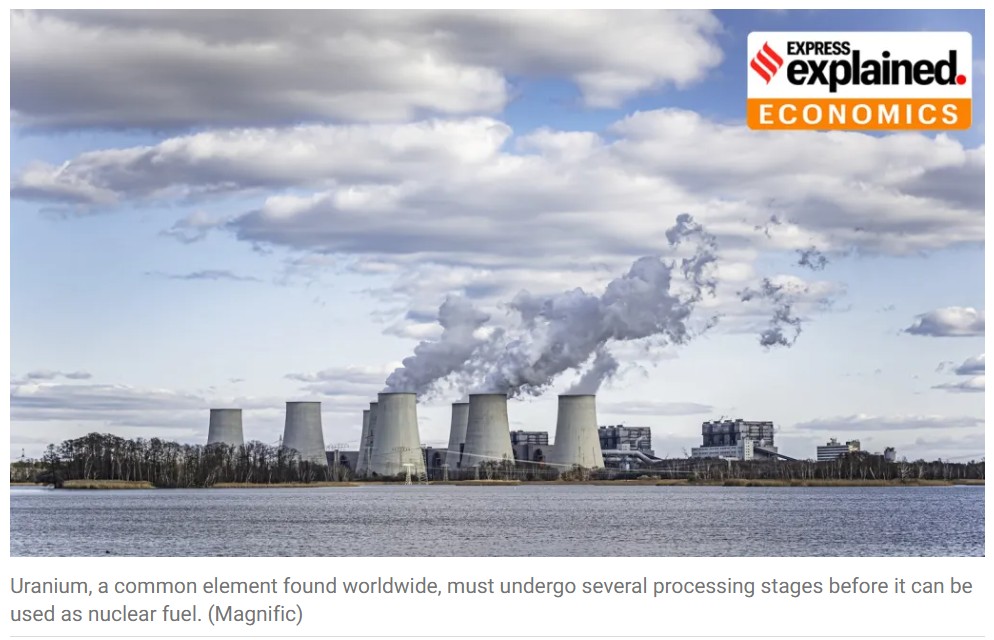
Uranium is processed through several stages before it becomes usable nuclear fuel, including mining and milling, conversion, enrichment (where required), and fuel fabrication.
India's Pressurised Heavy Water Reactors (PHWRs) use natural uranium, sourced through a combination of domestic production and imports. However, the country's Light Water Reactors (LWRs) at Tarapur and Kudankulam rely entirely on imported enriched uranium.
Although India possesses about 4.3 lakh tonnes of uranium oxide reserves spread across several states, domestic production currently meets the fuel requirement for only 2.4 GWe out of the country's 8.7 GWe installed nuclear capacity. The remaining requirement is met through imports.
A Ministry of Power committee has estimated that by 2047, India will require an additional 8,029 tonnes of natural uranium and 1,045 tonnes of enriched uranium annually to support the planned expansion.
NSG Waiver and Expanding Import Network
India's ability to import uranium became possible after receiving the 2008 Nuclear Suppliers Group (NSG) clean waiver, making it the only non-signatory to the Nuclear Non-Proliferation Treaty (NPT) permitted to engage in international nuclear commerce.
Besides Australia, India has recently concluded long-term uranium supply arrangements with:
- Canada (Cameco Corporation)
- Kazakhstan (Kazatomprom)
It also imports uranium from Russia and Uzbekistan, while France and the United States have supplied uranium products in recent years.
Between 2008–09 and 2024–25, India imported 18,842.6 metric tonnes of uranium products. In 2024–25, imported uranium contributed to 39,180 million units out of the total 56,631 million units of nuclear electricity generated.
Challenges
Despite possessing significant uranium reserves, India's ore is generally of low grade, making domestic mining and processing three to four times more expensive than importing uranium.
However, growing global demand for nuclear energy could increase international uranium prices in the future. Therefore, the government has been advised to simultaneously strengthen domestic uranium production through expansion of the Uranium Corporation of India Limited (UCIL) to enhance long-term energy security.
Significance
The Australia agreement strengthens India's fuel security for its expanding nuclear programme and supports the target of 100 GWe nuclear capacity by 2047. It also diversifies uranium imports, reduces supply risks, and complements India's broader strategy of expanding clean, low-carbon energy while balancing import dependence with increased domestic production.