
BRICS in Geopolitical Crosscurrents
- 17 May 2026
In News:
The BRICS Foreign Ministers’ Meeting, hosted in New Delhi under India’s 2026 Chairship, highlighted both the growing economic influence and the internal political friction of the expanded "BRICS " bloc. Operating under the theme “BRICS: Building for Resilience, Innovation, Cooperation and Sustainability,” India utilized its platform to champion a “Humanity First” approach to global governance. However, the summit exposed sharp structural vulnerabilities as bilateral animosities between newly inducted members directly impacted the grouping's ability to forge a unified diplomatic front.
The New Delhi Impasse: Chair’s Statement vs. Joint Declaration
The primary headline of the New Delhi ministerial meeting was the failure to adopt a consensus-based Joint Declaration. Instead, the summit concluded with the release of a “Chair’s Statement and Outcome Document.”
This diplomatic compromise was forced by intense disagreements between Iran and the United Arab Emirates (UAE). A similar deadlock had previously emerged during the BRICS Deputy Foreign Ministers and Special Envoys meeting in New Delhi, where the two nations clashed over references to the broader US-Israel conflict and UAE concerns regarding regional Iranian posture.
Core Areas of Contention and Consensus
- The Post-War Gaza Trajectory: While the bloc successfully achieved consensus in designating the Gaza Strip as an inseparable part of the Occupied Palestinian Territory and supported the unification of Gaza and the West Bank under the Palestinian Authority, both Tehran and Abu Dhabi raised serious objections to the specific vocabulary dictating this transition of power.
- Maritime Security Dimensions: The ministers highlighted the absolute necessity of maintaining safe, unhindered maritime commerce through vital international waterways, alongside safeguarding civilian infrastructure and human lives. However, the final text explicitly acknowledged differing internal views regarding localized flashpoints, specifically the Strait of Hormuz, the Red Sea, and the Bab-el-Mandeb Strait.
- Consensus on Palestinian Statehood: Despite internal rifts, the meeting formally reaffirmed support for an independent, sovereign, and viable Palestinian State based on the pre-1967 borders (the Green Line), with East Jerusalem as its capital, in complete alignment with international law, UN Security Council resolutions, and the Arab Peace Initiative.
Strategic Bilateral and Economic Deliverables
While political consensus faltered, the sidelines of the New Delhi summit delivered significant progress on regional connectivity, energy security, and de-dollarization:
1. The India-Iran Strategic Corridor: Iran used the ministerial platform to pitch the Chabahar Port as India’s definitive "golden gate" for accessing landlocked Central Asia, the Caucasus region, and broader European markets. This positioning strengthens the strategic value of the port, bypasses regional bottlenecks, and deepens India's continental footprint.
2. India-Russia Economic and Energy Guarantees: Russia provided explicit assurances to India regarding the uninterrupted supply of hydrocarbon energy resources. Furthermore, Moscow and New Delhi mapped out deeper structural cooperation across three areas:
- Accelerated infrastructure development along the International North-South Transport Corridor (INSTC).
- Expanded cooperation in civil nuclear energy projects.
- The formalization of trade settlement frameworks using national currencies, directly advancing the bloc's goal of bypassing Western-dominated financial networks.
Evolution of the BRICS Institutional Architecture
The structural evolution of BRICS reflects a concerted effort to establish a multipolar alternative to Bretton Woods institutions like the IMF and the World Bank.
- Genesis and Institutionalization: The term "BRIC" was originally conceptualized by economist Jim O’Neill in 2001 to identify the primary emerging economies of Brazil, Russia, India, and China. The grouping transitioned into a formal diplomatic collective on the sidelines of the G8 Outreach Summit in 2006, institutionalizing later that year through its first Foreign Ministers' meeting at the United Nations General Assembly. The inaugural formal summit occurred in Yekaterinburg, Russia, in 2009.
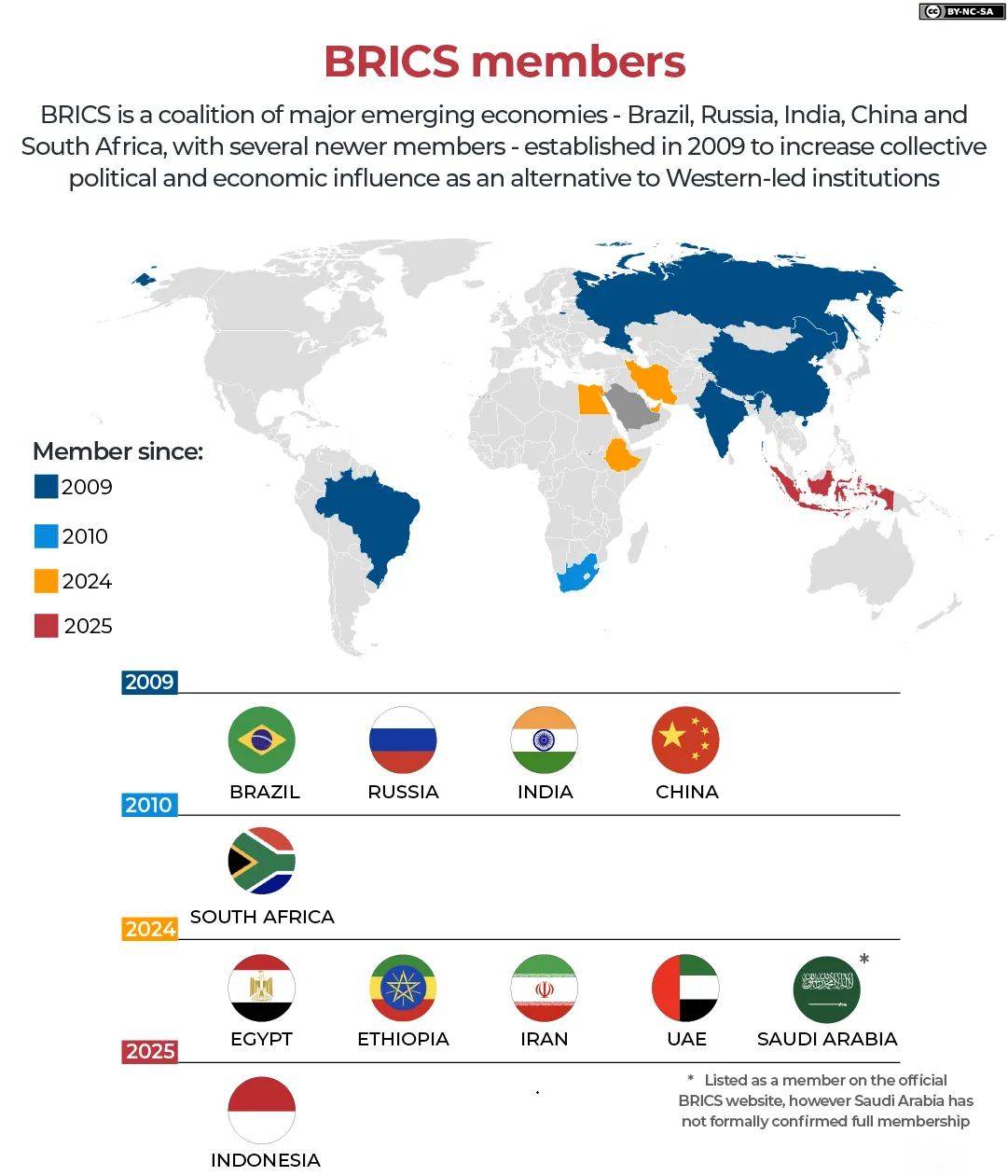
- Expansion Dynamics: With South Africa’s inclusion in 2010, the acronym became BRICS. The framework recently experienced a historic expansion into BRICS , absorbing Egypt, the United Arab Emirates, Ethiopia, Indonesia, and Iran. This expanded configuration commands massive global weight, representing 49.5% of the global population, 40% of global GDP, and 26% of global trade.
- Operational Rules: BRICS operates without a permanent secretariat or an official charter, relying instead on a rotating annual chairmanship. Its work is distributed across three pillars: political and security cooperation, economic and financial integration, and people-to-people exchanges.
- The New Development Bank (NDB): Headquartered in Shanghai, China, and established in 2015, the NDB serves as the operational financial arm of the bloc, mobilizing public and private resources for infrastructure and sustainable development projects across emerging economies.
Conceptualizing the Two-State Solution
The New Delhi outcome document's focus on the "Two-State Solution" refers to the core international framework aimed at resolving the Israeli-Palestinian conflict.
- Historical Underpinnings: The concept originated in the 1947 UN Partition Plan (Resolution 181), which proposed dividing Mandatory Palestine into distinct, independent Arab and Jewish sovereign entities, while placing Jerusalem under an international trusteeship. It gained formal operational momentum via the 1993 Oslo Accords, a landmark peace process where Israel and the Palestine Liberation Organization (PLO) recognized each other, establishing the Palestinian Authority (PA) as a transitional self-governance body in the West Bank and Gaza.
- Borders and Territorial Sovereignty: The standard consensus model advocates for permanent borders based on the lines existing prior to the 1967 Six-Day War, subject to mutually agreed land swaps.
- The Jerusalem Conundrum: The blueprint frequently envisions a shared or split sovereignty model, placing the capital of a future Palestinian state in East Jerusalem while keeping West Jerusalem as the capital of Israel.
- The Right of Return: The framework requires a negotiated resolution concerning the legal status, compensation, and repatriation rights of millions of Palestinian refugees displaced during the 1948 and 1967 wars.
India’s Balanced Foreign Policy and De-Hyphenation Strategy
India’s dual emphasis at the summit—reiterating its long-standing support for Palestine while managing its deep partnerships with alternative actors—highlights the sophisticated evolution of New Delhi's West Asian foreign policy.
1. Historical Pro-Palestine Posture: India was the first non-Arab sovereign state to recognize the PLO as the sole and legitimate representative of the Palestinian people in 1974. New Delhi subsequently extended full diplomatic recognition to the State of Palestine in 1988.
2. The 1992 Realignment: In 1992, India established full, formal diplomatic relations with Israel. This move allowed New Delhi to build deep strategic, counter-terrorism, and defense-technological partnerships with Tel Aviv without abandoning its ethical ties to the Palestinian cause.
3. Modern Policy of De-Hyphenation: In recent years, India has masterfully executed a policy of de-hyphenation. This strategy dictates that India evaluates and conducts its relations with Israel and Palestine as completely separate, independent bilateral vectors.
Consequently, while New Delhi stood firmly against terrorism by swiftly condemning the October 2023 Hamas attacks, it simultaneously maintained a continuous pipeline of humanitarian assistance to the civilian population in Gaza. By combining these positions with its reaffirmed support for a negotiated Two-State solution during the 2026 BRICS summit, India protects its strategic interests while reinforcing its reputation as a balanced, rule-of-law power in the Global South.