
India’s Defence Transformation: From Import Dependence to Strategic Self-Reliance
- 23 Aug 2026
In News:
India’s defence sector is undergoing a structural transformation towards Atmanirbharta, technological capability and greater private-sector participation. The objective is not merely to reduce imports but to build an integrated domestic ecosystem capable of designing, producing and exporting advanced defence systems.
Strengthening the Defence Industrial Base
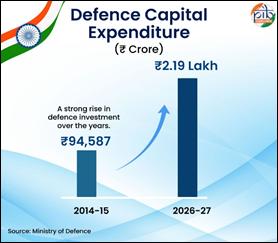
Defence expenditure has increased from ?2.53 lakh crore in 2013–14 to ?7.85 lakh crore in 2026–27, while capital expenditure rose from ?94,588 crore to ?2.19 lakh crore, supporting military modernisation. Indigenous defence production reached a record ?1.78 lakh crore in FY 2025–26, with the private sector contributing 24%.
Defence exports have expanded dramatically, from ?686 crore in 2013–14 to ?38,424 crore in 2025–26, with Indian products reaching 80 countries. The government targets ?3 lakh crore defence production and ?50,000 crore exports by 2029.
Innovation and Indigenisation
India is increasingly opening defence R&D to industry, startups and academia. 25% of the defence R&D budget has been opened to these participants since 2022–23. Schemes such as iDEX, ADITI and the Technology Development Fund (TDF) support indigenous development of critical technologies. As of March 2026, iDEX had facilitated 551 design and development contracts involving 676 innovators, while 80 TDF projects worth ?334 crore were under implementation.
The Positive Indigenisation Lists cover 5,521 items, while Srijan-DEEP provides a digital platform connecting domestic vendors with indigenisation opportunities. Defence Industrial Corridors in Uttar Pradesh and Tamil Nadu are further developing regional manufacturing ecosystems.
Acquisition Reforms and Operational Capability
The Defence Acquisition Council (DAC) has accorded Acceptance of Necessity worth over ?6 lakh crore for DRDO-designed systems to be manufactured by Indian industry. Indigenous procurement of platforms such as Tejas Mk-1A and LCH Prachand reflects the shift towards domestic design and production.
Operational self-reliance is also improving: the Army has achieved about 91% ammunition self-sufficiency, while indigenous missile, air-defence, hypersonic and naval capabilities are expanding. The commissioning of 12 warships and submarines, including platforms with high indigenous content, demonstrates growing naval industrial capacity.
Challenges and Way Forward
India must move beyond production targets towards technology ownership, higher domestic value addition and indigenous critical components. Persistent challenges include dependence on specialised imports, limited R&D-industry linkages, technology gaps and the need for skilled human capital.
The way forward lies in strengthening public-private R&D, MSME integration, defence startups, technology transfer and testing infrastructure, while ensuring predictable procurement and export policies. A deeper domestic defence ecosystem can simultaneously enhance national security, technological sovereignty, high-skilled employment and India’s strategic autonomy, supporting the vision of a technologically advanced defence power by 2047.