
Collegium System in India
- 19 Mar 2026
In News:
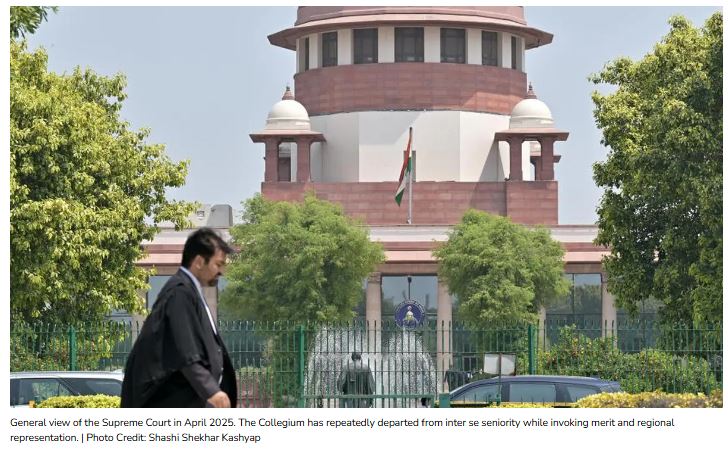
Recent debates (2025–26) have reignited concerns over the functioning of the Collegium system, particularly regarding lack of transparency, deviation from seniority norms, and inadequate regional representation in judicial appointments to the Supreme Court.
About the Collegium System
The Collegium system is a judge-led mechanism for the appointment and transfer of judges in the Supreme Court and High Courts. It is an extra-constitutional body, evolving through judicial interpretation of Articles 124(2) and 217, rather than being explicitly mentioned in the Constitution. The system vests primacy in the judiciary, with the Chief Justice of India (CJI) and four senior-most judges forming the Collegium for Supreme Court appointments.
Evolution through the Judges’ Cases
The Collegium system developed through a series of landmark judgments. The First Judges Case (1981) gave primacy to the executive by interpreting “consultation” as non-binding. The Second Judges Case (1993) reversed this, introducing the Collegium and granting judicial primacy. The Third Judges Case (1998) expanded the Collegium to a five-member body. Finally, the Fourth Judges Case (2015) struck down the National Judicial Appointments Commission (NJAC) as unconstitutional, reaffirming the Collegium system as the prevailing mechanism.
Working of the Collegium System
The process begins with the Collegium recommending names for judicial appointments and elevations based on criteria such as seniority, merit, integrity, and regional representation. These recommendations are sent to the Law Ministry, which conducts background checks through the Intelligence Bureau (IB). The executive may raise objections or delay decisions; however, if the Collegium reiterates a recommendation, conventionally the government is bound to accept it. Despite this framework, delays and informal vetoes have created friction between the judiciary and executive.
Key Issues and Challenges
1. Lack of Transparency: The Collegium’s functioning remains largely opaque, with no formal disclosure of deliberations or reasons for selection and rejection. This has raised concerns about accountability and public trust.
2. Supersession of Seniority: Frequent instances of superseding senior judges have sparked institutional debates. While merit-based elevation is important, arbitrary deviations from seniority can affect morale and predictability within the judiciary.
3. Regional Imbalance: Recent data indicates that seven High Courts remain unrepresented in the Supreme Court as of March 2026, highlighting uneven regional representation. This undermines the idea of the Supreme Court as a truly national court.
4. Executive–Judiciary Deadlock: The executive can delay or withhold appointments, effectively exercising a “pocket veto”, leading to vacancies and impacting judicial functioning.
5. Perception of Nepotism: Critics often describe the system as “judges appointing judges”, raising concerns about favouritism, lack of diversity, and absence of external oversight.
Significance of the Collegium System
Despite its limitations, the Collegium system acts as a crucial safeguard for judicial independence, preventing excessive executive interference in appointments. In a constitutional democracy, an independent judiciary is essential for upholding rule of law, fundamental rights, and separation of powers.
Reform Measures and Way Forward
Reforms are essential to enhance both credibility and efficiency. Greater transparency can be ensured by publishing reasoned decisions or redacted resolutions. Establishing an independent secretariat to maintain objective data on judicial performance can strengthen merit-based selection. There is also a need to finalise the Memorandum of Procedure (MoP) and introduce fixed timelines for appointments to avoid delays. Additionally, institutionalising diversity and regional representation norms can make the judiciary more inclusive and representative.
Conclusion
The Collegium system remains central to preserving judicial independence in India, but its continued legitimacy depends on its ability to reform. Addressing concerns of opacity, imbalance, and delays through institutional improvements can help build a more transparent, accountable, and representative judicial appointment system, thereby strengthening public trust in the judiciary.