
Right to Protest and Limits of Police Power
- 30 Jul 2026
In News:
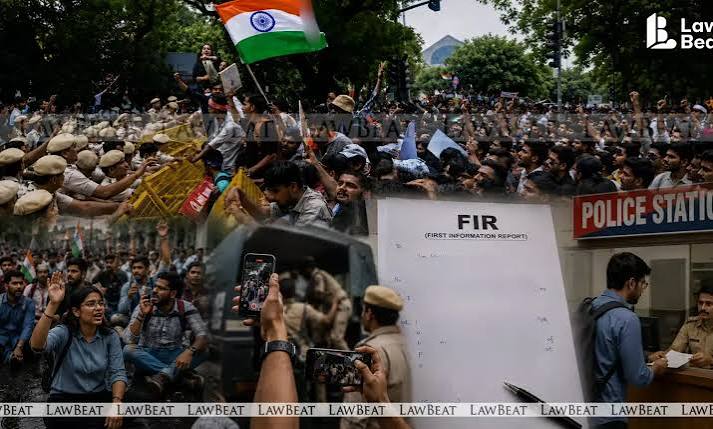
The 'Chalo Sansad' protests (July 2026) renewed debate over the constitutional limits of police powers, use of force during protests, internet restrictions, and the balance between public order and civil liberties.
Constitutional Basis of the Right to Protest
The Constitution of India does not explicitly mention the right to protest, but it is derived from multiple Fundamental Rights:
- Article 19(1)(a): Freedom of speech and expression.
- Article 19(1)(b): Right to assemble peacefully without arms.
- Article 19(1)(c): Right to form associations or unions.
- Article 21: Right to life and personal liberty, including the right to live with dignity and express grievances against the State.
These rights enable citizens to participate in democratic governance and hold the government accountable.
Reasonable Restrictions
The right to protest is not absolute.
- Article 19(2): Permits reasonable restrictions on free speech in the interests of sovereignty and integrity of India, security of the State, public order, decency, morality, defamation, contempt of court, and incitement to an offence.
- Article 19(3): Allows restrictions on peaceful assembly in the interests of sovereignty, integrity, and public order.
Statutory Framework
The State regulates public protests through various laws:
- Section 163 of the Bharatiya Nagarik Suraksha Sanhita (BNSS), 2023: Empowers Executive Magistrates to issue prohibitory orders in urgent situations.
- Delhi Police Act, 1978 and other state police laws regulate routes, timings, and conditions for public assemblies.
- Under the Bharatiya Nyaya Sanhita (BNS), 2023, an assembly of five or more persons becomes unlawful only if its common object involves criminal force, committing offences, resisting law, or intimidating others. A peaceful gathering may become unlawful if its conduct subsequently changes.
Standards Governing Police Action
Police action during protests must follow the principles of legality, necessity, proportionality, and minimum force.
The NHRC Manual on Human Rights for Police Officers and the UN Basic Principles on the Use of Force and Firearms (1990) require police to prioritise persuasion and warnings before using force. Under the BNSS and the Code of Conduct for Police, only the minimum force necessary should be employed.
The Supreme Court in D.K. Basu v. State of West Bengal (1997) also mandated that police personnel making arrests must display clear identification to ensure accountability.
Important Supreme Court Judgments
- Ram Manohar Lohia v. State of Bihar (1965): Distinguished "law and order" from "public order"; restrictions are justified only when public order is genuinely threatened.
- Himat Lal K. Shah v. Commissioner of Police (1973): The State may regulate but cannot arbitrarily prohibit peaceful assemblies.
- In Re: Ramlila Maidan Incident (2012): Force should be used only as a last resort.
- Anita Thakur v. State of J&K (2016): Excessive police force violates Fundamental Rights.
- Mazdoor Kisan Shakti Sangathan v. Union of India (2018): Regulation of protests is permissible, but the right cannot be extinguished.
- Amit Sahni v. Commissioner of Police (2020): Public protests cannot indefinitely occupy public spaces.
- Anuradha Bhasin v. Union of India (2020): Internet restrictions must satisfy the tests of legality, necessity, proportionality, publication, and periodic review.
Major Concerns
Concerns include excessive use of force, political interference in policing, inadequate human rights training, police manpower shortages, lack of accountability, weak implementation of the Prakash Singh (2006) police reforms, blanket internet shutdowns, and continuation of the colonial policing framework under the Police Act, 1861.
Way Forward
Effective implementation of the Prakash Singh reforms, independent Police Complaints Authorities, greater use of body cameras, modern crowd-control training, separation of investigation from law-and-order duties, and adoption of SMART Policing (Strict & Sensitive, Modern & Mobile, Alert & Accountable, Reliable & Responsive, Tech-savvy & Trained) can strengthen democratic policing while safeguarding citizens' constitutional rights.