
India–Russia Relations
- 08 Dec 2025
In News:
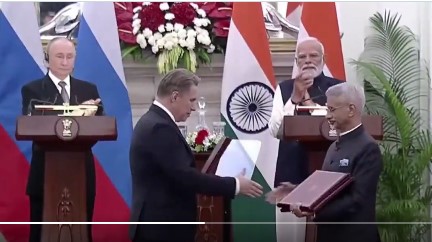
The 23rd India–Russia Annual Summit, held during President Vladimir Putin’s visit to India, reaffirmed the enduring strength of the “Special and Privileged Strategic Partnership” between the two countries. Marking 25 years of the 2000 Strategic Partnership Declaration, both sides signed 16 agreements across defence, trade, healthcare, education, culture, and energy, underscoring the resilience of bilateral ties amid global geopolitical turbulence.
Key Outcomes of the Summit
A major focus was on economic and trade cooperation. India and Russia adopted Programme 2030 to expand long-term strategic economic engagement and set an ambitious target of USD 100 billion in bilateral trade by 2030. Both sides agreed to fast-track negotiations on the proposed India–Eurasian Economic Union (EAEU) Free Trade Agreement. Given sanctions-related financial challenges, the two countries also discussed alternative payment mechanisms, while reaffirming energy as the central pillar of economic ties.
On connectivity, the leaders emphasized cooperation on strategic corridors such as the International North–South Transport Corridor (INSTC), the Chennai–Vladivostok maritime route, and the Northern Sea Route (NSR). These initiatives align with India’s efforts to improve access to Eurasia and Russia’s pivot towards Asia.
In the Russian Far East and Arctic, India reiterated its interest in expanding trade and investment in energy, mining, and maritime sectors. As an Observer in the Arctic Council, India signalled readiness to play a more active role in Arctic research and navigation cooperation.
In civil nuclear and space cooperation, Russia reaffirmed support for India’s nuclear energy expansion, including collaboration at the Kudankulam Nuclear Power Plant and across the nuclear fuel cycle. Space cooperation between ISRO and Roscosmos is set to deepen, particularly in human spaceflight, satellite navigation, and planetary exploration.
Defence cooperation remains a cornerstone. The partnership is gradually shifting from a traditional buyer–seller relationship to joint research, co-development, and co-production of defence equipment. Both sides reviewed progress under the Inter-Governmental Commission on Military and Military Technical Cooperation (IRIGC-M&MTC) and emphasized Make-in-India manufacturing of spare parts for Russian-origin platforms.
At the multilateral level, Russia reiterated support for India’s bid for a permanent seat in the UN Security Council and backed India’s BRICS Chairship in 2026. Cooperation in climate action, low-carbon technologies, and implementation of Article 6 of the Paris Agreement was also highlighted. Both countries reaffirmed a strong commitment to counter-terrorism.
Broader Pillars of Cooperation
Bilateral trade reached USD 68.7 billion in FY 2024–25, largely driven by India’s energy imports. Defence remains a major pillar, with cooperation on systems such as the S-400, BrahMos missile, and Su-30MKI aircraft. Science and technology ties include Gaganyaan astronaut training and the 2021 innovation roadmap. Cultural and educational exchanges are growing, with nearly 20,000 Indian students studying in Russia.
Challenges and Way Forward
Despite strong ties, challenges persist. Defence supply delays due to the Ukraine conflict have affected timelines, requiring India to strengthen indigenous production and joint spares manufacturing. The trade relationship is heavily skewed in Russia’s favour, making diversification of Indian exports through the EAEU FTA crucial. Western sanctions have complicated payment systems, necessitating the use of rupee-based trade settlements and alternative banking channels. Russia’s growing proximity to China also reduces its strategic neutrality, compelling India to balance ties through deeper engagement with Europe, Central Asia, and the Indo-Pacific. Concerns over Indian nationals recruited into the Russian military highlight the need for stronger migrant protection mechanisms.
Conclusion
India–Russia ties remain strategically significant, especially in defence, energy, and connectivity. However, the relationship is evolving toward broader economic, technological, and regional cooperation. Managing geopolitical pressures, diversifying trade, and strengthening financial arrangements will be key to sustaining this long-standing partnership in a rapidly changing global order.