
National Handloom Day
- 11 Aug 2026
In News:
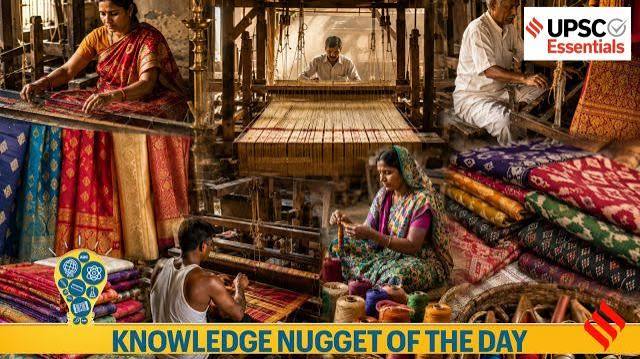
National Handloom Day, observed on 7 August, highlights the economic, social and cultural importance of India’s handloom sector. Despite supporting millions of livelihoods, the sector faces challenges such as declining returns, fragmented markets and the gradual disappearance of traditional weaving skills.
Historical and Economic Significance
India has a centuries-old handloom tradition. Indian textiles were historically traded across continents and contributed significantly to the country’s manufacturing and commercial importance. During the freedom struggle, handloom became an instrument of economic resistance. The Swadeshi Movement of 1905 promoted the boycott of British textiles, while Mahatma Gandhi’s charkha became a symbol of self-reliance.
The sector continues to have substantial economic significance. It provides livelihoods to more than 35 lakh weavers and allied workers across over 31 lakh households, with women constituting nearly 70% of the workforce. It also accounts for nearly 15% of India's cloth production, making it an important source of rural non-farm employment.
Challenges Facing the Sector
The major concern is the declining economic viability of weaving. Lower returns, fragmented markets and inadequate access to buyers are pushing younger generations away from the profession. As traditional skills are no longer consistently transmitted within families, several lesser-known weaving traditions face the risk of extinction.
The loss of a weave represents more than the disappearance of a commercial product. It also means the loss of traditional knowledge, design traditions and cultural identity accumulated over generations.
Government Support and Emerging Opportunities
The National Handloom Development Programme focuses on skill development, design innovation, technology adoption, branding and market access. Greater integration with e-commerce and export markets can help artisans reach consumers directly.
The Office of the Development Commissioner for Handlooms, in collaboration with UNESCO, has also been working towards identifying and documenting languishing and endangered weaves. Promotion of GI-tagged handloom products can further strengthen their market identity.
Examples such as the revival of Tangaliya weaving in Gujarat, cluster-based development in Badturang village of Odisha, and the growing popularity of Siddipet Gollabhama sarees show that traditional crafts can regain economic relevance when design, institutional support and market access come together.
Making Handloom Aspirational
The next phase of policy should move beyond simply preserving handloom traditions and make them economically viable and aspirational for younger generations. Contemporary designs, collaborations with designers, digital storytelling, influencers and limited-edition collections can position traditional Indian weaves as premium lifestyle products.
India should also expand the global presence of its handlooms by leveraging growing international demand for authentic, sustainable and handcrafted products. This would require stronger branding, quality standards, GI protection and action against cultural misappropriation.
Way Forward
A major gap is the inadequate measurement of the handloom economy. Better data on employment, household incomes, exports, GDP contribution and other economic indicators would enable more effective policymaking.
The focus should therefore be on improving incomes, strengthening market access, preserving traditional skills and connecting Indian handlooms with contemporary and global markets.
Conclusion
Indian handloom is simultaneously an economic sector, a source of rural livelihoods and a repository of cultural heritage. The objective should not be merely to preserve it as a historical tradition, but to ensure that it remains profitable, innovative and aspirational for future generations.
National Handloom Day and the Legacy of the Swadeshi Movement
- 09 Aug 2025
In News:
Every year on 7th August, India celebrates National Handloom Day, commemorating the launch of the Swadeshi Movement (1905), which emerged as a response to the Partition of Bengal by Lord Curzon. The movement marked a turning point in India’s struggle for self-reliance by promoting indigenous industries, especially handlooms, as an instrument of economic resistance against colonial rule.
Historical Background: Swadeshi Movement
The Calcutta Townhall meeting of 1905 formally initiated the Swadeshi Movement. Its key methods included:
- Boycott of British goods like Manchester cloth and Liverpool salt, encouraging Indian-made products.
- National Education, leading to the founding of institutions such as Bengal National College and Bengal Technical Institute.
- Formation of Samitis, e.g., Swadesh Bandhab Samiti led by Ashwini Kumar Dutta.
- Use of festivals and cultural symbols, such as Raksha Bandhan by Rabindranath Tagore, to foster unity.
- Social reform agenda, linking Atma Shakti (self-strength) with campaigns against caste oppression, dowry, and alcoholism.
The movement evolved from a moderate phase led by Surendranath Banerjee to a radical phase under Lal-Bal-Pal, demanding Swaraj through boycott, passive resistance, and mass mobilization.
Impact
- Political: The 1906 INC session under DadabhaiNaoroji declared Swaraj as the ultimate goal. However, ideological differences caused the Surat split (1907).
- Economic: Boosted Indian industries like handloom and textiles, with enterprises such as Bengal Chemicals and Lakshmi Cotton Mills. Imports declined significantly between 1905–1908.
- Social & Cultural: Rabindranath Tagore composed Amar Sonar Bangla, later Bangladesh’s national anthem. Artists like Abanindranath Tagore infused nationalism into Indian art. Women actively boycotted foreign goods and promoted indigenous crafts.
- Administrative Response: Rising unrest compelled the British to annul the Partition of Bengal in 1911.
Contemporary Relevance
The ideals of Swadeshi find resonance in India’s current policies:
- Atmanirbhar Bharat Abhiyan (2020): Aims for self-reliance with a ?20 lakh crore stimulus (~10% of GDP). It emphasizes local for global and vocal for local.
- Make in India: Improved FDI inflows from USD 45 bn (2015) to USD 81.04 bn (2024–25). Exports reached USD 437 bn in 2024, including global dominance in pharmaceuticals and vaccine production.
- PLI Schemes: Covering 14 sectors to boost domestic manufacturing and exports.
- Revival of Khadi: KVIC reported a 347% rise in production and 447% rise in sales (2013–2025), generating employment for 1.94 crore people.
Role of Handloom Sector in India’s Economy
- Employment: Largest cottage industry employing 35 lakh workers, 72% of whom are women.
- Sustainability: Handloom products are eco-friendly and preserve cultural heritage.
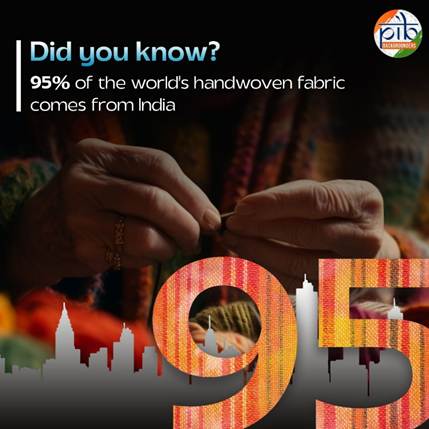
- Exports: India contributes 95% of global handwoven fabric and exported USD 10.94 bn worth of cotton yarn, fabrics, and made-ups in FY23.
- Initiatives:
- National Handloom Development Programme (NHDP) for raw materials, design, and marketing.
- Raw Material Supply Scheme (RMSS): 15% yarn subsidy.
- Pradhan Mantri MUDRA Yojana (PMMY): Low-interest loans to weavers.
- Workshed Scheme: Financial aid for family-based weaving units.
- Geographical Indication (GI): 104 registered handloom products.
- GeM Platform: 1.8 lakh weavers onboarded for direct sales.
Conclusion
National Handloom Day is not merely a tribute to India’s textile heritage but also a reminder of the Swadeshi spirit of self-reliance, sustainability, and economic nationalism. From the fight against colonial exploitation to the vision of Atmanirbhar Bharat, the movement underscores the enduring power of indigenous industries in shaping India’s economic and cultural identity.