
India’s Manufacturing Transformation
- 21 Aug 2026
In News:
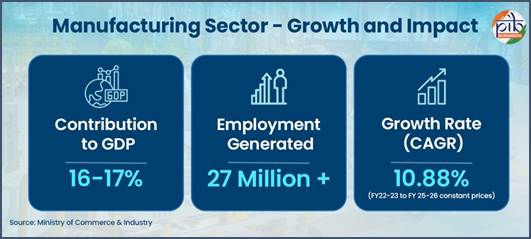
India’s manufacturing sector is increasingly becoming a pillar of Atmanirbhar Bharat and Viksit Bharat, with policy support shifting from import substitution towards globally competitive, technology-intensive and export-oriented production. Manufacturing contributes around 16–17% of GDP and employs over 27 million workers. Manufacturing GVA recorded a 10.88% CAGR during 2022–23 to 2025–26.
Emerging Strengths
The Make in India approach has diversified domestic production across defence, electronics, pharmaceuticals, textiles, automobiles, maritime equipment and renewable-energy technologies.
Defence manufacturing illustrates this transformation. Indigenous defence production reached ?1.78 lakh crore in FY 2025–26, compared with ?46,429 crore in 2014–15, while defence exports rose from ?686 crore in 2013–14 to ?38,424 crore in 2025–26. Positive Indigenisation Lists covering 5,521 items and the Srijan-DEEP platform are strengthening domestic supply chains.
The electronics sector has witnessed particularly rapid expansion. Electronics production increased nearly seven-fold to ?13.11 lakh crore in 2025–26, while exports reached ?4.24 lakh crore. Mobile-phone production rose to ?6.27 lakh crore, and 99.2% of phones used in India are now manufactured domestically.
India is also building strategic technological capabilities. Semicon India Programme has been complemented by Semicon 2.0, approved with an outlay of ?1.275 lakh crore. Twelve semiconductor projects involving over ?1.64 lakh crore have been approved, covering fabrication, packaging and advanced technologies.
In pharmaceuticals, India remains the third-largest producer by volume, supplies about 20% of global generic medicines, and has developed capacity for 218 APIs/KSMs/drug intermediates and 57 medical devices. Biopharma SHAKTI, with ?10,000 crore over five years, seeks to strengthen biopharmaceutical research and manufacturing.
Policy Ecosystem
The manufacturing push is supported by PLI schemes, PM GatiShakti, National Logistics Policy, PM MITRA Parks, ECMS, National Technical Textiles Mission and sector-specific programmes. Maritime manufacturing has also received a ?69,725-crore package, including the Shipbuilding Development Scheme and Maritime Development Fund.
Challenges and Way Forward
Despite significant progress, India must improve domestic value addition, R&D intensity, skilled manpower, MSME integration, logistics efficiency and component ecosystems. Production growth alone cannot ensure industrial competitiveness unless it creates deeper domestic supply chains and quality employment.
The way forward lies in moving from assembly-led manufacturing to innovation-led manufacturing, integrating MSMEs with global value chains, strengthening skilling and R&D, ensuring predictable policy frameworks and improving infrastructure. A competitive manufacturing base can simultaneously promote employment, exports, technological sovereignty, energy security and resilience of global supply chains, making it central to India’s transition towards Viksit Bharat 2047.