
Europe Wildfires: Climate Whiplash & Fire Clouds (PyroCb)
- 04 Aug 2026
In News:
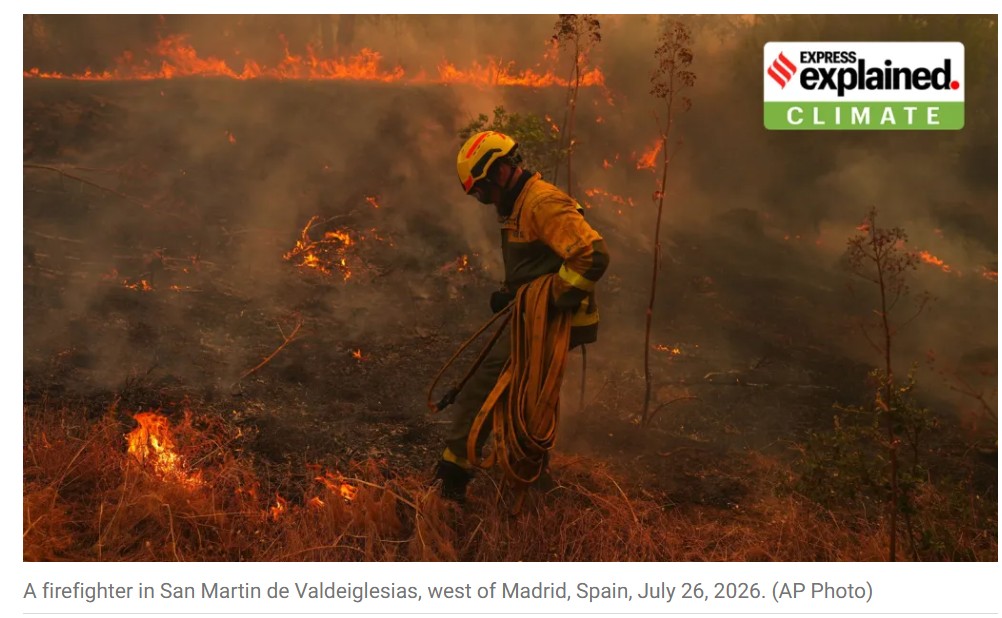
Intense wildfires across Greece, Spain, France, Portugal, and Italy have destroyed vast forest areas and triggered large-scale evacuations, highlighting the growing impact of climate change, climate whiplash, and fire-generated thunderstorms (PyroCb).
What are Europe’s Modern Wildfires?
Recent European wildfires are no longer ordinary seasonal fires. They have evolved into high-intensity, sixth-generation wildfires capable of generating their own weather systems, spreading rapidly, and causing extensive ecological, economic, and human losses.
Climate Whiplash
Climate whiplash refers to rapid shifts between contrasting weather extremes within a short period.
In wildfire-prone regions, an unusually wet season promotes rapid vegetation growth, which is followed by heatwaves and prolonged drought. The dried vegetation becomes a continuous layer of highly combustible fuel, greatly increasing wildfire intensity.
Fire Clouds (Pyrocumulonimbus or PyroCb)
Pyrocumulonimbus (PyroCb) is a fire-generated thunderstorm that develops over extremely intense wildfires.
Formation
- Extreme wildfire heat creates powerful updrafts carrying smoke, ash, and moisture high into the atmosphere.
- As the air cools, moisture condenses around ash particles, forming towering thunderclouds.
- These clouds generate lightning, strong winds, and localized rainfall.
- Lightning from PyroCb clouds can ignite new wildfires, while erratic winds make firefighting extremely difficult.
Major Drivers
Climate-related Factors
- Rising global temperatures.
- More frequent heatwaves and droughts.
- Increased atmospheric moisture leading to climate whiplash.
- Rapid vegetation growth during wet periods followed by drying.
Human & Land-use Factors
- Rural land abandonment and decline of traditional grazing.
- Accumulation of dry shrubs and undergrowth.
- Long-term fire suppression allowing excessive fuel build-up.
Impacts
- Large-scale destruction of forests and biodiversity.
- Soil degradation and increased carbon emissions.
- Toxic smoke affecting air quality and public health.
- Heavy economic losses (estimated €2.5 billion annually in the European Union).
- Record evacuations and damage to infrastructure.
Europe vs India: Wildfire Pattern
|
Europe |
India |
|
Intensified mainly by climate change and lightning from PyroCb |
Mostly human-induced (agricultural burning, accidental fires, NTFP collection) |
|
Major hotspots: Greece, Spain, Portugal, France, Italy |
Major hotspots: Northeast, Odisha, Chhattisgarh, Uttarakhand, Himachal Pradesh |
Way Forward
- Improve landscape management through controlled grazing, removal of dry biomass, and creation of firebreaks.
- Strengthen early warning systems, risk communication, and evacuation planning.
- Restore forests using diverse native, fire-resilient species.
- Promote sustainable rural livelihoods to reduce land abandonment.
- Enhance climate adaptation measures to address increasing weather extremes.