
AI Data Centers and Environmental Friction
- 17 Jun 2026
In News:
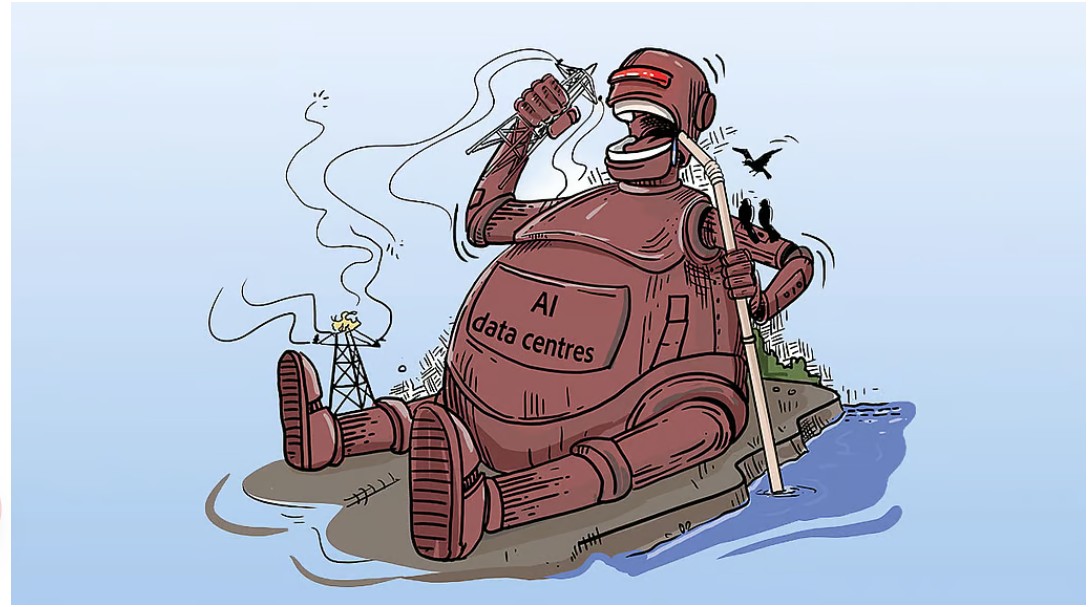
Global opposition to the environmental impact of Artificial Intelligence (AI) data centres is intensifying. Communities across the United States, Europe, Latin America, and Southeast Asia are increasingly resisting hyperscale AI infrastructure due to concerns over excessive water consumption, electricity demand, land use, and ecological degradation.
What are AI Data Centres?
AI data centres are hyperscale computing facilities equipped with high-performance processors designed to train, deploy, and operate Artificial Intelligence and machine learning models. Unlike conventional data centres that mainly store and process digital information, AI data centres require continuous, energy-intensive computing to handle billions of computations every second, resulting in significantly higher demand for electricity, cooling systems, and water.
Global Trends
Growing environmental concerns have led to increased scrutiny of AI infrastructure worldwide.
- In 2025, community protests reportedly delayed or blocked AI data centre projects worth about USD 152 billion.
- The European Union is encouraging smaller, energy-efficient regional data centres powered by renewable energy and waste-heat recovery.
- Several US States have introduced stricter approval processes and resource-impact assessments before permitting hyperscale facilities.
India's AI Data Centre Expansion
India is positioning itself as a major AI infrastructure hub.
- The Adani Group has announced plans to invest USD 100 billion in developing a 5 GW AI infrastructure platform by 2035.
- Google and the Adani Group are jointly establishing a 2 GW hyperscale data centre in Visakhapatnam, expected to be India's largest AI data centre.
- The project has been allotted 480 acres of land in a coastal zone, raising concerns regarding ecological sensitivity.
Environmental Concerns
AI data centres generate several environmental challenges:
- Extremely high electricity consumption, increasing pressure on already stressed power grids.
- Heavy water requirements for cooling, potentially affecting local drinking water availability.
- Land conversion in ecologically fragile coastal areas, agricultural land, and orchards.
- Increased heat generation, noise, and light pollution, affecting local ecosystems.
- Granting of utility subsidies and reported waivers from Environmental Impact Assessment (EIA) requirements for certain projects has raised concerns regarding environmental governance.
Challenges for India
India faces additional constraints owing to:
- Existing water scarcity and rising energy demand.
- Limited long-term local employment generated by highly automated hyperscale facilities.
- Balancing digital infrastructure growth with environmental sustainability.
- Need for stronger regulatory oversight of resource-intensive technology projects.
Way Forward
India should ensure that AI infrastructure development aligns with the principles of sustainable development by:
- Mandating comprehensive Environmental Impact Assessments (EIAs) for large AI data centres.
- Promoting renewable energy, water-efficient cooling technologies, and wastewater recycling.
- Rationalising electricity and water subsidies for resource-intensive projects.
- Encouraging distributed regional data centres rather than concentrating hyperscale facilities in ecologically sensitive areas.
- Establishing transparent standards for sustainable digital infrastructure while supporting India's AI ambitions.