
Urban Challenge Fund
- 16 Feb 2026
In News:
The Urban Challenge Fund (UCF) marks a structural shift from grant-based urban financing to market-linked, reform-driven and outcome-oriented urban infrastructure development.
Background & Rationale
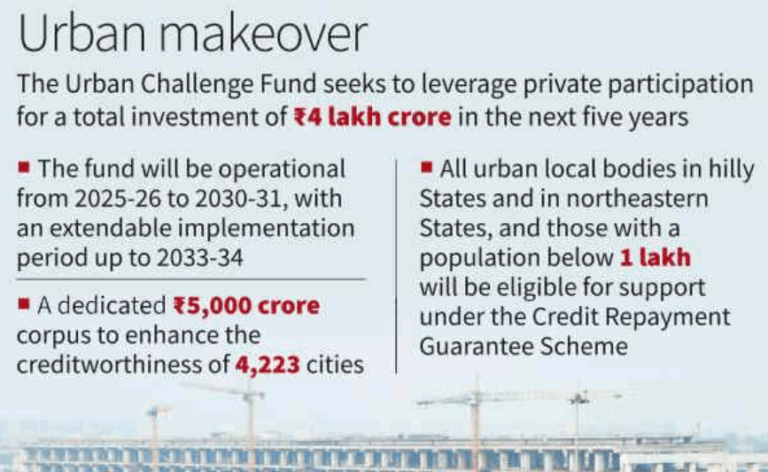
- Approved by the Union Cabinet; operational from FY 2025–26 to FY 2030–31 (extendable till FY 2033–34).
- Total Central Assistance (CA): ?1 lakh crore.
- CA limited to 25% of project cost, mandating minimum 50% financing from market sources.
- Expected to leverage ?4 lakh crore total investment over five years.
- Implements Budget 2025–26 vision: Cities as Growth Hubs, Creative Redevelopment, Water & Sanitation.
2. Financing Architecture
- Minimum 50% market mobilisation: municipal bonds, bank loans, PPPs.
- Remaining share: States/UTs/ULBs.
- Dedicated ?5,000 crore corpus to enhance creditworthiness of ~4,223 cities.
- Positions ULBs as a bankable asset class.
Credit Repayment Guarantee Scheme (?5,000 crore)
- For NE & Hilly States and smaller ULBs (<1 lakh population).
- Central guarantee:
- First loan: up to ?7 crore or 70% of loan (whichever lower).
- Subsequent loan: up to ?7 crore or 50% of loan.
- Enables projects of ?20–28 crore in smaller cities.
3. Challenge-Based Selection
- Competitive, transparent “challenge mode”.
- Linked to reforms, milestones & defined KPIs.
- Digital, paperless monitoring via MoHUA portal.
- Continuation of reforms mandatory for further fund release.
4. Reform-Linked Framework
Focus areas:
- Urban governance & digital reforms
- Market/financial reforms (creditworthiness)
- Operational efficiency
- Urban planning & spatial reforms (TOD, green infra)
- Project-specific KPIs with third-party verification
5. Project Verticals
- Cities as Growth Hubs – economic nodes, transit-oriented development, mobility, corridor development.
- Creative Redevelopment – CBD renewal, brownfield regeneration, climate resilience, decongestion (esp. NE & hilly states).
- Water & Sanitation – water supply, sewerage, stormwater, solid waste management, legacy waste remediation.
6. Coverage
- Cities ≥10 lakh population (2025 estimates).
- All State/UT capitals.
- Industrial cities ≥1 lakh population.
- Smaller & hilly/NE ULBs via guarantee mechanism.