
DHRUV64
- 20 Dec 2025
In News:
India has achieved a significant milestone in its semiconductor journey with the development of DHRUV64, the country’s first 1.0 GHz, 64-bit dual-core indigenous microprocessor. Developed by Centre for Development of Advanced Computing (C-DAC) under the Microprocessor Development Programme (MDP) of Ministry of Electronics and Information Technology (MeitY), DHRUV64 represents a major step towards technological self-reliance in advanced chip design, a core requirement for India’s digital and strategic autonomy.
Why Indigenous Microprocessors Matter
Microprocessors form the backbone of modern digital infrastructure, powering devices ranging from smartphones and automobiles to defence systems, satellites and medical equipment. For India, dependence on imported processors poses risks related to supply chain disruptions, strategic vulnerabilities and high foreign exchange outflows. Given that India consumes nearly 20% of globally manufactured microprocessors, indigenous capability is critical for sustaining the country’s expanding digital economy.
Key Features of DHRUV64
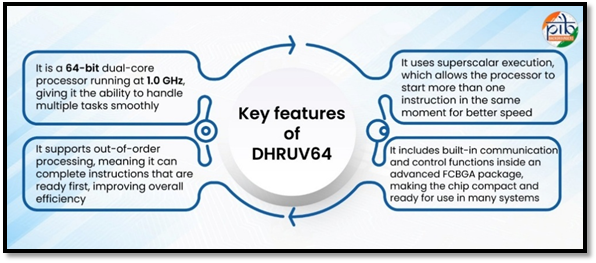
DHRUV64 incorporates modern architectural features that enhance efficiency, multitasking capability and system reliability. Its design enables seamless integration with diverse external hardware platforms, making it suitable for a wide range of applications, including:
- 5G and telecom infrastructure
- Automotive electronics
- Industrial automation
- Consumer electronics
- Internet of Things (IoT) ecosystems
The processor thus bridges the gap between strategic requirements and commercial scalability, a long-standing challenge in India’s chip ecosystem.
Strategic Significance for India
DHRUV64 strengthens India’s indigenous processor pipeline and reduces long-term reliance on foreign technologies. It contributes to:
- Secure digital infrastructure, especially for strategic sectors
- Technological sovereignty in critical electronics
- Capacity building for India’s large pool of chip design engineers
The development of DHRUV64 builds upon earlier indigenous processors such as SHAKTI (IIT Madras), AJIT (IIT Bombay), VIKRAM (ISRO–SCL) and THEJAS64 (C-DAC), collectively fostering a national processor ecosystem rather than isolated projects.
Role of RISC-V and Digital India RISC-V (DIR-V) Programme
DHRUV64 has been developed under the Digital India RISC-V Programme (DIR-V) initiative, which aims to establish India as a global hub for Electronics System Design and Manufacturing (ESDM).
RISC-V, being an open-source instruction set architecture, eliminates licence fees and enables shared innovation among academia, startups and industry. Its adoption:
- Lowers entry barriers for indigenous chip development
- Encourages collaborative research and standardisation
- Supports long-term scalability of Indian processors
Under DIR-V, DHRUV64 is the third fabricated chip, following THEJAS32 and THEJAS64, while next-generation DHANUSH and DHANUSH System-on-Chip (SoC) variants are currently under development.
Impact on R&D, Innovation and Human Capital
DHRUV64 provides a homegrown, affordable platform for startups, academia and industry to prototype and scale computing products without foreign dependence. It strengthens India’s R&D ecosystem by:
- Enabling low-cost system architecture experimentation
- Supporting indigenous product development
- Enhancing skill formation for semiconductor professionals
Given that India already accounts for nearly 20% of the world’s chip design workforce, such platforms are crucial for converting talent into domestic intellectual property.
Institutional and Policy Support Framework
India’s indigenous processor development is supported by a coordinated institutional ecosystem:
- MeitY: Provides policy direction, funding and long-term planning through programmes such as MDP, DIR-V, Chips to Startup (C2S) and the India Semiconductor Mission.
- C-DAC: Leads processor IP design, SoCs, development boards and toolchains, and is spearheading future RISC-V processors like Dhanush and Dhanush .
Key national programmes strengthening this ecosystem include:
- India Semiconductor Mission (ISM) – facilitating large-scale semiconductor investments
- Chips to Startup (C2S) – building manpower and fabless design capacity
- Design Linked Incentive (DLI) Scheme – incentivising semiconductor design
- INUP-i2i Programme – providing access to national nanofabrication facilities