
Tuvalu Island
- 21 Oct 2025
In News:
Tuvalu has formally become the 90th State Member of the International Union for Conservation of Nature (IUCN), marking a major step in strengthening its global environmental engagement. This development aligns with the nation’s growing efforts to protect its fragile ecosystems and advocate for climate-vulnerable island states.
About Tuvalu
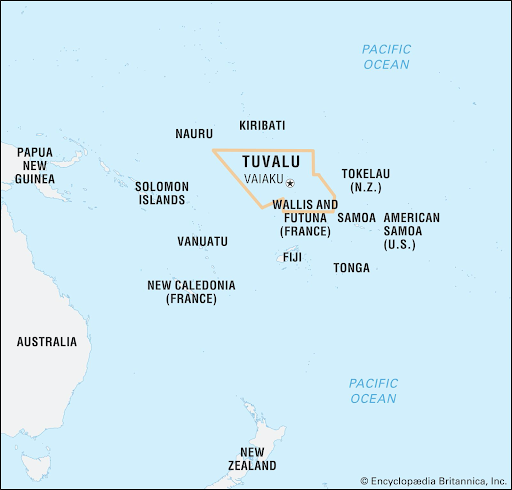
- Located in the west-central Pacific Ocean between Australia and Hawaii, Tuvalu (formerly the Ellice Islands) comprises nine low-lying atolls and coral islands spanning just 26 sq km—making it the fourth-smallest country in the world.
- With no point higher than 4.5 m above sea level, the country faces existential threats from sea-level rise, coastal erosion and climate change.
- It has an Exclusive Economic Zone (EEZ) of around 900,000 sq km, rich in marine biodiversity, coral reefs, fisheries and migratory seabirds.
- Tuvalu operates as a parliamentary democracy under a constitutional monarchy within the Commonwealth, recognizing King Charles III as head of state. Funafuti is the capital, and Tuvaluan and English are widely spoken. Its economy relies on subsistence activities, remittances, limited copra production, sale of postage stamps, and fisheries licensing revenues.
Significance of IUCN Membership
By joining IUCN, Tuvalu gains access to a global network of conservation experts, funding avenues and policy platforms. This membership strengthens its capacity to pursue:
- Climate change adaptation and resilience strategies
- Sustainable fisheries and marine resource management
- Community-driven conservation initiatives
- Partnerships with bodies such as the Green Climate Fund and Global Environment Facility
The move comes at a time when Pacific Island nations are pushing for stronger global action on climate change, adaptation financing and protection of ocean ecosystems.
Why It Matters
Tuvalu’s participation in IUCN brings heightened international focus on the plight of small island developing states (SIDS) facing climate-induced challenges. It enhances the country's voice in shaping global environmental governance and reinforces the need to safeguard vulnerable ecosystems and cultures deeply connected to the ocean.