
State of Food and Agriculture (SOFA) Report 2025
- 08 Nov 2025
In News:
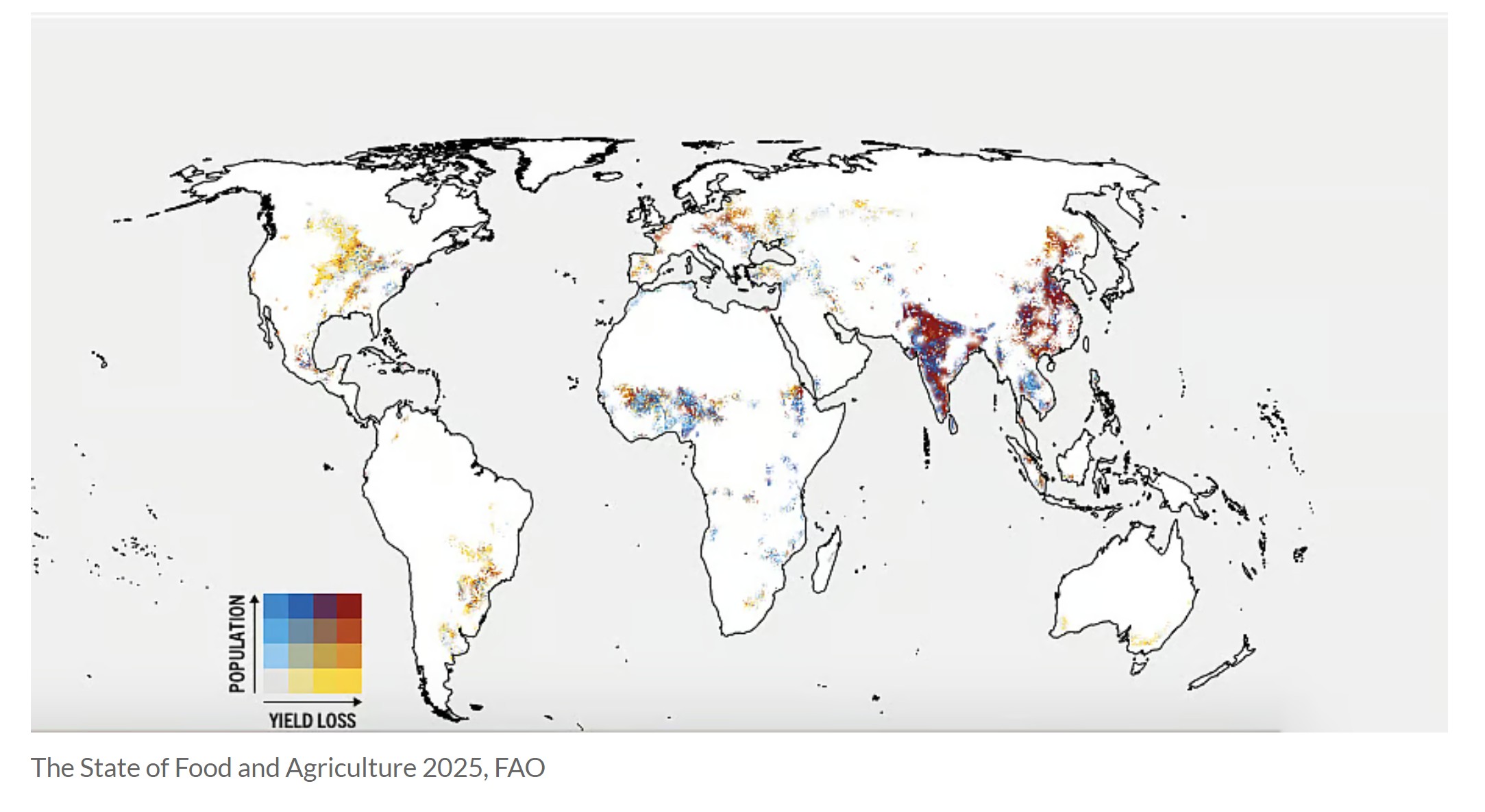
Land degradation has emerged as a silent but profound global crisis, undermining food security, livelihoods, and ecological sustainability. According to the State of Food and Agriculture (SOFA) Report 2025, published by the Food and Agriculture Organization (FAO) of the United Nations, nearly 1.7 billion people live in regions where agricultural productivity is declining due to human-induced land degradation. This degradation not only threatens global food systems but also exacerbates poverty, hunger, and malnutrition, particularly in developing regions.
Nature and Drivers of Land Degradation
The SOFA 2025 report provides a comprehensive assessment of how human activities have reshaped global land-use patterns over centuries. It identifies agricultural expansion as the primary driver of global deforestation, accounting for nearly 90 per cent of forest loss worldwide. While agriculture remains central to food production, its unregulated expansion has caused large-scale ecological stress.
In the 21st century (2001–2023), global agricultural land declined by 78 million hectares (mha), reflecting a complex land-use transition. Within this overall decline, cropland expanded by 78 mha, while permanent meadows and pastures contracted by 151 mha, indicating a shift towards more intensive cultivation. Regional variations were stark:
- Sub-Saharan Africa witnessed cropland expansion of 69 mha, accompanied by 72 mha of forest loss.
- Latin America recorded 25 mha of cropland growth, but lost 85 mha of forests, highlighting the trade-off between agricultural expansion and environmental sustainability.
Regional and National Impacts
The impacts of land degradation are unevenly distributed. The largest affected populations are concentrated in eastern and southern Asia, regions characterised by high population density and extensive land degradation. India stands out as one of the countries experiencing some of the highest yield gaps due to human-induced degradation, posing serious concerns for long-term food security and farmer incomes.
Globally, the report highlights that around 3.6 million hectares of croplands are abandoned every year, with land degradation playing a significant role. This abandonment reflects declining soil fertility, water stress, and unsustainable land management practices.
Land Degradation, Poverty and Nutrition
A critical contribution of the SOFA 2025 report lies in its identification of vulnerability hotspots, where land degradation overlaps with poverty, food insecurity, and malnutrition. The most severe intersections occur in Southern Asia and sub-Saharan Africa, regions already facing socio-economic stress.
Alarmingly, about 47 million children under the age of five, suffering from stunted growth, live in areas where severe yield losses are directly linked to land degradation. This underscores that land degradation is not merely an environmental issue but a human development challenge with intergenerational consequences.
Farm Size, Productivity and Degradation
The report also examines how farm size influences land management and degradation outcomes. Of the world’s approximately 570 million farms, nearly 85 per cent are smallholdings below 2 hectares, yet they cultivate only 9 per cent of global farmland. In contrast, just 0.1 per cent of farms larger than 1,000 hectares control about half of the world’s agricultural land.
Large farms often deploy advanced technologies and high external inputs to sustain yields. However, in intensively cultivated regions such as Europe and North America, historical degradation is often masked by heavy fertiliser and water use, leading to increasing economic and environmental costs.
Smallholder-dominated regions, especially in sub-Saharan Africa, face large yield gaps primarily due to resource constraints, limited access to credit, inputs, technology, and markets. Degraded soils in these regions respond poorly even when inputs become available, compounding vulnerability.
Despite these constraints, the world’s 500 million smallholder farmers play a vital role in global food systems, contributing 16 per cent of global dietary energy, 12 per cent of proteins, and 9 per cent of fats from crops, and supporting dietary diversity and rural livelihoods.
Scope for Reversal and Policy Implications
Importantly, the report highlights the significant potential for reversing land degradation. Restoring just 10 per cent of human-induced degradation on existing croplands could generate enough additional food to feed 154 million people annually. Furthermore, rehabilitating abandoned croplands could potentially feed between 292 and 476 million people, demonstrating that land restoration is a powerful tool for addressing global hunger.