
Emissions Gap Report 2025
- 07 Nov 2025
In News:
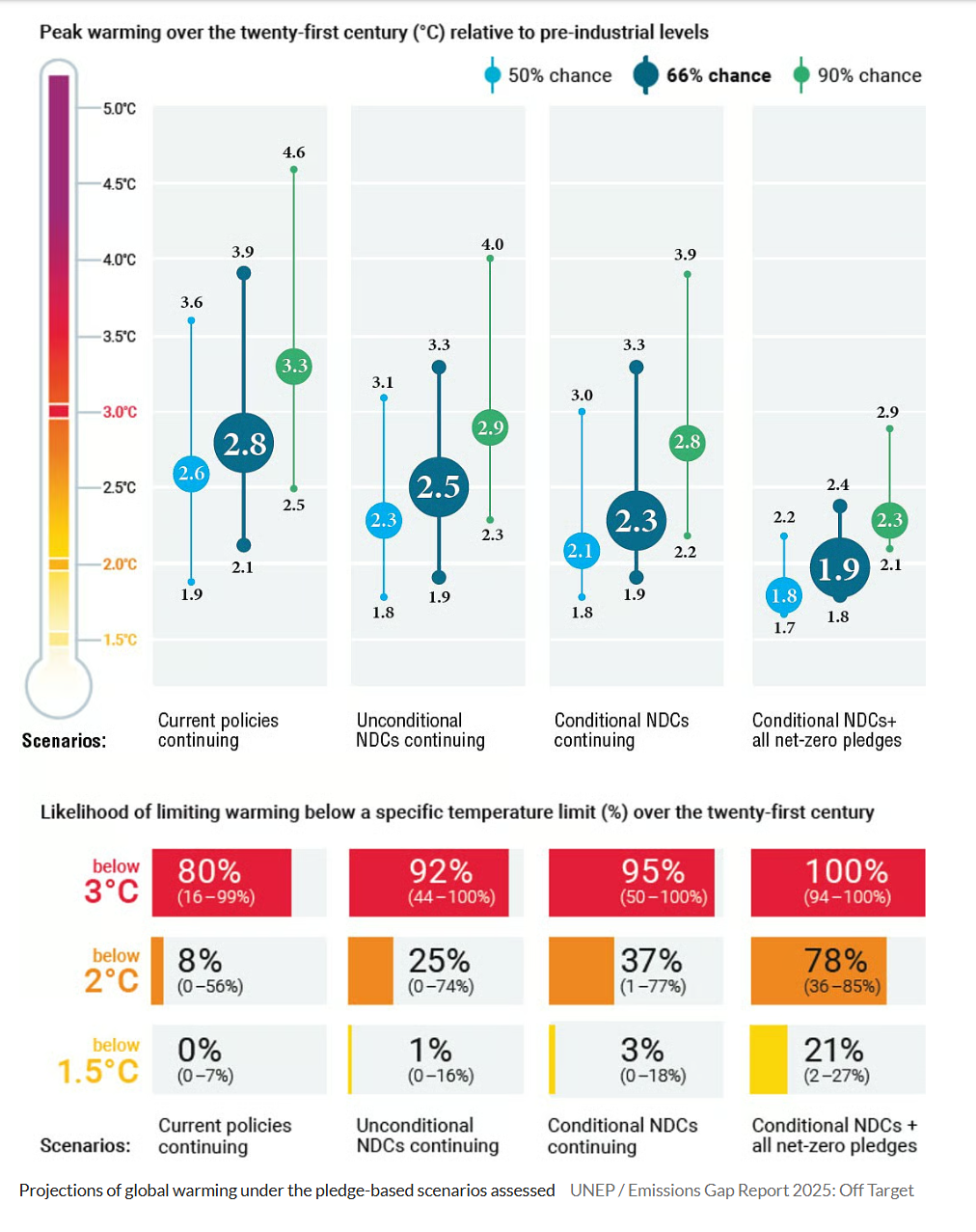
The United Nations Environment Programme (UNEP), in its Emissions Gap Report (EGR) 2025 – “Off Target”, has warned that despite updated climate pledges by countries, the world remains dangerously off course to meet the Paris Agreement temperature goals. Current trajectories indicate that global warming will reach 2.3–2.5°C this century, far exceeding the ambition of limiting warming to well below 2°C, preferably 1.5°C.
About the Emissions Gap Report
The Emissions Gap Report is an annual flagship publication of UNEP, co-produced with the UNEP Copenhagen Climate Centre (UNEP-CCC). It assesses the gap between where global greenhouse gas (GHG) emissions are heading under current pledges and where they should be to meet Paris Agreement targets. The report is released every year ahead of the UN Climate Change Conference of Parties (COP).
Key Findings of Emissions Gap Report 2025
- Marginal Progress in Climate Pledges
- Even if all countries fully implement their latest Nationally Determined Contributions (NDCs), global temperature rise is projected at 2.3–2.5°C.
- This is only a modest improvement from last year’s estimate of 2.6–2.8°C, and UNEP notes that much of this improvement is due to accounting and methodological changes, not real emission reductions.
- Rising Global Emissions
- Global GHG emissions rose by 2.3% in 2024, reaching a record 57.7 gigatonnes of CO? equivalent.
- This growth rate is over four times the annual average of the 2010s, signalling a reversal of earlier decarbonisation trends.
- Low Participation and Weak Ambition
- As of September 30, 2025, only 60 Parties, representing 63% of global emissions, had submitted or announced new 2035 NDCs.
- Even full implementation of existing NDCs would reduce global emissions by only 15% by 2035 (from 2019 levels), whereas a 55% reduction is required to stay on the 1.5°C pathway.
- Implementation Gap
- Most countries are not on track to meet even their 2030 targets, revealing a “huge implementation gap” between commitments and action.
- Overshoot of 1.5°C is Now Likely
- UNEP warns that global temperatures are very likely to exceed 1.5°C within the next decade.
- The policy focus has shifted from prevention to ensuring that this overshoot is temporary and limited, as every fraction of warming avoided reduces climate damages, health risks, and dependence on uncertain carbon dioxide removal (CDR) technologies.
Role of the G20
The G20, responsible for about 77% of global emissions (excluding the African Union), holds the key to closing the emissions gap. Despite some members submitting new NDCs, the group as a whole remains off track for its 2030 goals, undermining global mitigation efforts.
Geopolitical and Structural Challenges
UNEP highlights that geopolitical uncertainties, including the proposed withdrawal of the United States from the Paris Agreement in 2026, could offset climate gains. According to the report, this alone could negate around 0.1°C of the projected improvement.
Opportunities and Way Forward
Despite the bleak outlook, UNEP notes that the world is technically well-positioned to accelerate climate action due to:
- Rapidly declining costs of renewable energy technologies such as solar and wind.
- Proven solutions that can deliver economic growth, jobs, energy security, and health benefits alongside emission reductions.
UNEP’s Key Recommendations
To close the emissions gap, UNEP calls for:
- Removal of policy, governance, institutional, and technical barriers.
- A massive scale-up of climate finance and technology transfer to developing countries.
- Redesign of the international financial architecture to unlock affordable and predictable climate finance.