
Consumer Price Index (CPI) – Base Year 2024 = 100
- 14 Feb 2026
In News:
The Ministry of Statistics and Programme Implementation (MoSPI) released the first press note of the revised Consumer Price Index (CPI) series with base year 2024=100. The data reported retail inflation at 2.75% (Year-on-Year) for January 2026.
This marks the transition from the earlier base year 2012=100 to 2024=100, reflecting updated consumption patterns of households.
What is the Consumer Price Index (CPI)?
The Consumer Price Index (CPI) measures the change in retail prices of a fixed basket of goods and services consumed by households over time.
- It is India’s headline retail inflation indicator.
- Inflation is expressed as the percentage change in CPI over the same month of the previous year (YoY).
Compiled and Published By
- Published by: Ministry of Statistics and Programme Implementation
- Through: National Statistical Office (NSO)
- Price collection: Field Operations Division of NSO
Base Year Revision
- New Base Year: 2024 = 100
- Earlier Base Year: 2012 = 100
- Weights Source: Household Consumption Expenditure Survey (HCES) 2023–24
Base year revision ensures that:
- The consumption basket reflects current spending patterns.
- Inflation measurement aligns with structural changes in the economy.
Methodology Used in CPI (Base 2024)
1. Jevons Index (Item Level)
- Used at the individual item level.
- Calculates the average of price relatives (ratio of current to base prices).
- Reduces distortion caused by extreme values.
2. Young / Modified Laspeyres Index (Group Level)
- Aggregates item-level indices using fixed expenditure weights.
- Higher-weight items (e.g., food, rent) influence CPI more than low-spending items.
3. Combined CPI (All-India)
- Calculated by combining:
- Rural CPI
- Urban CPI
- Weighted by their respective shares in total consumption.
Thus, if rural consumption share is higher, rural inflation has greater influence on the all-India CPI.
Key Features of CPI (Base 2024=100)
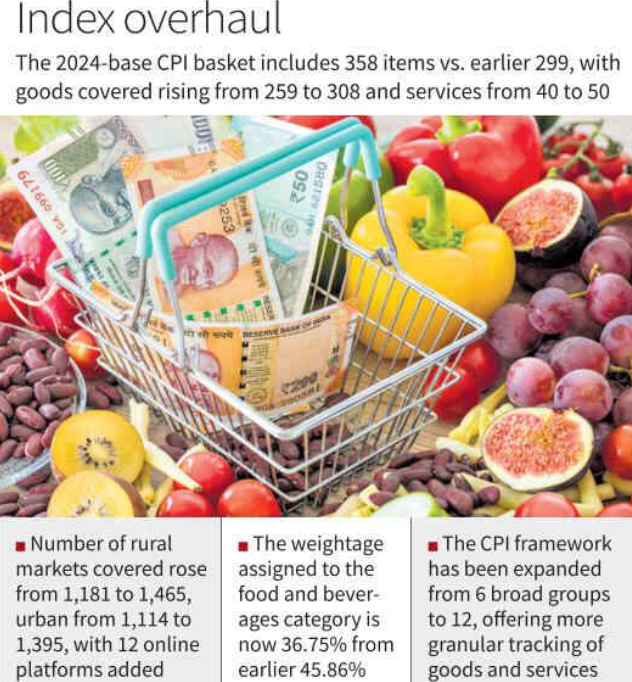
1. Expanded Classification (12 Groups Instead of 6)
Earlier CPI had 6 major groups. The new series follows an updated international classification system with 12 broader and clearer categories, including:
- Food & beverages
- Housing
- Health
- Education
- Transport
- Communication
- Recreation & culture
- Miscellaneous services
2. Expanded Basket of Items
- Earlier basket: 299 items
- New basket: 358 items
The revised basket better captures:
- Modern consumption habits
- Digital and service-based spending
3. Greater Focus on Services
With rising income levels, household expenditure on services has increased.
The new series includes:
- OTT subions
- Healthcare services
- Education fees
- Transport services
- Communication services
4. Inclusion of Online Prices
Given the growth of e-commerce: Prices from online platforms (e.g., air tickets, subions) are now incorporated.
5. Introduction of Rural House Rent
For the first time:
- Rural housing rent is included in CPI.
- This improves representation of rural housing consumption.
6. Official Administrative Price Data
For certain regulated items, official government data is used directly:
- Rail fares
- Postal charges
- Petrol & diesel
- LPG
This enhances accuracy and consistency.
7. Digital Price Collection
- Field officers now use tablets instead of paper schedules.
- Improves timeliness, data accuracy and monitoring.
8. Detailed Monthly Dissemination
CPI data is now available:
- All-India
- State-wise
- Rural and Urban separately
This strengthens regional inflation analysis.
Importance of CPI
- Monetary Policy Anchor
- Retail inflation targeting framework is based on CPI.
- Guides RBI’s monetary policy decisions.
- Indexation
- Used for Dearness Allowance (DA) revision.
- Impacts wage negotiations.
- Macroeconomic Assessment
- Reflects purchasing power.
- Indicates cost-of-living trends.