
Indus Waters Treaty: India Rejects Court of Arbitration’s Ruling
- 02 Sep 2026
In News:
The Indus Waters Treaty (IWT), 1960 between India and Pakistan has again come under strain after the Hague-based Court of Arbitration (CoA) ruled that the treaty continues to remain in force and that India cannot unilaterally place it in “abeyance”. India has rejected the ruling, questioning the court’s jurisdiction and constitution. The development highlights the complex intersection of transboundary water governance, national security, hydropower development and international dispute resolution.
Background
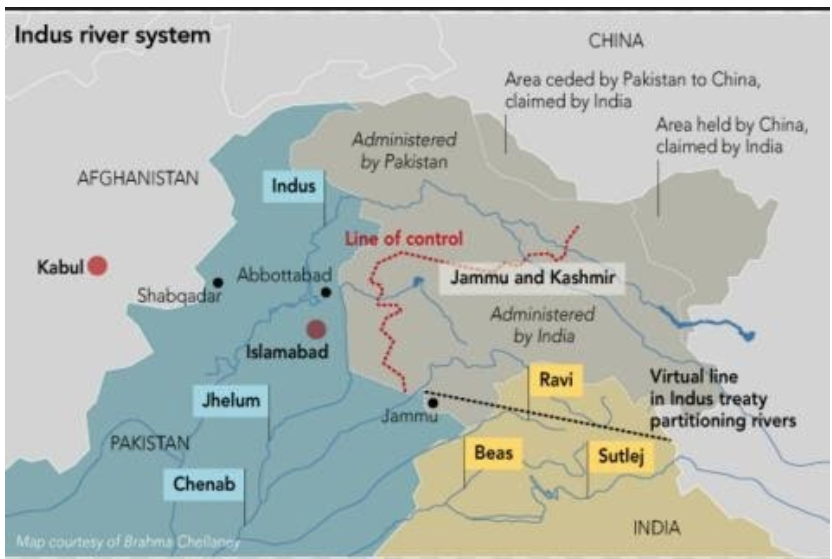
The IWT was signed in 1960 at Karachi, with the World Bank playing a key role in its negotiation. It divided the six Indus-system rivers between the two countries:
- Eastern Rivers – Ravi, Beas and Sutlej: allocated primarily to India.
- Western Rivers – Indus, Jhelum and Chenab: allocated primarily to Pakistan.
However, India is permitted to use the western rivers for specified purposes, including domestic use, agriculture and run-of-the-river hydropower, subject to treaty conditions.
Recent Dispute
The dispute concerns Indian hydropower projects, particularly the Kishenganga Hydroelectric Project (330 MW) on a tributary of the Jhelum and the Ratle Hydroelectric Project (850 MW) on the Chenab.
Pakistan has raised objections regarding aspects such as pondage and storage capacity.
A major disagreement has also emerged over the dispute-resolution mechanism. Pakistan pursued arbitration through the CoA, while India sought the appointment of a Neutral Expert. India argues that pursuing the two mechanisms simultaneously violates the treaty's intended sequential framework.
The Court of Arbitration, constituted through the World Bank process, has nevertheless proceeded with the case. Its recent ruling affirmed the continuing validity of the IWT and imposed interim restrictions relating to the Ratle project.
India’s Position
India has maintained that the CoA is illegally constituted and lacks jurisdiction over India's sovereign decision to place the treaty in abeyance. India did not participate in the arbitration proceedings and has instead engaged with the Neutral Expert mechanism.
The issue therefore extends beyond individual hydropower projects to a broader question: Can a treaty governing water rights be unilaterally suspended in response to developments outside the treaty's substantive framework?
Significance
The controversy has wider implications for India-Pakistan relations and international water governance.
First, it raises questions regarding the resilience of transboundary water treaties during periods of political and security tensions. Second, India's hydropower potential on the western rivers makes the treaty important for energy security and infrastructure development. Third, the dispute illustrates challenges arising from overlapping international dispute-resolution mechanisms.
Climate change further complicates the issue by altering river flows, precipitation patterns and the frequency of extreme hydrological events, making cooperative basin-level management increasingly important.
Way Forward
India and Pakistan need mechanisms that preserve the treaty's technical and institutional character while addressing legitimate concerns relating to water security, hydropower and changing hydrological conditions. Greater clarity regarding the hierarchy and sequencing of dispute-resolution mechanisms could reduce procedural conflicts.
At the same time, long-term management of the Indus basin should incorporate climate-resilient water planning, data sharing, ecological considerations and transparent technical dialogue.
Conclusion
The IWT has historically provided an institutional framework for managing one of the world's major transboundary river systems despite prolonged bilateral tensions. The present dispute demonstrates the need to reconcile sovereignty, national security, development requirements and international treaty obligations while maintaining sustainable management of shared water resources.