
Gravity and Earth’s Motion Through Space
- 12 Feb 2026
In News:
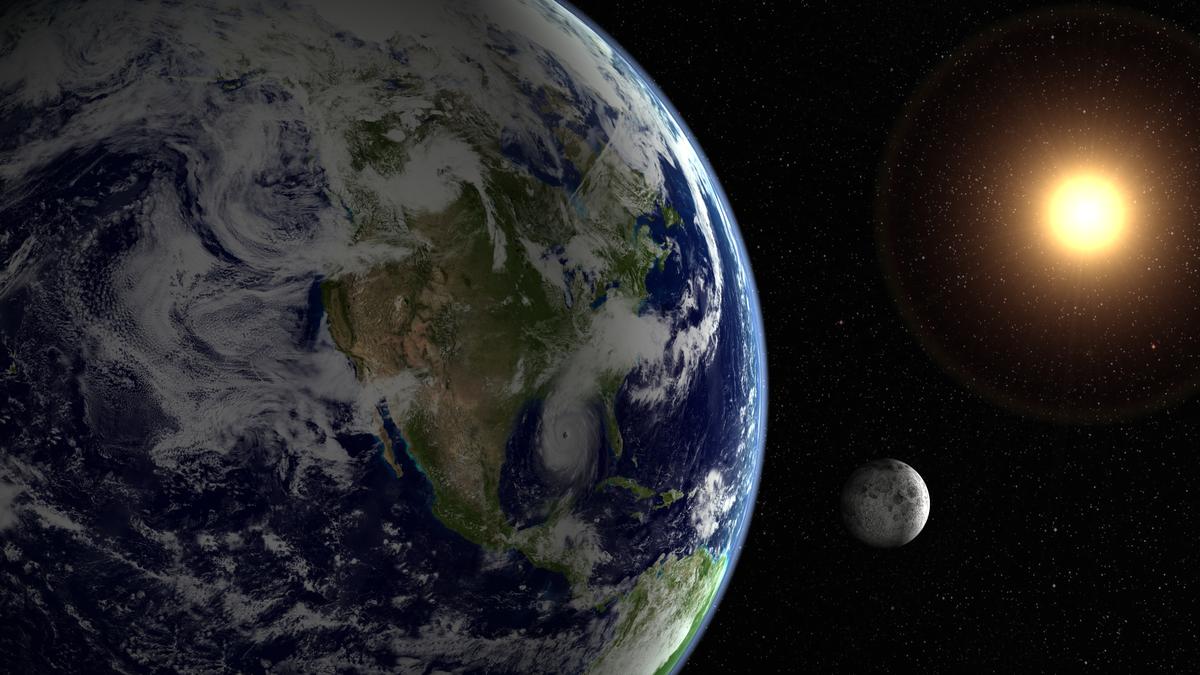
Gravity is the fundamental force governing the motion of celestial bodies and sustaining life on Earth. It not only keeps humans, oceans and the atmosphere anchored to the planet, but also ensures the stability of Earth’s orbit around the Sun and the Moon’s orbit around Earth.
Gravity as a Binding Force
Gravity acts as the universal attractive force between masses. On Earth, it:
- Keeps the atmosphere from escaping into space
- Holds oceans and land masses in place
- Enables life by maintaining stable environmental conditions
Without gravity, Earth’s atmosphere and hydrosphere would disperse into space, making life impossible.
Gravity as a Centripetal Force
Beyond pulling objects downward, gravity functions as a centripetal force-a force directed toward the centre of circular motion.
- It keeps the Moon in orbit around Earth.
- It keeps Earth revolving around the Sun.
In circular motion, centripetal force continuously changes the direction of velocity without necessarily altering speed. In planetary systems, gravitational attraction provides this inward pull.
Earth’s Planetary Motion
Due to gravitational attraction between Earth and the Sun:
- Earth completes one revolution every year.
- It travels nearly 1 billion kilometres along its orbital path annually.
- The planet moves at an average speed of approximately 1,07,000 km per hour (about 30 km per second).
These figures highlight the dynamic nature of planetary motion, even though such movement is imperceptible to humans due to uniform velocity and lack of external reference points.
Absence of Friction in Space
Unlike motion on Earth, where friction slows moving objects-planets move through the near-vacuum of outer space.
- Space offers negligible resistance.
- As a result, celestial bodies can continue moving without continuous energy input.
This aligns with Newton’s First Law of Motion, which states that an object in motion remains in motion unless acted upon by an external force.
Rejection of the Aether Hypothesis
In the 19th century, scientists proposed the existence of an invisible medium called “aether” through which light and celestial bodies were thought to move. However, the Michelson–Morley experiment disproved this hypothesis in 1887.
The experiment showed no detectable aether wind, confirming that Earth moves through empty space rather than through a resisting substance.
Scientific Significance
The understanding of gravity:
- Explains orbital mechanics and planetary stability
- Supports space exploration and satellite deployment
- Underpins astrophysics and cosmology
Gravity’s dual role, as a binding force on Earth and as a centripetal force in celestial mechanics—demonstrates its foundational importance in sustaining both terrestrial life and cosmic order.