
Indian Grey Hornbill
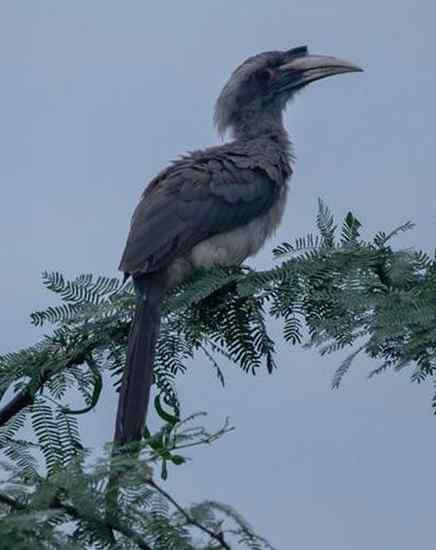
- 17 Jul 2026
In News:
After an absence of more than six decades from Gujarat's Gir forests, the Indian Grey Hornbill has successfully re-established its population through a landmark reintroduction programme undertaken by the Gujarat Forest Department.
About the Indian Grey Hornbill
- The Indian Grey Hornbill (Ocycerosbirostris) is a medium-sized arboreal bird belonging to the family Bucerotidae. It is one of the most widespread hornbill species of the Indian subcontinent, known for its distinctive calls, large curved bill and unique nesting behaviour.
- Unlike many hornbill species that inhabit dense forests, the Indian Grey Hornbill is highly adaptable and thrives in open deciduous forests, thorn scrublands, riparian forests, agricultural landscapes and even urban parks containing mature fruit-bearing trees.
- It is endemic to the Indian subcontinent and is distributed across India, Pakistan, Nepal and Bangladesh.
- According to the IUCN Red List, the species is classified as Least Concern (LC).
Key Features
The Indian Grey Hornbill measures about 24 inches in length and has grey-brown plumage, a long white-tipped tail, and a large curved bill topped by a prominent casque. The casque is generally smaller and more pointed in females.
One of its most remarkable adaptations is its mud-sealing nesting behaviour. During the breeding season, the female seals herself inside a tree cavity using mud, fruit pulp and droppings, leaving only a narrow slit through which the male supplies food until the chicks are ready to emerge.
The species is monogamous, usually found in pairs or small family groups, and is recognised by its loud, harsh calls and characteristic flight pattern of alternating wing beats and glides.
Ecological Importance
The Indian Grey Hornbill plays a significant ecological role as an important seed disperser. By consuming fruits and dispersing seeds over long distances, it contributes to forest regeneration and enhances plant diversity.
It also serves as a natural pest controller, feeding on insects, lizards, scorpions and other small animals, thereby helping maintain ecological balance in forests and nearby agricultural ecosystems.