
Thwaites Glacier
- 10 Feb 2026
In News:
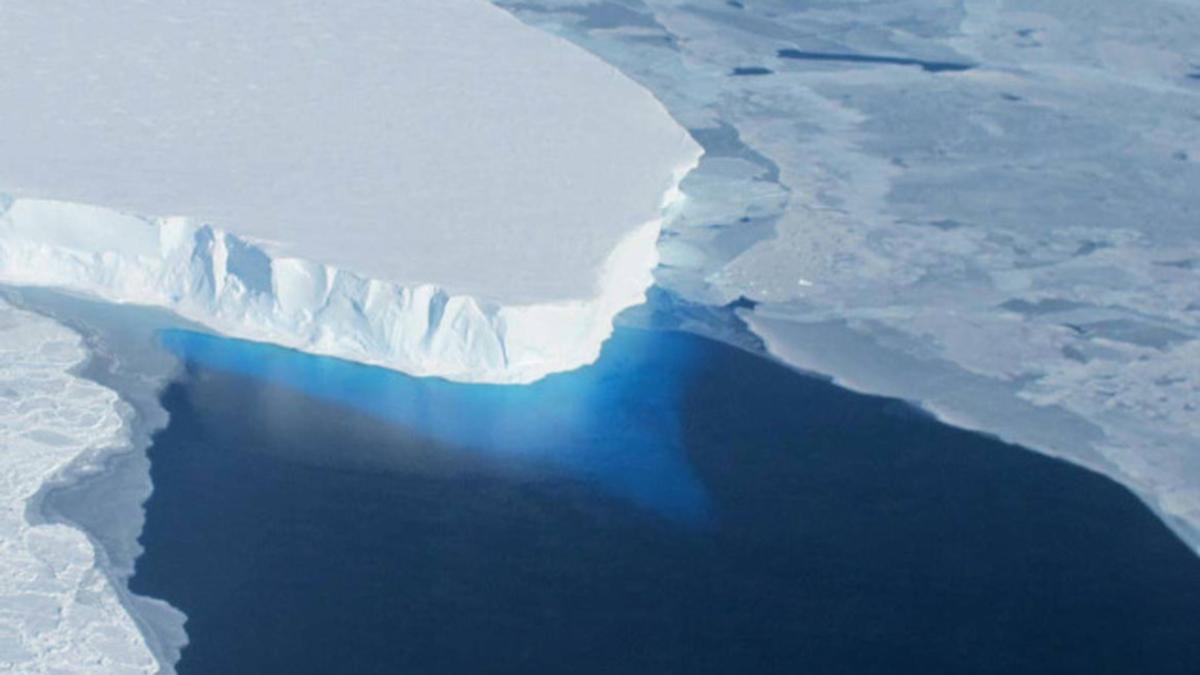
The Thwaites Glacier, often referred to in popular media as the “Doomsday Glacier”, is one of the most crucial glaciers in the world for understanding future sea-level rise. Located in West Antarctica, it is an outflow glacier of the West Antarctic Ice Sheet (WAIS) and drains into the Amundsen Sea.
Why is Thwaites Glacier Important?
- Mass and Size: Thwaites is among the largest glaciers in Antarctica, covering an area comparable to a large country.
- Climate Sensitivity: The WAIS, of which Thwaites is a key component, is recognised as one of the planet’s climate tipping elements, meaning its destabilisation could trigger irreversible changes.
Unique Physical Characteristics
A defining feature of Thwaites Glacier is its retrograde bed slope, the land beneath it slopes downward as one moves inland and lies below sea level. This makes the glacier highly vulnerable to warm ocean water intrusion.
- Warm seawater flows beneath the glacier’s floating ice shelf, melting it from below.
- The ice shelf currently acts as a buttress or brace, slowing the flow of ice into the ocean.
- As the ice shelf thins or fractures, this restraining effect weakens, causing the glacier to accelerate and lose ice more rapidly.
Current Scientific Observations
Scientific studies have confirmed that Thwaites Glacier is:
- Thinning steadily
- Retreating inland
- Already contributing to global sea-level rise
The rapid melting is strongly linked to human-induced climate change, particularly rising ocean temperatures.
Potential Global Impacts
- Sea-Level Rise: A complete collapse of Thwaites over a long period could raise global sea levels by around 0.5 metres.
- Cascade Effect: Thwaites acts as a barrier holding back neighbouring glaciers in the WAIS. Its weakening could destabilise adjacent ice masses, further accelerating sea-level rise.
- Coastal Risks: Higher sea levels would increase coastal flooding, shoreline erosion, storm surges, and threaten:
- Coastal cities
- Low-lying islands
- Ports and critical infrastructure
Why It Matters for the World
Although Thwaites Glacier is geographically remote and far from human settlements, its evolution has global consequences. Changes in this single glacier have the potential to reshape coastlines worldwide, making it a key focus area for climate science, global risk assessment, and international climate policy.