
Mons Mouton
- 11 Feb 2026
In News:
India’s upcoming Chandrayaan-4 mission marks a significant leap in its space exploration programme. Approved by the Union Government, Chandrayaan-4 is designed as India’s first lunar sample-return mission and is expected to launch around 2028, as indicated by ISRO leadership. It will be India’s most complex lunar endeavour to date.
Landing Site: Mons Mouton in the Lunar South Polar Region
ISRO scientists have identified the Mons Mouton region in the Moon’s South Polar area as the landing site. Mons Mouton:
- Is a mountain approximately 6,000 metres high
- Lies in the South Circumpolar Region (SCR)
- Is positioned on the rim of the South-Pole-Aitken Basin, the largest and oldest known impact basin on the Moon
- Is officially named after NASA mathematician Melba Roy Mouton
The region is scientifically significant because:
- It is located near permanently shadowed craters believed to contain water-ice deposits
- It receives long-duration sunlight, aiding power generation
- It offers clear line-of-sight communication with Earth
Selection of MM-4 Landing Zone
ISRO shortlisted four potential sites in the Mons Mouton area—MM-1, MM-3, MM-4 and MM-5. After detailed analysis using high-resolution datasets from the Orbiter High Resolution Camera (OHRC), MM-4 was selected.
Key terrain characteristics of MM-4:
- A 1 km × 1 km landing zone
- Mean slope: 5 degrees
- Mean elevation: 5,334 metres
- Highest number of hazard-free grids (24 m × 24 m)
- Least hazardous terrain percentage among shortlisted sites
Safe landing depends on terrain suitability combined with robust navigation, guidance and control systems.
Mission Architecture
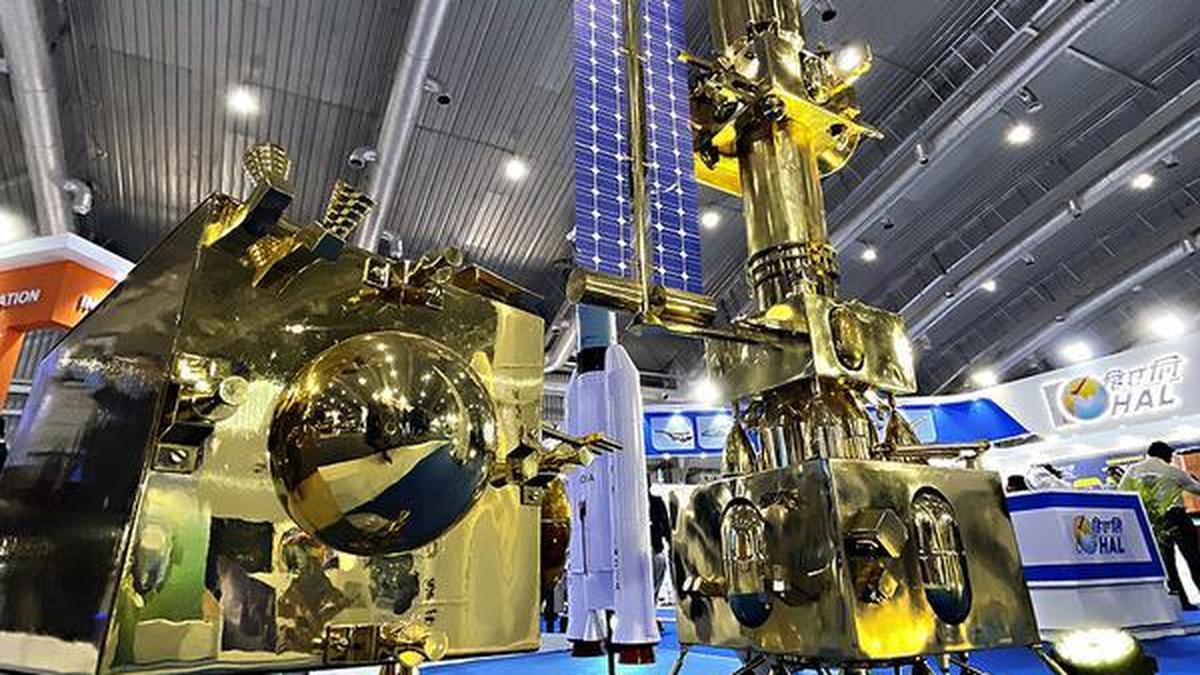
Chandrayaan-4 consists of five major components:
- Propulsion Module (PM)
- Descender Module (DM)
- Ascender Module (AM)
- Transfer Module (TM)
- Re-entry Module (RM)
The combined Descender Ascender stack will execute soft landing at the selected site. After collecting lunar samples, the Ascender Module will lift off from the Moon’s surface, transfer samples to the Return module, and enable re-entry to Earth.
This architecture makes Chandrayaan-4 technologically more complex than previous missions, as it involves:
- Precision soft landing
- Surface operations
- Lunar ascent
- Sample transfer
- Earth re-entry
Scientific Importance
The Mons Mouton region offers major scientific opportunities:
- Study of water-ice and volatile deposits
- Understanding the geological evolution of the South-Pole-Aitken Basin
- Insights into early Solar System history
- Assessment of lunar resources for future human missions