
Mangrove clam (Geloina erosa)
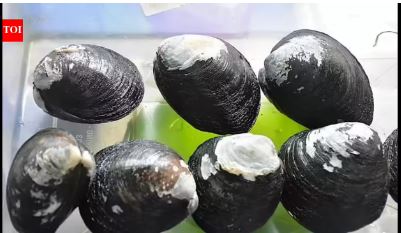
- 10 Feb 2026
The ICAR–Central Marine Fisheries Research Institute (CMFRI) has achieved a rare global scientific feat by successfully inducing captive breeding of the mangrove clam (Geloina erosa). This breakthrough enables controlled hatchery production of the species, offering a sustainable pathway for conservation, aquaculture, and ecosystem restoration.
About Mangrove Clam (Geloina erosa)
- Scientific name: Geloina erosa (also referred to in some literature as Polymesoda erosa)
- Common name: Mangrove clam / Mud clam
- Local name: “Kandal Kakka” (Northern Kerala)
- Type: Ecologically significant bivalve mollusc
Habitat and Distribution
- Found in organic-rich muddy substrates of intertidal mangrove and estuarine ecosystems
- Distributed across South and Southeast Asia
- Tolerates a wide salinity range, from brackish to near-freshwater conditions
- Deep-burrowing, semi-infaunal species; juveniles are more tide-independent
Key Ecological Characteristics
- Large Size:
- One of the world’s largest mangrove clams
- Reaches up to 10 cm shell width, making it valuable as a food resource
- Efficient Filter Feeder:
- Filters suspended particles and plankton
- Improves estuarine water quality through nutrient recycling
- Ecosystem Stabiliser:
- Burrowing behaviour stabilises sediments
- Enhances nutrient cycling
- Strengthens resilience of mangrove ecosystems
- Reproductive Biology:
- Sex differentiation based on gonad colour and structure (not external organs)
- Facilitates broodstock identification and reproductive studies
Scientific Breakthrough: Induced Breeding
CMFRI has achieved:
- Controlled spawning under captive conditions, reducing dependence on wild seed collection
- Complete life-cycle closure, successfully rearing the clam from embryo to larval stages and eventually to spat (around the 18th day)
- Hatchery-scale seed production feasibility
This represents a global first for this species and marks a major step in sustainable marine resource management.
Conservation and Aquaculture Applications
The hatchery-produced seeds can be utilised for:
- Grow-out farming:
- Suitable for estuarine aquaculture
- Requires minimal external feed and infrastructure
- Mangrove ranching:
- Release of juvenile clams into degraded mangrove habitats
- Aids ecological restoration
- Stock enhancement:
- Replenishes overexploited natural clam beds
- Reduces harvesting pressure on wild populations