
Supreme Court Recognises Right to Walk as a Fundamental Right
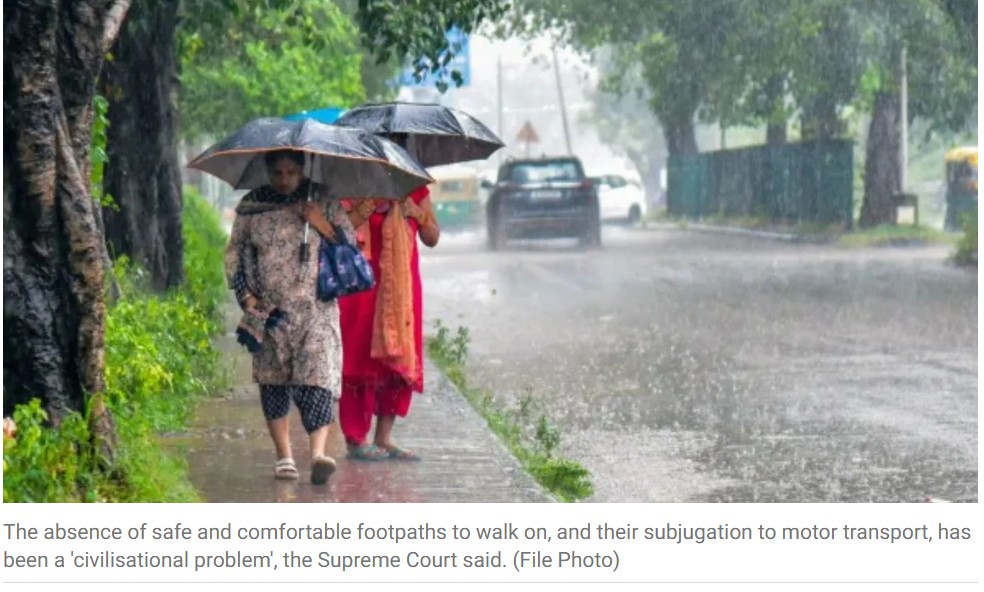
- 23 Jun 2026
In News:
In a landmark judgment, the Supreme Court of India held that the right to walk on safe and demarcated footpaths is a Fundamental Right under Part III of the Constitution. The Court ruled that pedestrian rights take precedence over the movement of motorised vehicles and called for a comprehensive legal framework to safeguard pedestrians.
Background
The judgment arose from the death of a five-year-old boy, who was fatally hit by a tanker while walking to school with his father. The accident occurred at a location lacking both a footpath and pedestrian crossing. While enhancing compensation from ?4.70 lakh to ?11.44 lakh, the Supreme Court used the case to address the broader issue of pedestrian safety and urban planning.
Constitutional Recognition of the Right to Walk
The Court held that the right to walk is an integral part of several Fundamental Rights guaranteed under the Constitution:
- Article 19(1)(a) – Freedom of speech and expression.
- Article 19(1)(b) – Freedom of peaceful assembly.
- Article 19(1)(c) – Freedom to form associations.
- Article 19(1)(d) – Freedom of movement.
- Article 21 – Right to life and personal liberty.
The Court observed that walking is the most basic and universal mode of human movement, predating motorised transport, and therefore access to safe footpaths is a constitutional entitlement.
Key Observations
The Supreme Court declared that wherever a road exists, there is a corresponding legal obligation to provide safe pedestrian infrastructure. It placed responsibility on Urban Development Authorities, Municipal Corporations, Municipalities, and Panchayats to construct, demarcate, maintain, and protect footpaths from encroachment.
The judgment emphasized that pedestrian rights take precedence over the convenience of motorised vehicles, criticizing automobile-centric urban planning that marginalizes walkers. Roads and public spaces, the Court noted, must serve all citizens rather than only vehicle users.
The Court further recognized that citizens suffering injury or loss due to the absence or poor maintenance of footpaths can seek constitutional remedies, restitution, and compensation, independent of relief available under the Motor Vehicles Act, 1988.
Need for Legal and Institutional Reforms
The Court observed that while the Motor Vehicles Act, 1988 regulates drivers and vehicles, it does not adequately recognize pedestrian rights. It urged the government to enact a dedicated law on pedestrian rights, clearly define institutional responsibilities, establish effective grievance redressal mechanisms, and create a full-time regulatory authority for planning, monitoring, and enforcing pedestrian infrastructure standards.
The judgment also highlighted the broader democratic significance of walking, describing it as a means of expression, assembly, association, and political participation, closely linked to India's constitutional values and the spirit of the freedom movement.
Significance
The ruling transforms access to safe footpaths from a governance objective into an enforceable constitutional obligation. It strengthens the rights-based approach to urban planning, promotes inclusive mobility, and aligns with sustainable, people-centric city development by prioritizing the safety and dignity of pedestrians.