
Institutionalising Artificial Intelligence for Culture and Languages in India
- 10 Feb 2026
In News:
India is increasingly leveraging Artificial Intelligence (AI) as a strategic instrument for preserving cultural heritage, strengthening linguistic diversity and enabling inclusive development. Recent policy initiatives reflect a shift from passive archival preservation to active cultural participation, positioning AI as “Technology for Humanity”.
Rationale: Cultural Diversity and Digital Inclusion
India’s linguistic landscape is vast and complex. As per Census 2011, India has 22 Scheduled languages and 99 Non-Scheduled languages, besides hundreds of tribal and mother tongues. This diversity, while culturally enriching, has historically created barriers in digital access, governance and knowledge dissemination.
AI is being deployed to bridge these divides by enabling multilingual access, voice-based interaction and enhanced discoverability of cultural and knowledge assets.
Language as Digital Public Infrastructure
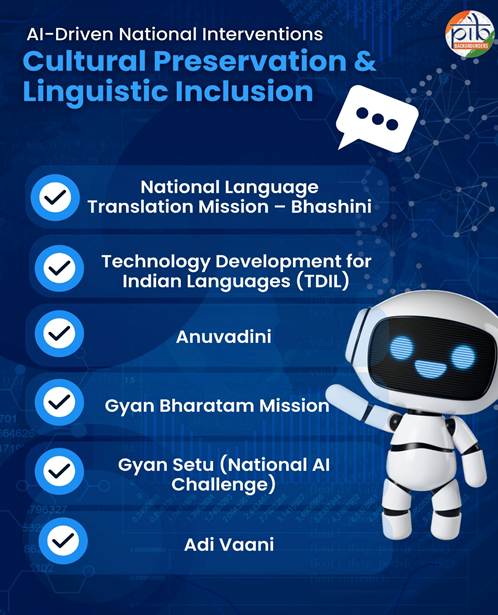
BHASHINI (National Language Translation Mission)
Launched in 2022, BHASHINI functions as a foundational multilingual AI infrastructure.
Key data:
- Supports voice services in 22 languages
- Provides text services in 36 languages
- Hosts 350 AI models and datasets
- Has processed over 4 billion language inferences
BHASHINI demonstrated real-time translation at Kashi Tamil Sangamam 2.0 and powered the multilingual “Kumbh Sah’AI’yak” chatbot at Maha Kumbh 2025, providing assistance in 11 languages.
Technology Development for Indian Languages (TDIL)
TDIL laid the groundwork for:
- OCR for Indian s
- Machine translation
- Speech-to-text and text-to-speech systems
It enabled scalable Indian language computing and supports platforms like BHASHINI.
Anuvadini (AICTE)
An AI-driven multilingual translation platform that:
- Translates technical and academic textbooks
- Strengthens Indian languages as mediums of higher education
- Integrates with repositories like e-KUMBH
AI for Cultural Heritage and Knowledge Systems
Gyan Bharatam Mission (2024–31)
- Approved outlay: ?482.85 crore
- Over 44 lakh manus documented in the Kriti Sampada repository
- Uses AI-based Handwritten Text Recognition (HTR) and metadata extraction
- Aims to create a National Digital Repository
This marks a transition from physical archives to shared digital access.
Gyan-Setu National AI Challenge
Focused on:
- Manu digitisation
- deciphering
- Knowledge dissemination
It generated deployable AI prototypes for heritage preservation.
Adi Vaani (Tribal Language Platform)
- Covers languages such as Santali, Bhili, Mundari and Gondi (beta phase)
- Enables real-time translation and speech tranion
- Supports subtitling of public advisories in tribal languages
This addresses the challenge of low-resource language datasets and oral traditions.
Economic Empowerment and Cultural Participation
AI is integrating artisans into digital value chains by:
- Enabling multilingual catalogues for GI-tagged products
- Providing voice-based digital interfaces for low-literacy users
- Supporting AI-based tagging for authenticity and provenance
This enhances market access while preserving cultural identity.
Key Challenges
- Digital literacy and infrastructure gaps in rural and tribal regions
- Limited datasets for endangered languages
- Manus held in private collections
- Authenticity and intellectual property concerns
- Need for offline-capable AI systems
Way Forward
Policy discourse, including NITI Aayog’s recommendations, emphasises:
- Expanding language AI as core digital public infrastructure
- Developing open-source AI models
- Creating verifiable digital credentials for artisans
- Promoting multi-stakeholder collaboration
Conclusion
With initiatives such as BHASHINI (2022) and the ?482.85 crore Gyan Bharatam Mission (2024–31), India is institutionalising AI as a guardian of its civilisational heritage. By aligning technological progress with linguistic inclusion and livelihood generation, India is transforming AI from a tool of automation into an instrument of cultural resilience and social empowerment.