
Infrastructure-Led Nation Building
- 16 Jun 2026
In News:
The Press Information Bureau (PIB) has released a comprehensive report highlighting the transformation of India's physical, digital, financial and social infrastructure over the last twelve years. The report showcases progress across transport, logistics, housing, water, energy and Digital Public Infrastructure (DPI), reflecting the government's focus on infrastructure-led economic growth.
Infrastructure-Led Nation Building
Infrastructure has emerged as a key driver of economic integration, employment generation, ease of living and global competitiveness. India's approach has shifted from isolated projects to integrated, multimodal infrastructure planning, combining transport, logistics, digital connectivity and social infrastructure to support long-term economic development.
Key Achievements
Transport & Logistics
- Railway electrification increased from about 20% (pre-2014) to 99.6% (69,873 route km) by March 2026.
- 162 Vande Bharat and 60 Amrit Bharat Express services are operational.
- Kavach 4.0, India's indigenous Automatic Train Protection system, has been deployed over 3,103 route km and installed on 4,277 locomotives, reducing consequential train accidents from 135 (2014-15) to 16 (2025-26).
- India possesses the world's second-largest road network (63.73 lakh km), while four-lane and above National Highways expanded from 18,371 km (2014) to 45,516 km (2026).
- Under PMGSY, 99.6% of eligible rural habitations are now connected by all-weather roads.
Civil Aviation, Metro & Maritime
- Operational airports increased from 74 to 165 under the UDAN Scheme, benefiting 1.64 crore passengers across 665 routes.
- Digi Yatra has facilitated over 9.3 crore seamless passenger journeys across 38 airports.
- Metro rail network expanded from 248 km to over 1,155 km across 26 cities, making India home to the world's third-largest metro network.
- Major port capacity nearly doubled from 873 MMTPA to 1,726 MMTPA, while average cargo turnaround time reduced from 94 hours to 48.8 hours.
- Operational National Waterways increased from 5 to 111, with inland cargo movement rising from 29 MMT to 218 MMT.
Social Infrastructure & Energy
- Under Jal Jeevan Mission, rural tap water coverage increased from 17% (3.23 crore households) in 2019 to 81.94% (15.86 crore households) by June 2026.
- PMAY-Urban has completed 98.10 lakh houses out of 125.31 lakh sanctioned, with 96% registered in women's ownership. PMAY-Gramin has completed 3.06 crore houses.
- India's installed power generation capacity reached 532.74 GW, while the power deficit declined from 4.2% (2014) to 0.03% (2025-26).
- LPG coverage expanded from 55.9% to 107.2%, covering 33.39 crore consumers.
Digital Public Infrastructure (DPI)
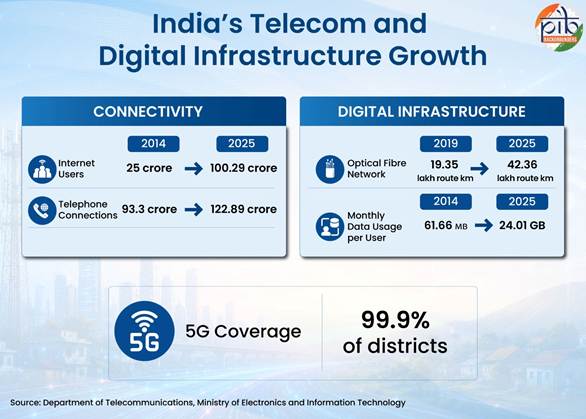
- Internet connections increased to 100.29 crore, while average monthly data consumption rose from 61.66 MB (2014) to 24.01 GB (2025).
- The JAM Trinity now comprises over 144 crore Aadhaar numbers and 57.71 crore Jan Dhan accounts.
- UPI processed 2,264 crore transactions worth ?29.53 lakh crore in March 2026 and is operational in eight countries.
- Since 2015, PRAGATI has reviewed 382 projects worth over ?85 lakh crore, resolving 2,958 implementation bottlenecks.
Challenges
Despite significant progress, challenges remain in land acquisition, last-mile approvals, difficult Himalayan terrain, underutilisation of PM-WANI public Wi-Fi, and delays in infrastructure projects due to litigation and administrative coordination.
Way Forward
The focus should remain on expanding Kavach across the remaining railway network, achieving universal rural tap water coverage under the extended Jal Jeevan Mission, strengthening Infrastructure Investment Trusts (InvITs) for infrastructure financing, accelerating industrial infrastructure under the BHAVYA initiative, and expanding India's Digital Public Infrastructure, including UPI and DigiLocker, globally.