
National Handloom Day
- 11 Aug 2026
In News:
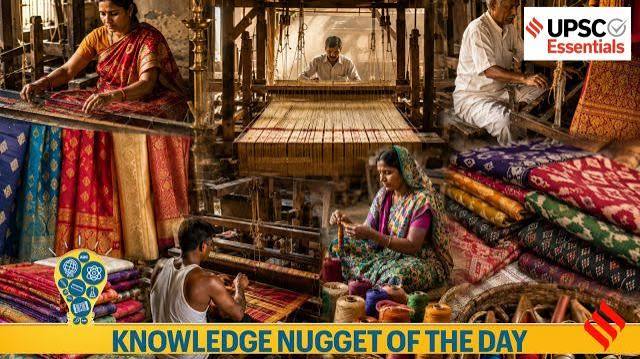
National Handloom Day, observed on 7 August, highlights the economic, social and cultural importance of India’s handloom sector. Despite supporting millions of livelihoods, the sector faces challenges such as declining returns, fragmented markets and the gradual disappearance of traditional weaving skills.
Historical and Economic Significance
India has a centuries-old handloom tradition. Indian textiles were historically traded across continents and contributed significantly to the country’s manufacturing and commercial importance. During the freedom struggle, handloom became an instrument of economic resistance. The Swadeshi Movement of 1905 promoted the boycott of British textiles, while Mahatma Gandhi’s charkha became a symbol of self-reliance.
The sector continues to have substantial economic significance. It provides livelihoods to more than 35 lakh weavers and allied workers across over 31 lakh households, with women constituting nearly 70% of the workforce. It also accounts for nearly 15% of India's cloth production, making it an important source of rural non-farm employment.
Challenges Facing the Sector
The major concern is the declining economic viability of weaving. Lower returns, fragmented markets and inadequate access to buyers are pushing younger generations away from the profession. As traditional skills are no longer consistently transmitted within families, several lesser-known weaving traditions face the risk of extinction.
The loss of a weave represents more than the disappearance of a commercial product. It also means the loss of traditional knowledge, design traditions and cultural identity accumulated over generations.
Government Support and Emerging Opportunities
The National Handloom Development Programme focuses on skill development, design innovation, technology adoption, branding and market access. Greater integration with e-commerce and export markets can help artisans reach consumers directly.
The Office of the Development Commissioner for Handlooms, in collaboration with UNESCO, has also been working towards identifying and documenting languishing and endangered weaves. Promotion of GI-tagged handloom products can further strengthen their market identity.
Examples such as the revival of Tangaliya weaving in Gujarat, cluster-based development in Badturang village of Odisha, and the growing popularity of Siddipet Gollabhama sarees show that traditional crafts can regain economic relevance when design, institutional support and market access come together.
Making Handloom Aspirational
The next phase of policy should move beyond simply preserving handloom traditions and make them economically viable and aspirational for younger generations. Contemporary designs, collaborations with designers, digital storytelling, influencers and limited-edition collections can position traditional Indian weaves as premium lifestyle products.
India should also expand the global presence of its handlooms by leveraging growing international demand for authentic, sustainable and handcrafted products. This would require stronger branding, quality standards, GI protection and action against cultural misappropriation.
Way Forward
A major gap is the inadequate measurement of the handloom economy. Better data on employment, household incomes, exports, GDP contribution and other economic indicators would enable more effective policymaking.
The focus should therefore be on improving incomes, strengthening market access, preserving traditional skills and connecting Indian handlooms with contemporary and global markets.
Conclusion
Indian handloom is simultaneously an economic sector, a source of rural livelihoods and a repository of cultural heritage. The objective should not be merely to preserve it as a historical tradition, but to ensure that it remains profitable, innovative and aspirational for future generations.
What are the costs of population decline?
- 11 Nov 2024
In News:
India has been witnessing significant demographic changes due to decades of family planning policies. This has led to declining fertility rates in certain States, particularly in the southern and smaller northern regions.
Introduction: Demographic Shift in India
- Southern States’ Fertility Trends: States like Tamil Nadu, Kerala, Andhra Pradesh, and Telangana have fertility rates below the replacement level (around 1.4–1.5), while Bihar, Uttar Pradesh, and Madhya Pradesh have higher fertility rates (2.6–3).
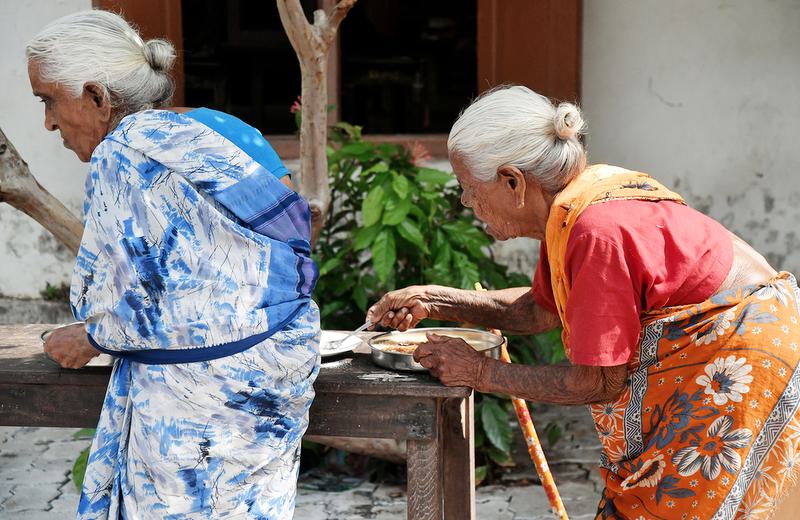
- Ageing Population: Southern States face the challenge of an ageing population, with Kerala projected to have 22.8% of its population aged 60+ by 2036, while Bihar will have only 11%.
Economic and Health Impact of Population Decline
- Economic Consequences:
- Dependency Ratio: The old-age dependency ratio (the number of elderly for every 100 working-age individuals) has increased significantly in some States. Kerala, for example, had a ratio of 26.1 in 2021, signaling a crisis point.
- Loss of Demographic Dividend: States with declining fertility rates face the loss of a demographic dividend, i.e., the economic benefit from a large working-age population, which is increasingly burdened by elderly dependents.
- Health Expenditure: Rising healthcare costs, especially for cardiovascular diseases in southern States, will strain public health systems. The southern States, although comprising one-fifth of India's population, spent 32% of the country’s total out-of-pocket expenditure on cardiovascular diseases in 2017-18.
- Challenges of Low Fertility:
- Declining Labour Force Participation: Policies encouraging higher fertility may also reduce women’s labour force participation, undermining the economic growth of these States.
- Economic Pressures: Southern States, despite higher tax contributions, face a diminished share of central resources due to slower population growth. This is a point of concern in inter-State fiscal relations.
Political Implications of Uneven Population Growth
- Impact on Federal Structure:
- The uneven population growth across States will lead to significant changes in the delimitation of constituencies after the current freeze on seat allocation in Parliament expires in 2026.
- Redistribution of Lok Sabha Seats: Northern States like Uttar Pradesh and Bihar will likely gain more seats, while southern States like Tamil Nadu, Kerala, and Andhra Pradesh will lose seats due to their declining population shares.
- Challenges in Federal Relations:
- Southern States’ economic contributions through taxes are disproportionate to the resources they receive from the central pool, leading to growing tensions between high-growth and slow-growth regions.
- The shift in political power post-delimitation could increase regional disparities, potentially leading to political tensions between States.
Solutions and Policy Recommendations
- Pro-Natalist Policies:
- Southern States are considering pro-natalist policies to incentivize higher fertility rates. However, such measures have been largely unsuccessful internationally, especially when women’s economic independence and educational choices are restricted.
- International Experience: Attempts to incentivize childbearing, without addressing broader socio-economic factors like gender equality, have generally failed in other nations. Maternity benefits, gender-neutral parental leave, and childcare support are key to increasing fertility sustainably.
- Gender Equity and Work-Family Balance:
- Work-family policies that support paid maternity and paternity leaves, affordable childcare, and gender-neutral employment policies are essential to empower women to balance family and career.
- Studies indicate that countries with higher gender equity have better fertility rates because women are less likely to forgo childbearing for career reasons.
- Increasing Retirement Age:
- One way to reduce the old-age dependency ratio is to increase the retirement age, which would allow older workers to remain employed longer and support a sustainable economy.
- Social Security and pension reforms should also be considered to accommodate the ageing workforce and reduce the economic burden on younger generations.
- Managing Migration:
- Migration policies should be adjusted to manage the influx of economic migrants into southern States, who contribute to the economy but continue to be counted in their home States for fiscal and political purposes.
- Migration-based policy reforms could address the challenge of an ageing population in states with declining fertility while ensuring equitable resource distribution across States.