
FAO’s Global Forest Resources Assessment 2025
- 25 Oct 2025
In News:
India has moved up to the 9th position globally in total forest area, according to the Global Forest Resources Assessment (GFRA) 2025, released by the Food and Agriculture Organization (FAO) in Bali. The report reflects India’s steady progress in forest conservation, afforestation, and sustainable land management.
About the Global Forest Resources Assessment (GFRA)
- Published by: Food and Agriculture Organization (FAO) of the United Nations
- Frequency: Every five years
- Objective: To provide comprehensive data on the world’s forests, covering their extent, condition, management, and use.
- 2025 Theme: Strengthening forest resilience for sustainable development.
Global Findings (GFRA 2025)
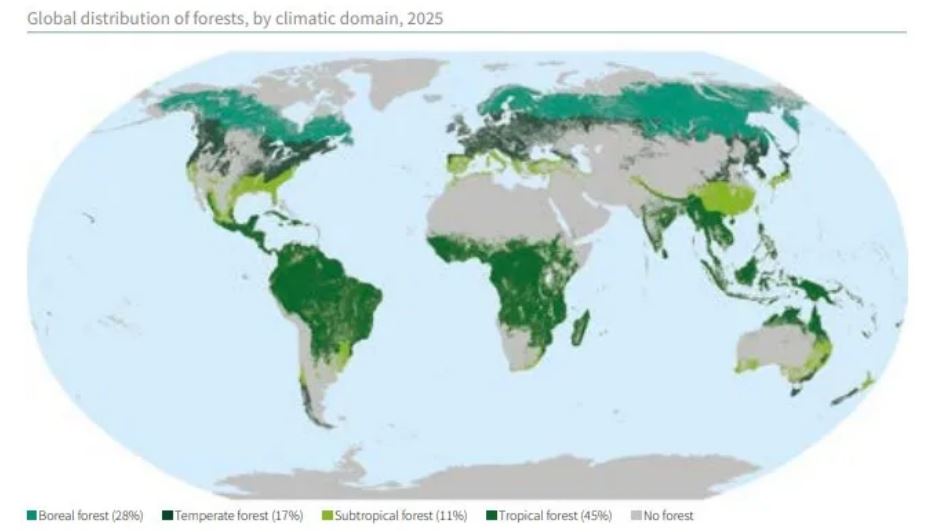
- Total global forest cover:4.14 billion hectares, accounting for 32% of the Earth’s land area, equivalent to 0.5 hectares per person.
- Top 10 countries by forest area:Russia, Brazil, Canada, USA, China, Democratic Republic of the Congo, Australia, Indonesia, India, and Peru.
- Deforestation trends:Global deforestation has slowed in the past decade, but the world continues to lose about 10.9 million hectares of forest annually (2015–2025)—a rate still considered alarming.
India’s Forest Status and Achievements
- Total forest cover:72.7 million hectares, accounting for about 2% of global forest area.
- Global ranking:
- 9th in total forest area (up from 10th position in the previous assessment).
- 3rd in annual forest area gain, after China and Russia, highlighting successful afforestation initiatives.
- Agroforestry Leadership:India and Indonesia together contribute over 70% of the world’s agroforestry areas, reflecting strong integration of trees in farmlands.
Significance of India’s Achievement
- Climate Change Mitigation:Expanding forest area enhances carbon sequestration, supporting India’s Nationally Determined Contributions (NDCs) under the Paris Agreement.
- Biodiversity Conservation:Forests serve as habitats for India’s rich flora and fauna, aiding ecosystem balance and wildlife protection.
- Livelihood and Socioeconomic Support:Around 275 million people in India depend on forests for subsistence, employment, and traditional livelihoods.
- Land and Water Security:Forests play a crucial role in soil conservation, groundwater recharge, and regulating hydrological cycles, particularly in fragile ecosystems.
- Global Commitments:Aligns with India’s obligations under the UN Decade on Ecosystem Restoration (2021–2030) and Sustainable Development Goal 15 (Life on Land).
Government Initiatives Driving Forest Growth
- Ek Ped MaaKe Naam Campaign:A nationwide movement encouraging citizens to plant trees in honor of their mothers, fostering personal and cultural ties to environmental conservation.
- National Mission for a Green India (GIM):A key component of the National Action Plan on Climate Change (NAPCC), targeting increased forest cover and improved forest quality to enhance carbon sinks.
- Compensatory Afforestation Fund Act, 2016 (CAMPA):Mandates compensatory levies for diversion of forest land for non-forest purposes and channels these funds into afforestation and eco-restoration activities.
- Eco-Sensitive Zones (ESZs):Buffer zones around Protected Areas, National Parks, and Wildlife Sanctuaries to limit harmful anthropogenic activities and protect ecological integrity.
- Joint Forest Management (JFM):Promotes community participation in forest conservation and regeneration by forming partnerships between local communities and forest departments.