
Giant Malabar Squirrel
- 04 Jun 2026
In News:
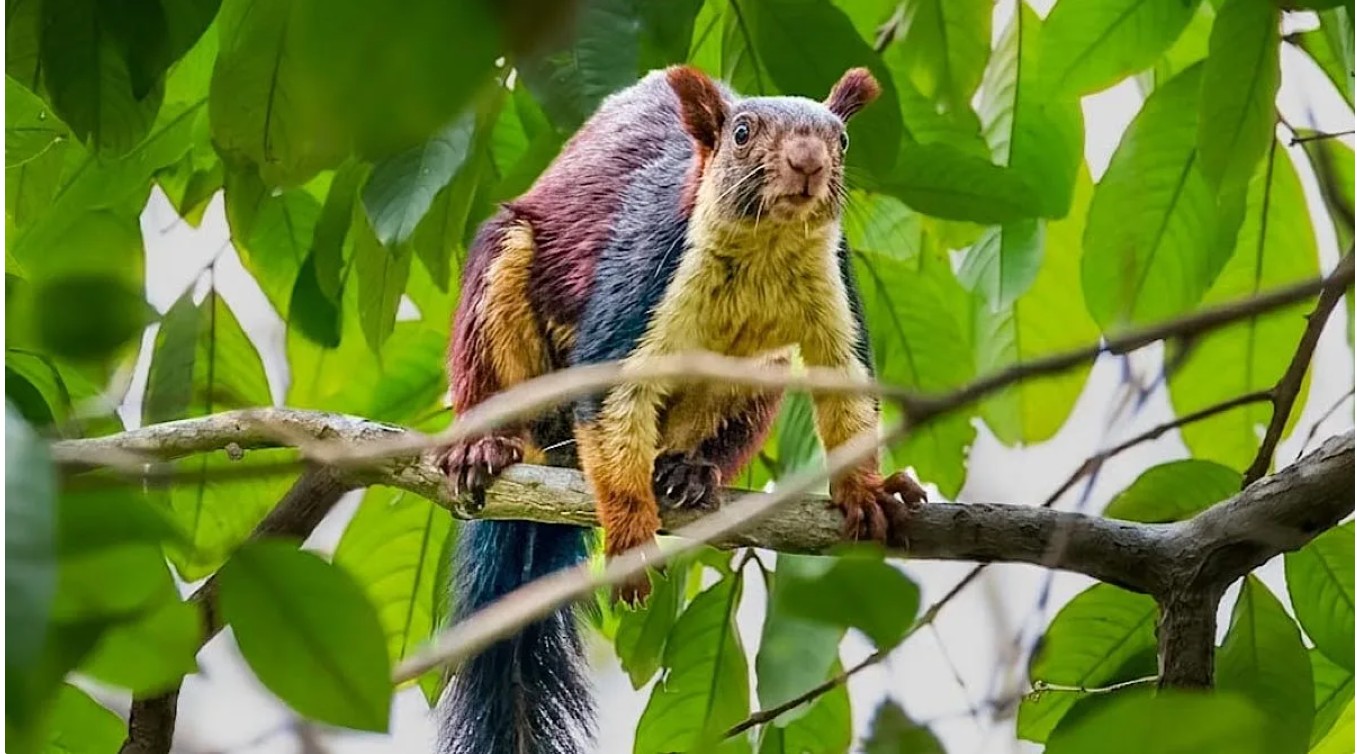
The recent sighting of a Giant Malabar Squirrel in the Devpur forest areaof Chhattisgarh's Barnawapara forest has drawn attention to one of India's most striking and largest arboreal mammals.
About the Giant Malabar Squirrel
- The Giant Malabar Squirrel, also known as the Indian Giant Squirrel, is a large, multicoloured tree squirrel endemic to India. Its scientific name is Ratufa indica, and it is considered one of the largest squirrel species in the world.
- The species is predominantly distributed across the Western Ghats, Eastern Ghats, and the Satpura Range, inhabiting tropical deciduous, semi-deciduous, and evergreen forests at elevations ranging from 180 to 2,300 metres.
- It is also the State Animal of Maharashtra, where it is popularly known as Shekru.
Habitat and Behaviour
- The Giant Malabar Squirrel is a highly arboreal species, spending most of its life in the forest canopy. It moves with remarkable agility, often leaping between trees over distances of up to six metres. Instead of descending to the ground frequently, it relies on interconnected tree canopies for movement and survival.
- The species generally takes shelter in tree hollows and constructs nests high above the ground. Unlike many other squirrels, it is usually solitary, coming together mainly during the breeding season.
- An interesting defensive behaviour displayed by the species is that when threatened, it often remains motionless or flattens itself against a tree trunk rather than attempting to flee immediately. This camouflage strategy helps it avoid predators.
Physical Characteristics
- The Giant Malabar Squirrel is renowned for its striking appearance and vibrant colouration. Its body length ranges from 254 to 457 mm, while the tail is usually longer than the body itself.
- The species exhibits multiple colour patterns, typically featuring combinations of:Black, Brown, Deep red or maroon, Cream or dirty white patches.
- Other notable features include:pink lips and nose, Bright brown eyes, Short rounded ears, Large powerful claws, expanded inner paws adapted for gripping tree bark and branches.
- Its long, bushy tail is generally light brown with a creamy-white tip, aiding balance while navigating the forest canopy.
Ecological Importance
- As a canopy-dwelling herbivore and frugivore, the Giant Malabar Squirrel plays an important role in forest ecosystem functioning. By feeding on fruits, seeds, flowers, bark and nuts, it contributes to seed dispersal and supports forest regeneration.
- Its presence is also considered an indicator of healthy forest ecosystems with well-connected tree canopies and adequate habitat quality.
Conservation Status
The Giant Malabar Squirrel is currently classified as "Least Concern" on the IUCN Red List, indicating that its population remains relatively stable across its range. However, localized threats such as:Habitat fragmentation, Deforestation, Forest fires, Infrastructure development, can affect populations in specific regions.
The recent sighting in Chhattisgarh highlights the importance of conserving forest corridors and monitoring wildlife populations beyond their traditionally recognized habitats.