
Beaufort Castle
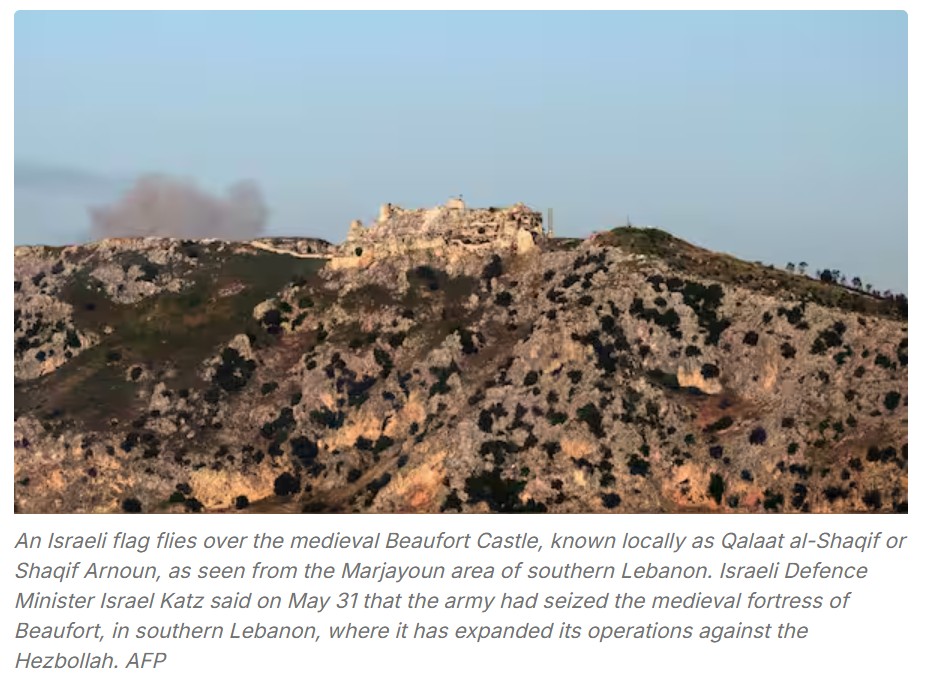
- 04 Jun 2026
In News:
Amid the ongoing tensions in West Asia, Israel's recent capture of Beaufort Castle and the surrounding strategic ridge in southern Lebanon has once again brought attention to one of the region's most historically and militarily significant fortresses. Perched atop a rocky hill overlooking southern Lebanon, Beaufort Castle has for centuries served as a symbol of military power, territorial control, and strategic dominance.
About Beaufort Castle
- Beaufort Castle, known locally as Qalaat al-Shaqif ("Castle of the High Rock"), is a medieval fortress located near the city of Nabatieh in southern Lebanon.
- Situated only about 14.5 km from the Israeli border, the castle occupies a commanding hilltop position that offers extensive views of the surrounding landscape.
- Constructed by the Crusaders during the 12th century, the fortress subsequently passed through the hands of various rulers, including Muslim dynasties, the Mamluks, and the Ottomans. Today, it remains one of the best-preserved examples of medieval military architecture in the Near East.
- Architecturally, the castle consists of a high castle and a low castle, reflecting its defensive role during the medieval era. Its massive stone fortifications, elevated position, and commanding visibility made it an ideal military stronghold capable of monitoring troop movements and protecting surrounding territories.
Strategic Importance
The strategic value of Beaufort Castle stems primarily from its geography. The fortress overlooks:
- Large parts of southern Lebanon,
- The fertile Litani River Valley,
- Key transportation routes in the region,
- Parts of northern Israel.
This commanding vantage point allows military forces to monitor movement across a wide area, making the site highly valuable for surveillance, defence, and military operations. Control over the castle provides tactical advantages in any conflict involving southern Lebanon and northern Israel.
Its location near the Israeli border also places it at the centre of the long-standing security dynamics between Israel, Lebanon, and armed groups operating in the region.