
Supreme Court Ruling on Menstrual Hygiene in Schools
- 05 Feb 2026
In News:
In a landmark decision, the Supreme Court of India recognised menstrual hygiene management (MHM) as part of the fundamental rights of girl students. The Court reframed menstrual health from a welfare issue into a constitutional entitlement linked to equality, dignity, and the right to education, and issued binding directions to ensure implementation across schools.
Constitutional and Legal Foundations
- Substantive Equality under Article 14: The Court clarified that equality does not mean identical treatment. Girls experience a biological process that, without institutional support, becomes a structural barrier to education. Lack of access to sanitary products and safe sanitation facilities places them at a disadvantage compared to boys, amounting to indirect gender discrimination.
- Right to Life and Dignity under Article 21: Menstrual health was interpreted as part of the right to live with dignity. The Court linked denial of menstrual hygiene facilities to stigma, humiliation, and violation of bodily autonomy and privacy. Forcing girls to miss school due to lack of support was held to undermine their dignity and well-being.
- Right to Education and Statutory Interpretation: Reading the Right of Children to Free and Compulsory Education Act in a purposive manner, the Court held that “free education” means removal of all barriers, financial or infrastructural that prevent attendance. When the cost of sanitary products or absence of facilities leads to absenteeism or dropout, the State fails in its statutory duty.
Key Directions to Governments and Schools
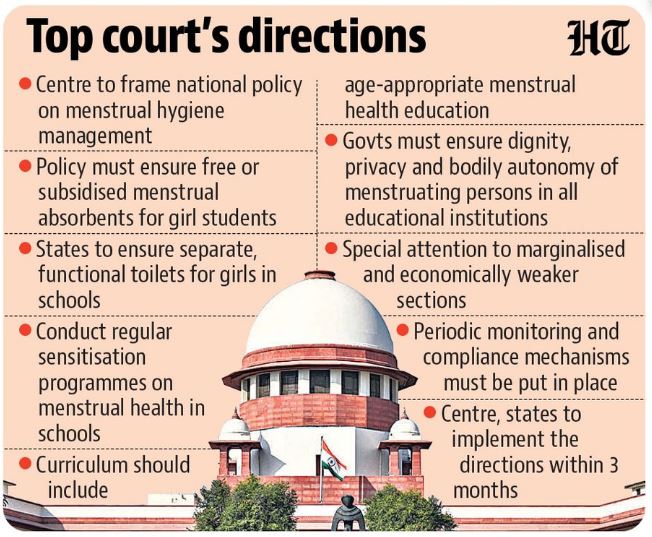
The Court issued time-bound directions under a continuing mandamus to ensure compliance.
All schools, whether government-run or private, must provide free sanitary napkins to girl students. Preference has been given to environmentally sustainable, oxo-biodegradable products. Distribution should take place through vending machines installed in toilets or through designated school authorities.
Schools must establish safe and hygienic disposal mechanisms. Covered waste bins must be available and cleaned regularly, along with environmentally compliant systems for disposal.
Every school must have functional, gender-segregated toilets with assured water supply. Toilets must guarantee privacy, be accessible to children with disabilities, and include handwashing facilities with soap and water at all times.
Institutions are required to create Menstrual Hygiene Management corners equipped with emergency supplies such as spare uniforms, innerwear, and disposal bags. This ensures that girls are not forced to leave school due to menstrual emergencies.
Behavioural and Educational Reforms
The Court emphasised that infrastructure alone cannot ensure inclusion unless stigma is addressed. Boys must be sensitised about menstruation to prevent harassment and discrimination. Teachers, irrespective of gender, must receive training to support menstruating students with empathy and awareness.
The National Council of Educational Research and Training (NCERT) and State Councils of Educational Research and Training have been directed to integrate gender-responsive education on puberty and menstruation into school curricula.
Monitoring and Accountability
District Education Officers are required to conduct periodic inspections to verify compliance. The Court also mandated collection of anonymous student feedback to assess the real availability and usability of facilities. By keeping the matter pending through a continuing mandamus, the Court retained supervisory jurisdiction to ensure effective implementation.
Broader Significance
The judgment advances gender justice by recognising menstruation-linked exclusion as a form of structural discrimination. It strengthens educational equity by addressing a key cause of absenteeism among adolescent girls. It also links public health, sanitation, and environmental sustainability with constitutional governance. Most importantly, it transforms menstrual hygiene from a matter of charity into a matter of rights and State accountability.
Conclusion
The ruling represents a shift from formal equality to substantive inclusion. By embedding menstrual hygiene within constitutional guarantees and statutory duties, the Court has affirmed that biological differences must not translate into educational disadvantage. The decision reinforces the vision of a gender-sensitive education system grounded in dignity, access, and equal opportunity.