
Solid Fuel Ducted Ramjet (SFDR) Technology
- 05 Feb 2026
In News:
The Defence Research and Development Organisation successfully demonstrated Solid Fuel Ducted Ramjet (SFDR) technology from the Integrated Test Range.
What is SFDR Technology?
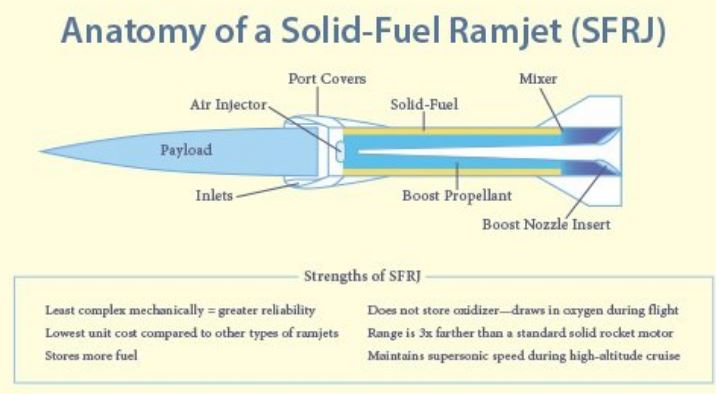
- SFDR is an advanced air-breathing missile propulsion system that uses a solid fuel gas generator combined with ramjet propulsion.
- It is being developed by Defence Research and Development Laboratory along with other DRDO labs.
How It Works
- The missile is first accelerated to supersonic speed (Mach 2+) using a nozzle-less solid booster.
- Once at high speed, the ramjet engine takes over.
- The system draws oxygen from the atmosphere instead of carrying an oxidiser.
- A solid fuel ducted ramjet motor then produces sustained and controllable thrust throughout the missile’s flight.
Key Subsystems Tested
- Nozzle-less Booster
- Solid Fuel Ducted Ramjet Motor
- Fuel Flow Controller
All systems performed as expected during the flight test.
What is a Ramjet?
A ramjet is a jet engine that:
- Has no moving compressor parts
- Uses the missile’s forward speed to compress incoming air
- Works efficiently only at high supersonic speeds
Advantages of SFDR Over Conventional Rockets
|
Feature |
Conventional Rocket |
SFDR System |
|
Oxidiser |
Carried onboard |
Not required (air-breathing) |
|
Weight |
Heavier |
Lighter |
|
Thrust Duration |
Short boost phase |
Sustained throughout flight |
|
Maneuverability |
Reduces after boost |
Maintains high agility till end |
|
Range |
Limited by fuel burn |
Significantly extended |
Strategic Significance
- Long-Range Air-to-Air Missiles (LRAAM): SFDR will power advanced missiles such as future variants of Astra Mark-3, potentially enabling engagement ranges beyond 150–300 km.
- Expanded “No-Escape Zone”: Sustained propulsion allows high-G manoeuvres near the target, making evasion extremely difficult.
- Elite Technology Club: Places India among a select group of nations possessing advanced ramjet missile propulsion capability.
- Future Surface-to-Air Systems: Technology may be adapted for next-generation SAM systems to counter high-speed cruise or hypersonic threats.