
India–Vietnam Strategic Partnership
- 11 May 2026
In News:
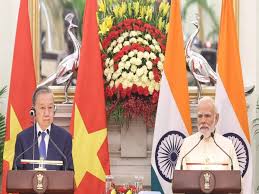
In May 2026, the bilateral relationship between India and Vietnam reached a historic milestone as both nations elevated their ties to an Enhanced Comprehensive Strategic Partnership during the state visit of Vietnamese President Tô Lâm to India. This elevation reflects a deep-seated convergence of interests regarding Indo-Pacific stability, maritime security, and the pursuit of strategic autonomy in an increasingly multipolar world.
The Strategic Backbone: Defence and Maritime Security
Defence cooperation has transitioned from mere buyer-seller interactions to a robust strategic pillar. The partnership is defined by a mutual commitment to a "free, open, and rules-based Indo-Pacific."
- Capacity Building: India continues to provide advanced training assistance and defence financing to Vietnam.
- Asset Transfers: The transfer of military assets, such as the INS Kirpan, serves as a symbol of India’s commitment to enhancing Vietnam’s maritime patrol capabilities.
- Maritime Domain Awareness (MDA): Both nations have intensified cooperation in maritime security to counter common challenges in the South China Sea, ensuring the protection of Sea Lines of Communication (SLOCs).
Economic Resilience and Trade Expansion
Economic engagement is being leveraged as a tool for strategic resilience. As both nations seek to de-risk their supply chains, trade has become a primary vehicle for integration.
- Trade Volume: Bilateral trade has officially surpassed the $16 billion mark.
- Vision 2030: A roadmap has been established to scale this trade to $25 billion by 2030, focusing on diversifying the basket of goods and services.
- Critical Sectors: New avenues for cooperation have opened in critical minerals, green energy, and the development of a resilient economic architecture to withstand global market volatility.
Vietnam’s Role in India’s ‘Act East’ Policy
Vietnam stands as a central pillar of India’s Act East Policy and its broader Indo-Pacific Oceans Initiative (IPOI).
- ASEAN Linkage: As one of the most vibrant economies in Southeast Asia, Vietnam acts as a gateway for India’s deeper engagement with the ASEAN bloc.
- Strategic Balancing: The partnership contributes to regional balancing alongside powers like Japan, Australia, and the US. Notably, both India and Vietnam maintain strategic autonomy, choosing to collaborate based on shared principles rather than joining formal military alliance systems.
Emerging Technology and Connectivity
The "Enhanced" nature of the partnership in 2026 emphasizes the transition into high-technology domains:
- Emerging Tech: Joint ventures in semiconductors, AI, and telecommunications are being prioritized.
- Connectivity: Improving physical and digital connectivity remains a priority to facilitate smoother movement of goods and people between the two regions.
- Space Cooperation: Collaborative efforts in satellite tracking and remote sensing for disaster management and resource mapping.
Non-market Economy Status

- 10 May 2024
Why is it in the News?
Vietnam has been pushing the President Joe Biden administration to quickly change its “non-market economy” classification to “market economy”, in a bid to avoid high taxes imposed by the US on the goods imported from the Southeastern country.
Why does Vietnam Want to Get the ‘Market Economy’ Status?
- Vietnam has argued that in recent years it has implemented enough economic reforms that get its name off the non-market economies list.
- The country does meet a number of criteria for the status to be changed.
- For instance, Vietnam allows foreign investment, wages are determined by free negotiations between workers and management, and most of the means of production are not owned by the state.
- The change in status will also help Vietnam get rid of the anti-dumping duties, making its products more competitive in the US market.
- Vietnam’s Center for WTO and International Trade has said that the method of calculating anti-dumping duties is flawed as it causes “the dumping margin to be pushed up very high” and does not actually reflect the situation of Vietnamese companies.
About Non-market Economy Status:
- Non-market economy status refers to a designation applied to countries by international trade authorities, particularly the World Trade Organization (WTO), based on their economic structure and policies.
- In a non-market economy, the allocation of resources, production decisions, and pricing mechanisms are predominantly influenced by the government rather than by market forces.
- This can include state ownership of key industries, government intervention in setting prices, and restrictions on foreign investment and trade.
- For trade purposes, countries classified as non-market economies may face different treatment in anti-dumping investigations and trade disputes.
- This designation can affect how trade regulations and tariffs are applied to goods originating from these countries.
- The US designates a country as a non-market economy based on several factors which are:
- If the country’s currency is convertible
- If wage rates are determined by free bargaining between labour and management
- If joint ventures or other foreign investments are allowed whether the means of production are owned by the state; and
- If the state controls the allocation of resources and price and output decisions.
- Other factors like human rights are also considered.
- The non-market economy label allows the US to impose “anti-dumping” duties on goods imported from designated countries.
Market Economies:
- Market economies operate based on the interactions between consumers and businesses, guided primarily by the law of supply and demand, rather than by central government policies.
- Theoretical Foundation: Developed by classical economists like Adam Smith, David Ricardo, and Jean-Baptiste Say, market economies emphasize the role of free markets in allocating resources efficiently.
- Modern Market Economies: Often referred to as mixed economies, modern market economies may still involve some government interventions, such as price-fixing, licensing, quotas, and industrial subsidies, but the majority of decisions are market-driven.
- Examples include countries like India, the USA, and the UK, where market forces play a significant role in shaping economic activities.
What is Anti-dumping Duty?
- An anti-dumping duty is a protectionist tariff that a domestic government imposes on foreign imports that it believes are priced below fair market value.
- In order to protect their respective economy, many countries impose duties on products they believe are being dumped in their national market; this is done with the rationale that these products have the potential to undercut local businesses and the local economy.
- While the intention of anti-dumping duties is to save domestic jobs, these tariffs can also lead to higher prices for domestic consumers.
- In the long term, anti-dumping duties can reduce the international competition of domestic companies producing similar goods.
- The World Trade Organization (WTO)–an international organization that deals with the rules of trade between nations–also operates a set of international trade rules, including the international regulation of anti-dumping measures.?
India initiates Anti-Dumping Probe into Solar Glass Imports from China and Vietnam (TOI)
- 17 Feb 2024
Why is it in the News?
India has launched an anti-dumping investigation into the import of solar glass from China and Vietnam following a complaint from domestic players.
What is Anti-Dumping Duty?
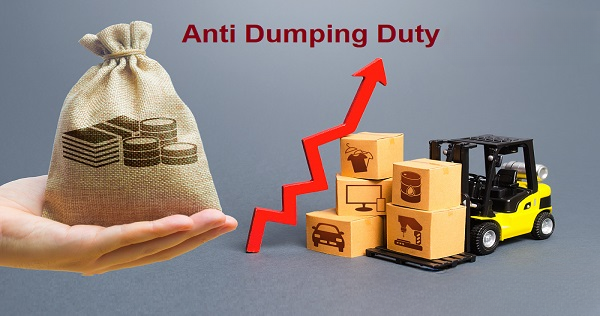
- Anti-dumping duty is a tariff levied on imports from foreign countries when their prices are lower than the fair market value of similar goods in the domestic market.
- It's implemented by governments to counteract the practice of "dumping," where foreign goods are sold at unfairly low prices in the domestic market, posing a threat to local businesses.
- The primary objective of anti-dumping duty is to safeguard domestic industries from unfair competition and restore fair trade practices.
- This measure is permitted by the World Trade Organization (WTO) to address instances where dumping causes genuine harm to domestic industries.
- To impose anti-dumping duties, governments must provide evidence of dumping, quantify its extent in terms of costs, and demonstrate the resulting injury or threat to domestic markets.
- While aimed at protecting local industries, anti-dumping duties can sometimes lead to increased prices for consumers within the country.
About Countervailing Duty (CVD):
- Countervailing duty (CVD) is a type of tariff imposed by a government to offset the adverse effects of import subsidies on domestic producers.
- It serves as an import tax applied by the importing country on subsidised products from abroad.
- CVD is imposed to address situations where foreign governments provide subsidies to their producers, lowering the cost of their goods and potentially disrupting fair competition.
- To prevent the influx of subsidised products into their markets, importing countries levy CVD, effectively neutralising the price advantage enjoyed by these imports.
- The imposition of CVD is permitted by the World Trade Organization (WTO) to help maintain fair trade practices among its member countries.
Difference Between Anti-dumping Duty and Countervailing Duty:
- Anti-dumping duty is enacted to safeguard domestic markets from the harmful effects of low-priced foreign goods, while CVD targets products benefiting from government subsidies, resulting in artificially low prices.
- The amount of Anti-dumping duty is determined by the margin of dumping, whereas CVD is calculated based on the subsidy value granted to foreign goods.