
ULPGM-V3
- 21 May 2026
In News:
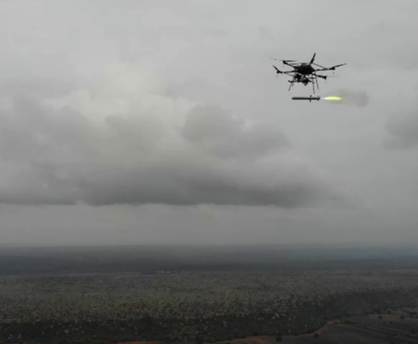
The Defence Research and Development Organisation (DRDO) successfully conducted flight trials of the Unmanned Aerial Vehicle Launched Precision Guided Missile Version 3 (ULPGM-V3) at the National Open Area Range (NOAR), Kurnool, Andhra Pradesh. The trials were carried out in the Anti-armour configuration, marking a significant milestone in India's indigenous drone-based precision strike capability.
About ULPGM-V3
ULPGM-V3 is an advanced drone-launched precision guided missile capable of engaging both surface and aerial targets. It is an upgraded version of the earlier ULPGM-V2, developed and delivered by DRDO. The missile was tested in two operational modes:
- Air-to-Ground mode — primarily for destroying tanks and armoured vehicles, as well as fortified bunkers.
- Air-to-Air mode — for targeting hostile drones, helicopters, and other airborne threats.
The missile was launched from an indigenously developed UAV built by NewSpace Research Technologies, Bengaluru — a domestic start-up — underscoring India's growing defence-industrial ecosystem. Development-cum-Production Partners (DcPPs) Adani Defence and Bharat Dynamics Limited (BDL), Hyderabad, along with 30 MSMEs and start-ups, contributed to the project.
Key Technical Features
- Precision Targeting: Equipped with a high-definition dual-channel seeker, the missile can engage a wide range of targets with high accuracy across varying terrain types.
- All-Weather Operations: ULPGM-V3 possesses full day-and-night operational capability, ensuring reliability under adverse visibility conditions.
- Terrain Versatility: Deployable in both plain terrains and high-altitude regions — a critical requirement given India's operational theatres in Ladakh and the northeastern highlands.
- Real-Time Guidance: A two-way data link enables post-launch target updates and mid-course aim-point corrections, making the missile highly responsive to dynamic battlefield conditions.
Three Modular Warhead Options
One of ULPGM-V3's defining features is its modular warhead architecture, offering mission-specific lethality:
- Anti-armour warhead — designed to neutralise modern armoured vehicles protected by Rolled Homogeneous Armour (RHA) combined with Explosive Reactive Armour (ERA), the two principal passive protection systems on contemporary main battle tanks.
- Penetration-cum-Blast warhead — optimised for destroying fortified structures and underground bunkers.
- Pre-fragmentation warhead — designed for area suppression and high-lethality anti-personnel effects.
Collaborative Development
The missile was jointly developed by six DRDO laboratories: Research Centre Imarat (RCI), Defence Research and Development Laboratory (DRDL), Terminal Ballistics Research Laboratory (TBRL), High-Energy Materials Research Laboratory (HEMRL), Integrated Test Range (ITR), and Defence Electronics Research Laboratory (DLRL). DRDO is actively pursuing integration of ULPGM weapons with long-range, high-endurance UAVs from multiple Indian companies.
Strategic Significance
The ULPGM-V3 trial is significant across several dimensions. First, it advances India's loitering and precision strike from unmanned platforms, a defining feature of modern warfare demonstrated in conflicts in Ukraine, Nagorno-Karabakh, and West Asia. Second, it reflects the maturation of India's defence start-up ecosystem — a UAV built by a private Indian start-up launching a DRDO missile represents genuine civil-military industrial integration. Third, the modular warhead design offers the Indian Army and Air Force operational flexibility across counter-armour, counter-infrastructure, and counter-drone missions.