
Singapore Emerges as India’s Second-Largest Export Destination
- 19 May 2026
In News:
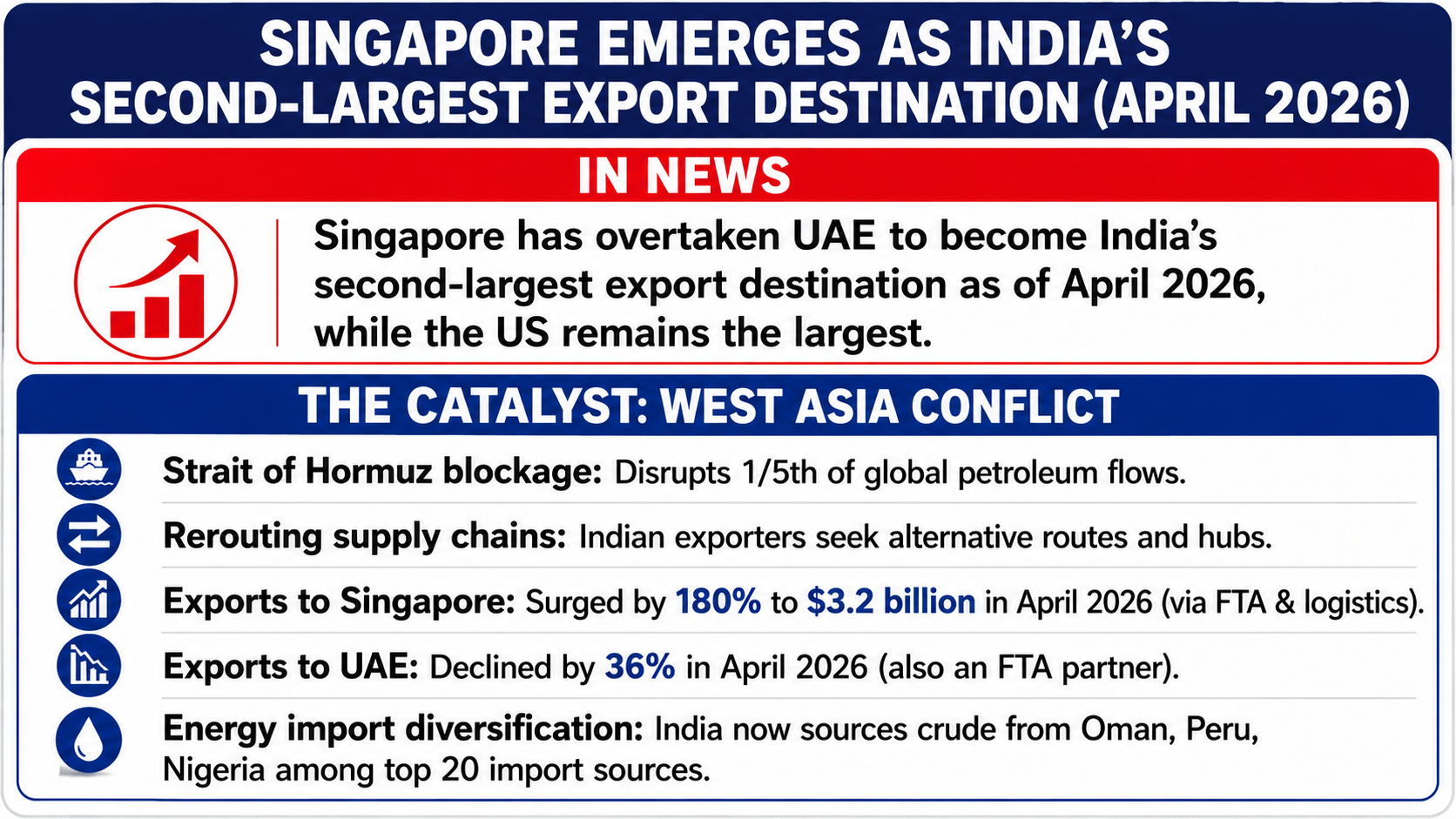
The protracted West Asia conflict has triggered systemic shocks in global supply chains, driving a significant structural shift in India’s external trade dynamics. In an unprecedented realignment, Singapore has overtaken the United Arab Emirates (UAE) to become India’s second-largest export destination as of April 2026, while the United States continues to retain the pole position.
The Catalyst: Geopolitical Disruptions in West Asian Trade
The primary driver behind this shift is the logistical blockage of the Strait of Hormuz—a critical maritime choke point between Iran and Oman that historically facilitates a fifth of global petroleum flows.
- Rerouting Supply Chains: The trade paralysis in the Gulf has forced Indian exporters to aggressively seek alternative routes and transshipment hubs.
- The Contrast in FTA Partners: Leveraging its world-class logistics infrastructure and the bilateral Free Trade Agreement (FTA), India's exports to Singapore surged exponentially by 180% to reach $3.2 billion in April 2026. Conversely, exports to the UAE (another key FTA partner) witnessed a sharp decline of 36%.
- Energy Import Diversification: To insulate itself from Middle Eastern energy shocks, India has altered its crude oil sourcing, integrating non-traditional suppliers like Oman, Peru, and Nigeria into its top 20 import sources.
Macroeconomic Strain on the Indian Economy
The enduring global energy supply crisis has severely impacted India's macroeconomic indicators:
- Currency Depreciation: Widening import bills have drained foreign exchange reserves, causing the Indian rupee to depreciate by 5.2% against the US Dollar since February 2026, touching multiple record lows.
- Fiscal Interventions: To defend the domestic currency and curb non-essential imports, the Government of India has hiked import duties on precious metals. Furthermore, oil marketing companies (OMCs) were permitted to increase retail petrol and diesel prices for the first time in four years to check domestic consumption.
India-Singapore Economic Matrix
- Bilateral Trade Scale: Expanded from USD 6.7 billion (FY 2004-05) to USD 34.3 billion (FY 2024-25) via the Comprehensive Economic Cooperation Agreement (CECA). Singapore is currently India’s 6th largest trading partner.
- FDI Inflows: Singapore stands as India’s largest source of Foreign Direct Investment, bringing in USD 14.94 billion in FY 2024-25.
Deeping Institutional and Fintech Integration
The trade surge is underpinned by a robust framework of institutional mechanisms and digital financial architecture established between the two nations:
- Institutional Presence: Facilitating cross-border capital, Invest India set up a dedicated office in Singapore (September 2024), matched by the Singapore Business Federation opening its debut Indian office in Bengaluru (November 2025).
- Fintech Leadership: The operationalization of the UPI-PayNow Linkage created India's first cross-border Person-to-Person (P2P) payment facility, significantly slashing the cost of remittances.
- Digital Trade Architecture: Bilateral trade finance has been modernized through the GIFT Connect linkage (unifying liquidity between the NSE and SGX for NIFTY products), ONDC-Proxtera connectivity for MSME retail trade, and the TradeTrust framework for interoperable electronic Bills of Lading (eBLs).